This live refactoring was too hard to finish - refactoring a react app & express api
TL;DR
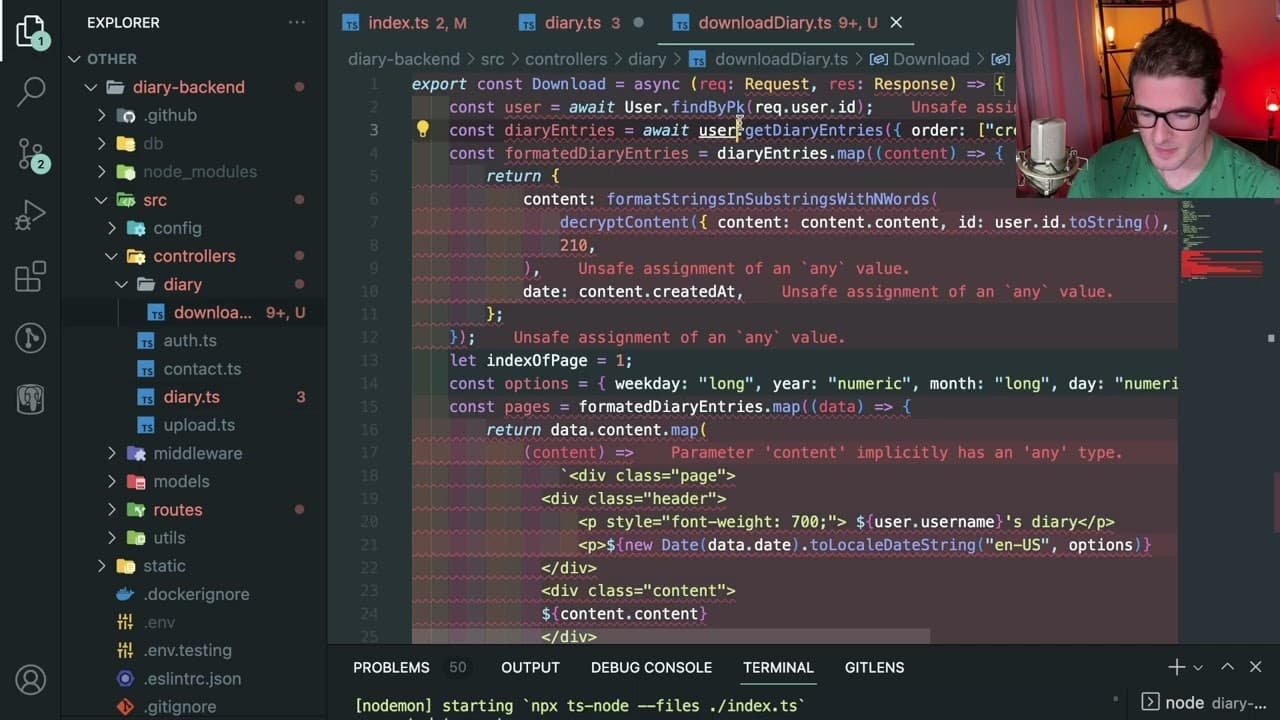
The video provides a detailed feedback session on a subscriber's diary application built with XJS and Express.js.
Transcript
hi how's it going everyone I'm doing another live refactoring slash live feedback on a subscribers project he is working on a diary application where you can kind of keep track of diary entries it's all in xjs and I think the backend is using express.js so this is the first project I've done where I've had a chance to look at express.js so this wil... Read More
Key Insights
- 👤 Prioritize user experience by simplifying interaction flows and adding intuitive navigation options.
- 👨💻 Refactor code for modularity, separating functionality into clear, single-purpose files for better organization.
- 💪 Establish a strong connection management strategy to avoid issues with database connectivity.
- 🔨 Utilize API documentation tools to assist in clarifying endpoints and their usage.
- 👤 Implement auto-save features to reduce user workload and improve entry management.
- 🌍 Recognize the value of Docker knowledge in real-world application deployment scenarios.
- 🍳 Clean up React components by breaking down complexity and improving naming conventions for better readability.
Install to Summarize YouTube Videos and Get Transcripts
Explore YouTube Video Summarizer or Get YouTube Transcript Extractor
Questions & Answers
Q: What are some key usability issues identified in the diary application?
The presenter pointed out that the diary application lacks an intuitive way for users to add past entries, as there is no calendar option to navigate through previous dates. An ordered list of entries displays in ascending order, which might confuse users who prefer seeing their most recent entries first. Additionally, there is insufficient feedback after saving entries, leading to a potential loss of context while using the application.
Q: How can the diary application's code structure be improved?
The presenter suggests moving towards a more modular code structure where related functionality is encapsulated in separate files. This includes separating handling functions into individual controllers or utility functions, and ensuring that each piece of code serves a single responsibility, which can aid in maintainability and readability.
Q: What does the presenter recommend about the database connection in the Express app?
It's recommended that the Express application should not start listening for requests before confirming an active connection to the database. This proactive approach helps prevent the application from accepting calls when it cannot process them correctly, thus minimizing the risk of errors due to database connectivity issues.
Q: What tools are discussed for enhancing API development?
The presenter mentions using tools like Swagger or OpenAPI for documenting API endpoints. Such documentation helps other developers or users understand how to interact with the API effectively and what responses to expect from different requests.
Q: How does the video suggest handling user interactions for saving diary entries?
One improvement proposed is implementing a debounce feature on the save functionality. Instead of relying on a discrete save button, entries could automatically save a short period after user input ceases. This would expedite the process for users, ensuring entries are consistently saved without extra steps.
Q: What is highlighted regarding the use of Docker in this development process?
The presenter emphasizes the importance of understanding Docker as a beginner, particularly when dealing with projects that have various dependencies. Proficiency in Docker can greatly enhance a developer's value when working with microservices and deployments, as it facilitates consistent environments and easier management of different project components.
Q: How does the presenter suggest improving the application's frontend design?
The feedback includes simplifying the React components and breaking down complex logic into smaller, manageable functions or components. Cleaner design with improved naming conventions will make the code more readable and maintainable, and using hooks wisely can help manage side effects and data fetching more elegantly.
Q: What feedback is provided regarding error handling in the application?
The presenter suggests straightforward error handling practices, advocating for throwing errors rather than returning error strings. This change would provide clearer, more standardized management of error states across the application, facilitating better debugging and user notifications when issues arise.
Summary & Key Takeaways
-
The video discusses a diary application with features like account management, diary entry saving, and PDF export, highlighting its potential usability issues.
-
Insights are provided on refactoring the application, particularly in code structure, user experience, and data management to enhance maintainability and efficiency.
-
The presenter emphasizes the importance of separating concerns in the code, improving API design, and simplifying user interactions to create a more intuitive application.
Read in Other Languages (beta)
Share This Summary 📚
Summarize YouTube Videos and Get Video Transcripts with 1-Click
Try YouTube Summary with ChatGPT & Claude or YouTube Transcript Generator
Explore More Summaries from Web Dev Cody 📚
Summarize YouTube Videos and Get Video Transcripts with 1-Click
Try YouTube Summary with ChatGPT & Claude or YouTube Transcript Generator