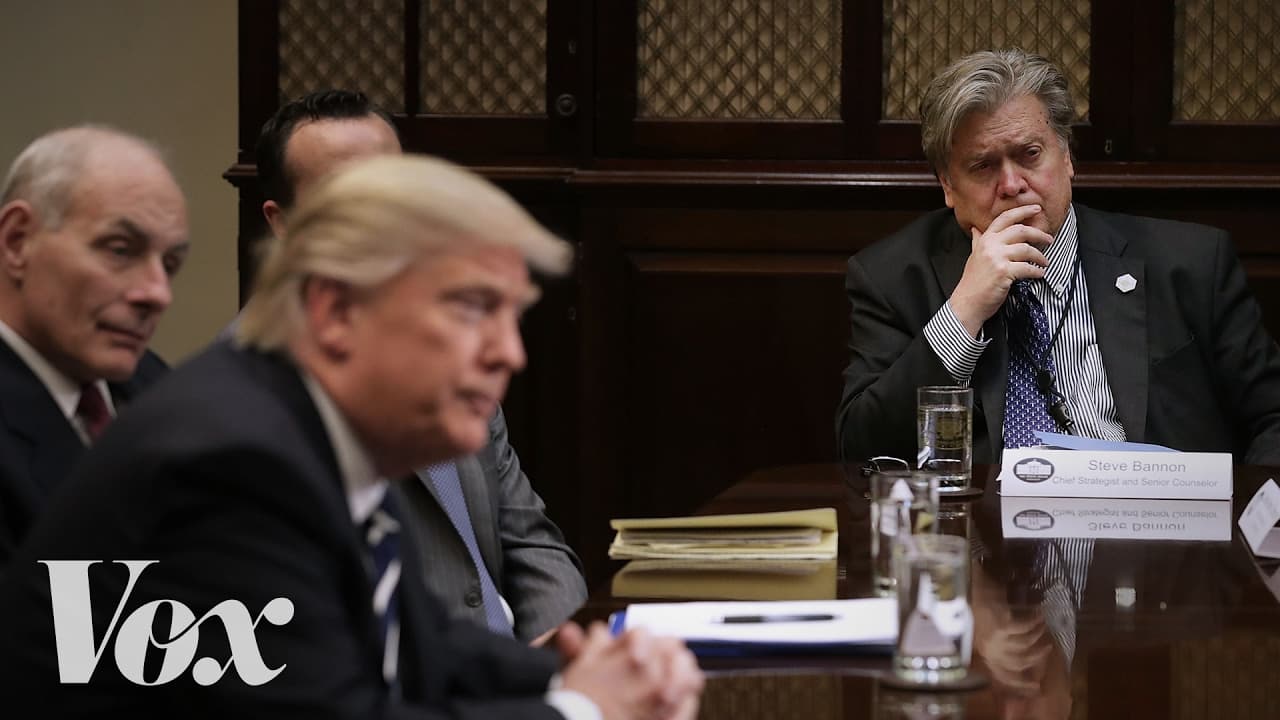
How Steve Bannon sees the world
TL;DR
Steve Bannon views Islam and immigration as threats to the West.
Transcript
When talking about the world’s 1.6 billion Muslims, American presidents are traditionally very careful to differentiate between the vast majority who practice the religion peacefully and the small minority who don't. There's nothing in there, in Islam that condones the kind of brutality that we've seen Our actions today were not aimed against Islam... Read More
Key Insights
- Steve Bannon, Trump's chief strategist, believes the US and Western Europe are in a historical struggle against Islam, viewing it as a fundamental threat.
- Bannon's perspective diverges from traditional American presidential rhetoric, which distinguishes between peaceful Muslims and extremists.
- His views have influenced Trump administration policies, including the controversial travel ban targeting several majority-Muslim countries.
- Bannon's stance on immigration extends beyond Muslims; he opposes both legal and illegal immigration, believing it undermines American values.
- He argues that immigrants, even those with high skills, take jobs from native-born Americans and contribute to a bleak economic future.
- Bannon's views are not aligned with mainstream Republicans, who generally support legal immigration as beneficial to the economy.
- His historical references focus on European resistance to Muslim conquests, framing current issues as a continuation of past conflicts.
- Bannon's influence in the White House suggests a push towards policies that close America off from the rest of the world, especially from Muslim nations.
Install to Summarize YouTube Videos and Get Transcripts
Explore YouTube Video Summarizer or Get YouTube Transcript Extractor
Questions & Answers
Q: What is Steve Bannon's view on Islam?
Steve Bannon views Islam as a fundamental threat to Western civilization. He believes that the US and Western Europe are engaged in a historical struggle against Islam itself, rather than just against extremist factions. This perspective diverges from traditional American presidential rhetoric, which typically distinguishes between peaceful Muslims and extremists.
Q: How has Bannon's worldview influenced Trump administration policies?
Bannon's worldview has significantly influenced Trump administration policies, particularly the executive order that temporarily banned travelers from seven majority-Muslim countries and almost all refugees from entering the US. His influence suggests a push towards policies that aim to close America off from Muslim-majority nations, reflecting his belief in an ongoing cultural struggle.
Q: What is Bannon's stance on immigration?
Bannon opposes both legal and illegal immigration, believing that immigrants undermine American values and contribute to economic instability. He argues that even high-skilled immigrants take jobs from native-born Americans, presenting a bleak economic future. This view is not aligned with mainstream Republicans, who generally see legal immigration as beneficial.
Q: How does Bannon's view on immigration contrast with mainstream Republican views?
Bannon's view on immigration contrasts sharply with mainstream Republicans, who generally support legal immigration as an economic benefit. While Bannon sees immigrants as undermining American values and taking jobs from native-born citizens, many Republicans and business interests view immigrants as vital to economic growth and societal vitality.
Q: What historical context does Bannon use to frame his views?
Bannon uses historical references to European resistance against Muslim conquests in the 8th and 16th centuries to frame his views. He sees current geopolitical issues as a continuation of these past conflicts, suggesting that the West is engaged in an ongoing cultural and civilizational struggle against Islam, which informs his approach to policy.
Q: How does Bannon's influence reflect in Trump's immigration policies?
Bannon's influence is reflected in Trump's immigration policies, such as the travel ban on several majority-Muslim countries. His views suggest a shift towards policies that aim to restrict immigration from Muslim-majority nations, aligning with his belief that such measures are necessary to protect Western civilization from perceived threats.
Q: What is Bannon's perspective on the economic impact of immigrants?
Bannon believes that immigrants, both legal and illegal, negatively impact the American economy by taking jobs from native-born citizens and undermining American values. He argues that this contributes to a bleak economic future, particularly for younger generations, and advocates for policies that restrict immigration to preserve economic stability.
Q: How does Bannon's view on Islam differ from previous American presidents?
Bannon's view on Islam differs from previous American presidents, who traditionally distinguished between peaceful Muslims and extremists. Bannon sees Islam itself as a fundamental threat, suggesting an inherent conflict between Islam and the West. This perspective has influenced policies that target Muslim-majority countries, diverging from the more inclusive rhetoric of past administrations.
Summary & Key Takeaways
-
Steve Bannon, chief strategist for President Trump, believes Islam poses a fundamental threat to Western civilization, diverging from traditional American rhetoric that differentiates between peaceful Muslims and extremists. His views have influenced policies like the travel ban on several majority-Muslim countries, reflecting a broader anti-immigration stance.
-
Bannon's perspective on immigration extends beyond Muslims, opposing both legal and illegal immigrants, whom he believes undermine American values and economic stability. This stance contrasts with mainstream Republican views that support legal immigration as an economic benefit, highlighting Bannon's divergence from party norms.
-
Bannon's historical references to European resistance against Muslim conquests frame current geopolitical issues as a continuation of past conflicts. His influence in the White House suggests a shift towards policies that close America off from the world, particularly from Muslim-majority nations, reinforcing his worldview of an ongoing cultural and civilizational struggle.
Read in Other Languages (beta)
Share This Summary 📚
Summarize YouTube Videos and Get Video Transcripts with 1-Click
Try YouTube Summary with ChatGPT & Claude or YouTube Transcript Generator
Explore More Summaries from Vox 📚


Summarize YouTube Videos and Get Video Transcripts with 1-Click
Try YouTube Summary with ChatGPT & Claude or YouTube Transcript Generator