GMAT: Math 53 | Problem solving | GMAT | Khan Academy
TL;DR
This video explains how to solve equations with two unknowns and how to identify arithmetic sequences.
Transcript
We're on problem 245. If x plus y is equal to a, and x minus y is equal to b, then what is-- they want to know what 2xy is equal to. Let's solve for x and y in terms of a and b, and then just figure out what this equals to. So we have two equations with two unknowns. Let's just add them together to solve for x. We get x plus x is 2x-- the y's cance... Read More
Key Insights
- 🪜 By adding and subtracting equations, it is possible to solve for two unknowns in a system of equations.
- 😉 The value of k in the area equation can be expressed in terms of other variables by introducing an additional variable and manipulating the equations.
- 🍉 In an arithmetic sequence, the difference between consecutive terms is constant.
- 🍉 Arithmetic sequences can be identified by comparing the differences between consecutive terms.
Install to Summarize YouTube Videos and Get Transcripts
Explore YouTube Video Summarizer or Get YouTube Transcript Extractor
Questions & Answers
Q: How are the values of x and y determined in the first problem?
In the first problem, two equations are added and subtracted to find the values of x and y in terms of a and b. By adding the equations, x is calculated as (a+b)/2, and by subtracting the equations, y is calculated as (a-b)/2.
Q: How is the value of k determined in the second problem?
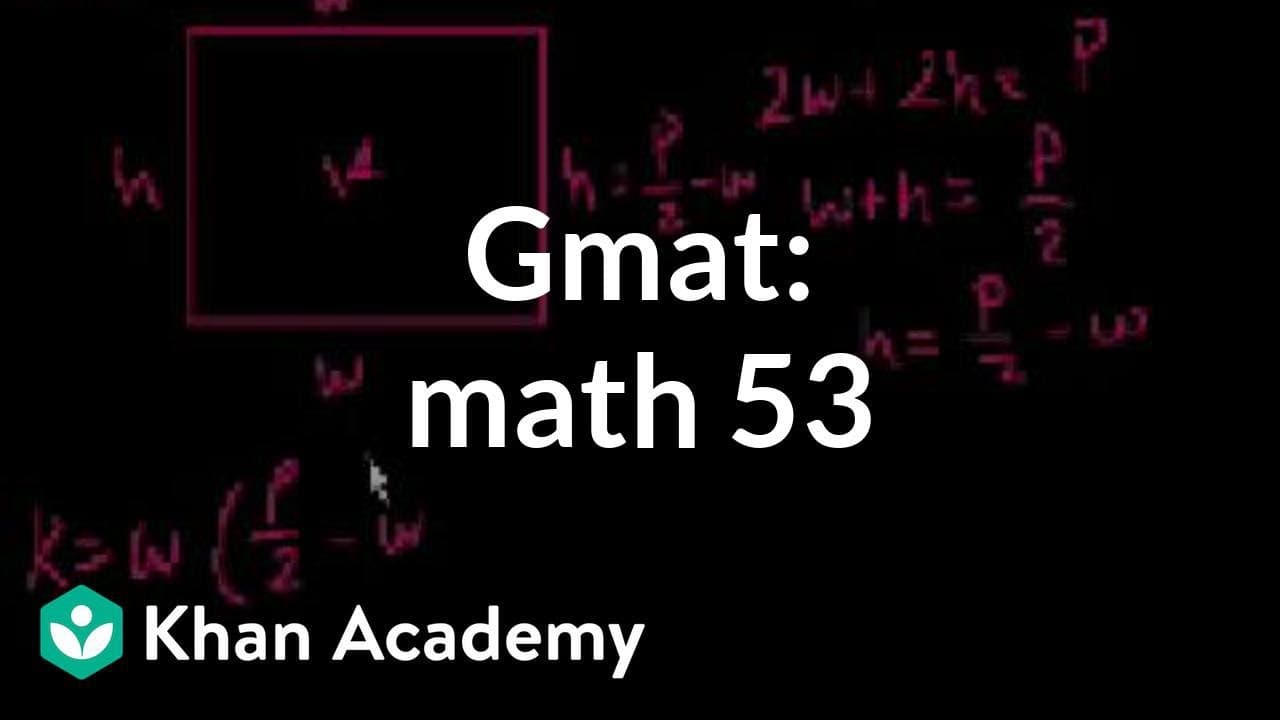
In the second problem, the perimeter and area of a rectangular circuit board are given in terms of width and height. By introducing a variable for height and using the equations for perimeter and area, the value of k is calculated as pw/2 - w squared.
Q: What is an arithmetic sequence?
An arithmetic sequence is a sequence of numbers where each term after the first is equal to the sum of the preceding term and a constant. The difference between consecutive terms in an arithmetic sequence is constant.
Q: How is the difference between terms in an arithmetic sequence calculated?
The difference between terms in an arithmetic sequence can be calculated by subtracting the value of the preceding term from the value of the current term.
Summary & Key Takeaways
-
The video begins by solving a problem involving two equations with two unknowns. By adding and subtracting the equations, the values of x and y are determined, which are then used to find the value of 2xy.
-
Next, the video discusses a problem related to a rectangular circuit board, where the width, perimeter, and area are given. By introducing a variable for height and using equations for perimeter and area, the value of k is calculated in terms of w and p.
-
The video ends by explaining what an arithmetic sequence is and solving a problem where a list of letters is given. Based on the given arithmetic sequence, the video determines which other sequences are also arithmetic.
Read in Other Languages (beta)
Share This Summary 📚
Summarize YouTube Videos and Get Video Transcripts with 1-Click
Try YouTube Summary with ChatGPT & Claude or YouTube Transcript Generator
Explore More Summaries from Khan Academy 📚



Summarize YouTube Videos and Get Video Transcripts with 1-Click
Try YouTube Summary with ChatGPT & Claude or YouTube Transcript Generator