Measurement of Frequency using Cathode Ray Oscilloscope CRO
TL;DR
Learn how to measure frequency using a cathode ray oscilloscope (CRO) and interpret Lissajous patterns displayed on the screen.
Transcript
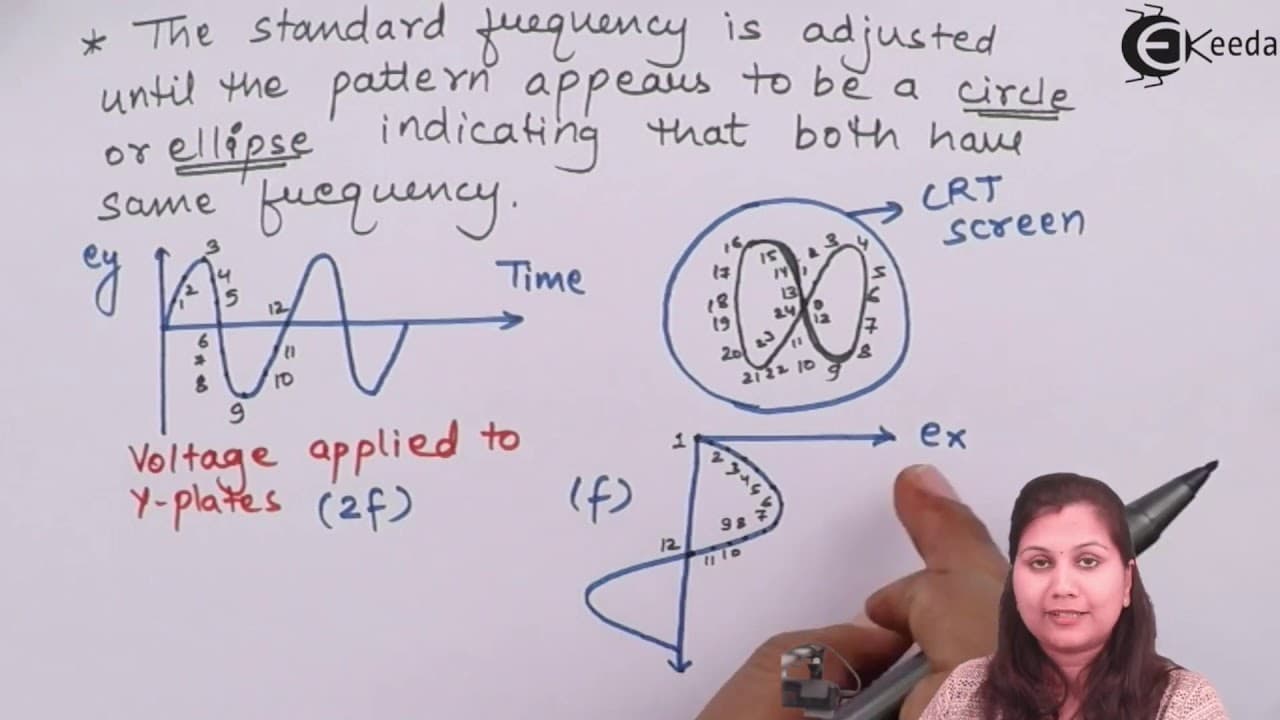
hello friends in this video we are going to study that how the frequency can be measured with the help of cathode ray oscilloscope also known as crm so let us start with our topic we know that in the cathode ray oscilloscope we are having two inputs the vertical input and the horizontal input the vertical input is the input signal which we want to ... Read More
Key Insights
- 🔠 A cathode ray oscilloscope (CRO) has vertical and horizontal inputs for measuring and displaying input signals.
- 💁 Lissajous patterns are patterns formed on the CRO screen when two sinusoidal signals are applied.
- 📡 The frequency of an unknown signal can be measured by adjusting the frequency of a standard signal until a Lissajous pattern appears as a circle or ellipse.
- 🥳 The ratio of the frequencies of the two signals can be determined by analyzing the number of tangencies in the Lissajous pattern.
- 🤗 Lissajous patterns with open ends require modified calculations, considering the open end as a half tangency and the closed part as a full tangency.
Install to Summarize YouTube Videos and Get Transcripts
Explore YouTube Video Summarizer or Get YouTube Transcript Extractor
Questions & Answers
Q: How can a cathode ray oscilloscope (CRO) be used to measure frequency?
By adjusting the frequency of a standard variable frequency source until a Lissajous pattern appears as a circle or ellipse, indicating the equal frequency of the two signals being measured.
Q: What are Lissajous patterns and how are they used in frequency measurement?
Lissajous patterns are patterns formed on the CRO screen when two sinusoidal signals are applied. They can be used to measure frequency by analyzing the shape of the pattern and the number of tangencies.
Q: What happens if a Lissajous pattern appears as an eight pattern?
If a Lissajous pattern appears as an eight pattern, it means that one signal's frequency is twice that of the other signal.
Q: How are Lissajous patterns with open ends treated in frequency measurement?
Lissajous patterns with open ends are treated differently. The open end is considered as a half tangency, while the closed part is considered as a full tangency when calculating the frequency ratio.
Summary & Key Takeaways
-
A cathode ray oscilloscope (CRO) has two inputs, vertical and horizontal, used to display and measure input signals on its screen.
-
Lissajous patterns are formed when two sinusoidal signals are applied to the CRO, and they can be used to measure frequency and phase difference.
-
To measure frequency, adjust the frequency of a standard variable frequency source until a Lissajous pattern appears as either a circle or an ellipse, indicating that the frequencies of the two signals are equal.
Read in Other Languages (beta)
Share This Summary 📚
Summarize YouTube Videos and Get Video Transcripts with 1-Click
Try YouTube Summary with ChatGPT & Claude or YouTube Transcript Generator
Explore More Summaries from Ekeeda 📚




Summarize YouTube Videos and Get Video Transcripts with 1-Click
Try YouTube Summary with ChatGPT & Claude or YouTube Transcript Generator