What Is Machiavellianism in Politics?
TL;DR
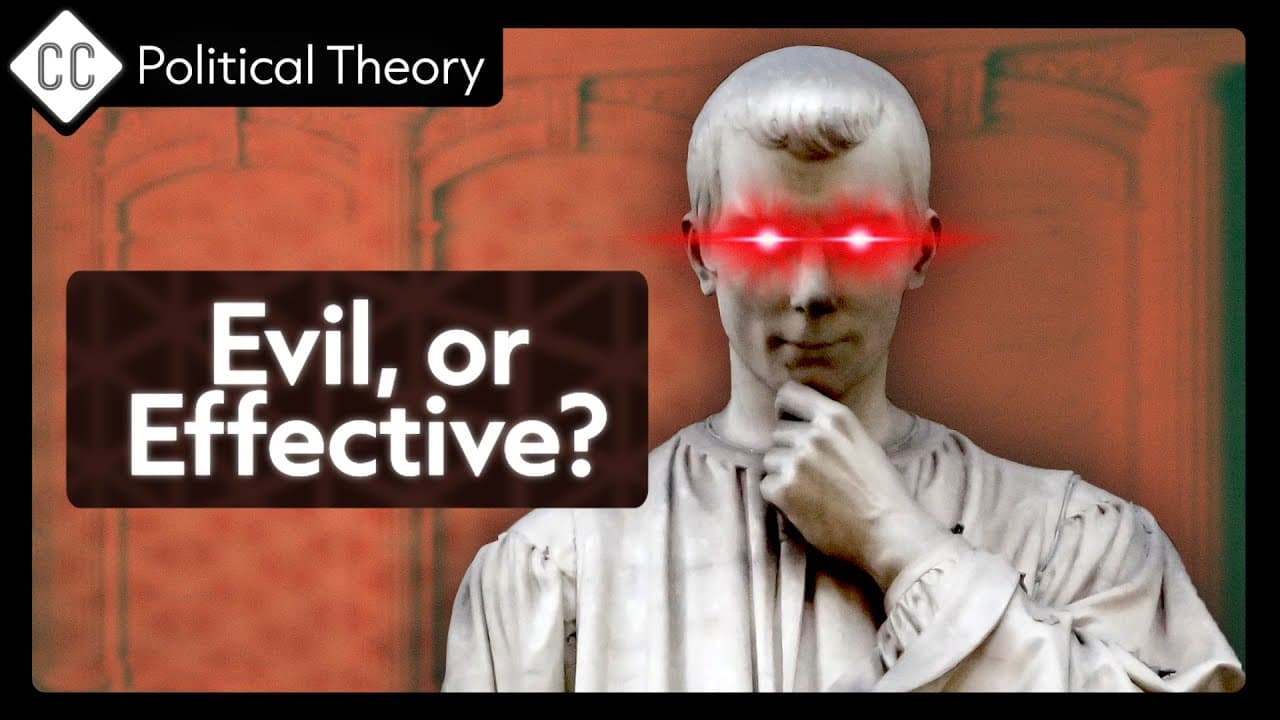
Machiavelli's 'The Prince' suggests that effective leaders must balance morality with pragmatism, knowing when to be good or not good. This perspective, often labeled as Machiavellian, is about strategic realism in politics, where outcomes might outweigh ethical considerations. It challenges the notion of leaders as purely virtuous figures and invites debate on the ethics of leadership.
Transcript
Would you choose to live in a world with no war? No violence? No needless deaths? What if there was a politician who could make all of that true? I’d vote for them in a heartbeat, wouldn’t you? But what if in order to get there, we had to drop a nuclear bomb and kill tens of thousands of innocent people? Would you still vote for them? What if it ... Read More
Key Insights
- Machiavelli argues that effective leadership requires balancing fear and love, with a preference for fear if one must choose.
- Machiavelli's 'The Prince' is often misunderstood as promoting evil, but it actually emphasizes strategic decision-making.
- Henry Kissinger's realpolitik echoes Machiavellian principles, prioritizing national interests over strict ethics.
- Machiavellianism in politics involves pragmatic realism, focusing on maintaining power and state stability.
- The term 'Machiavellian' is often used to describe political strategies that are cunning or unscrupulous.
- Machiavelli suggests that leaders must sometimes act immorally to achieve greater good, a view debated in political theory.
- Hannah Arendt views Machiavelli as someone who sacrificed personal morals for the public good.
- The debate continues on whether politics should prioritize moral ideals or practical outcomes.
Install to Summarize YouTube Videos and Get Transcripts
Explore YouTube Video Summarizer or Get YouTube Transcript Extractor
Questions & Answers
Q: What is the main argument of Machiavelli's 'The Prince'?
Machiavelli's 'The Prince' argues that effective leadership requires a balance between morality and pragmatism. Leaders must know when to act immorally for the greater good, prioritizing fear over love if necessary. This strategic realism suggests that outcomes may sometimes outweigh ethical considerations in maintaining power and state stability.
Q: How does Machiavellianism relate to modern politics?
Machiavellianism in modern politics is often associated with strategic realism, where leaders prioritize national interests and outcomes over strict adherence to moral principles. Figures like Henry Kissinger have applied these principles, emphasizing pragmatic decision-making in complex political landscapes, sparking debates about the ethics of such approaches.
Q: Why is Machiavelli often seen as a 'teacher of evil'?
Machiavelli is often seen as a 'teacher of evil' due to his advocacy for pragmatic, sometimes ruthless leadership strategies in 'The Prince.' He suggests that leaders must occasionally act immorally to achieve greater good, which has led to perceptions of his work as endorsing unethical behavior in politics, though this interpretation is debated.
Q: What role does morality play in Machiavellian politics?
In Machiavellian politics, morality is secondary to pragmatic decision-making. While ethical considerations are not dismissed, the primary focus is on achieving and maintaining power, often requiring leaders to act immorally when necessary. This approach challenges traditional views on the role of ethics in governance, emphasizing outcomes over ideals.
Q: How do theorists like Hannah Arendt view Machiavelli's ideas?
Theorists like Hannah Arendt view Machiavelli's ideas as highlighting the complex realities of political life. Arendt sees Machiavelli as someone willing to sacrifice personal morals for the public good, suggesting that effective governance may require difficult ethical compromises. This perspective encourages a pragmatic understanding of political leadership.
Q: What is the significance of fear in Machiavelli's political theory?
Fear plays a significant role in Machiavelli's political theory as he argues that it is safer for a leader to be feared than loved if both cannot coexist. Fear ensures obedience and stability, making it a more reliable foundation for maintaining power. This emphasis on fear reflects Machiavelli's pragmatic approach to leadership and governance.
Q: How does realpolitik relate to Machiavellian principles?
Realpolitik, a concept associated with Henry Kissinger, relates to Machiavellian principles by prioritizing practical national interests over strict ethical considerations. It involves strategic decision-making in complex political environments, often requiring morally ambiguous actions to achieve desired outcomes, reflecting Machiavelli's emphasis on pragmatic realism in governance.
Q: What ethical dilemmas arise from Machiavellian leadership?
Machiavellian leadership presents ethical dilemmas by challenging the balance between moral ideals and pragmatic outcomes. Leaders may face decisions requiring immoral actions for perceived greater good, raising questions about the extent of acceptable ethical compromise. This tension between ethics and effectiveness continues to provoke debate in political theory.
Summary & Key Takeaways
-
Machiavelli's 'The Prince' posits that leaders must balance morality with pragmatism, often prioritizing fear over love for effective governance. This Machiavellian approach is about strategic realism, where outcomes may outweigh ethical considerations, challenging the notion of leaders as purely virtuous figures.
-
Henry Kissinger's realpolitik reflects Machiavellian principles, emphasizing national interests over moral absolutes. His actions, while controversial, demonstrate the practical application of Machiavelli's ideas in modern politics, sparking ongoing debate about the ethics of leadership.
-
Political theorists like Hannah Arendt and Catherine Zuckert interpret Machiavelli's work as a guide to understanding political realities, encouraging a pragmatic view of politicians. This perspective suggests that effective governance may require compromising personal morals for the greater good.
Read in Other Languages (beta)
Share This Summary 📚
Summarize YouTube Videos and Get Video Transcripts with 1-Click
Try YouTube Summary with ChatGPT & Claude or YouTube Transcript Generator
Explore More Summaries from CrashCourse 📚


Summarize YouTube Videos and Get Video Transcripts with 1-Click
Try YouTube Summary with ChatGPT & Claude or YouTube Transcript Generator