How to Multiply Complex Numbers with FOIL and Distributive Method
TL;DR
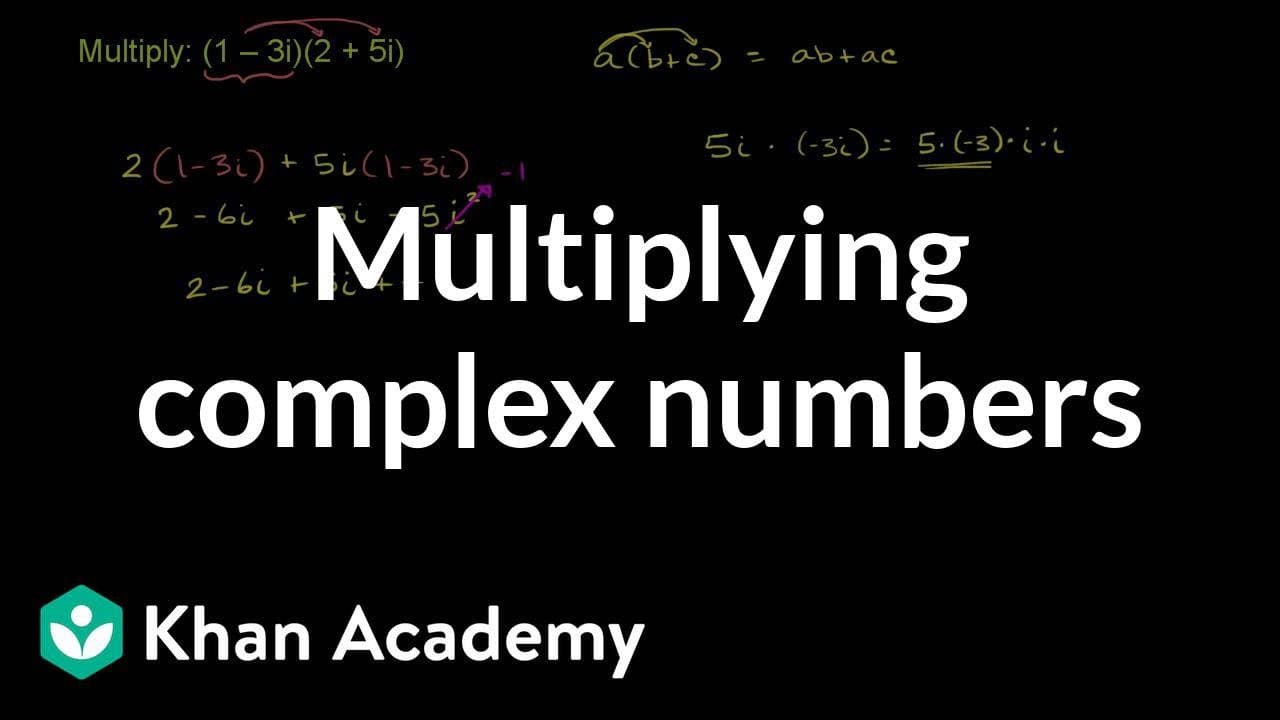
To multiply complex numbers, use either the distributive property or the FOIL method. Apply the distributive property to multiply each part of the numbers, or use FOIL to systematically multiply the First, Outer, Inner, and Last components. Remember that i squared equals -1 to simplify your results.
Transcript
We're asked to multiply the complex number 1 minus 3i times the complex number 2 plus 5i. And the general idea here is you can multiply these complex numbers like you would have multiplied any traditional binomial. You just have to remember that this isn't a variable. This is the imaginary unit i, or it's just i. But we could do that in two ways. W... Read More
Key Insights
- ✖️ Complex numbers can be multiplied using the distributive property or FOIL method.
- 🥳 The distributive property is a fundamental rule that allows for multiplication of parts of the complex number.
- ✖️ FOIL method simplifies the multiplication process by systematically multiplying each part of the complex numbers.
- ✖️ Remembering that i squared is equal to -1 helps with simplifying complex number multiplication.
- 🥳 Adding the real and imaginary parts separately after multiplication gives the final result.
- 🦾 Both methods yield the same result but may have variations in speed or mechanical nature.
- ✋ Understanding the techniques used to multiply complex numbers is essential for higher-level mathematics.
Install to Summarize YouTube Videos and Get Transcripts
Explore YouTube Video Summarizer or Get YouTube Transcript Extractor
Questions & Answers
Q: How can complex numbers be multiplied?
Complex numbers can be multiplied using the distributive property or the FOIL method, treating the imaginary unit "i" like a variable.
Q: What is the distributive property?
The distributive property allows for multiplying a number by every part of an expression using the rule a(b + c) = ab + ac. Applying this to complex numbers involves distributing the real and imaginary parts separately.
Q: What is the FOIL method?
The FOIL method is a straightforward way to ensure every part of the first complex number is multiplied by every part of the second complex number. It stands for First, Outer, Inner, Last.
Q: What is i squared equal to?
By definition, i squared is equal to -1. This knowledge is used to simplify the multiplication of complex numbers.
Summary & Key Takeaways
-
Complex numbers can be multiplied like traditional binomials by using either the distributive property or the FOIL method.
-
Distributing the complex number over the two numbers inside the expression allows for multiplication.
-
FOIL, which stands for First, Outer, Inner, Last, is a method that ensures all parts of the numbers are multiplied.
Read in Other Languages (beta)
Share This Summary 📚
Summarize YouTube Videos and Get Video Transcripts with 1-Click
Try YouTube Summary with ChatGPT & Claude or YouTube Transcript Generator
Explore More Summaries from Khan Academy 📚



Summarize YouTube Videos and Get Video Transcripts with 1-Click
Try YouTube Summary with ChatGPT & Claude or YouTube Transcript Generator