Statistical Learning: 10.R.2 Convolutional Neural Networks in R
TL;DR
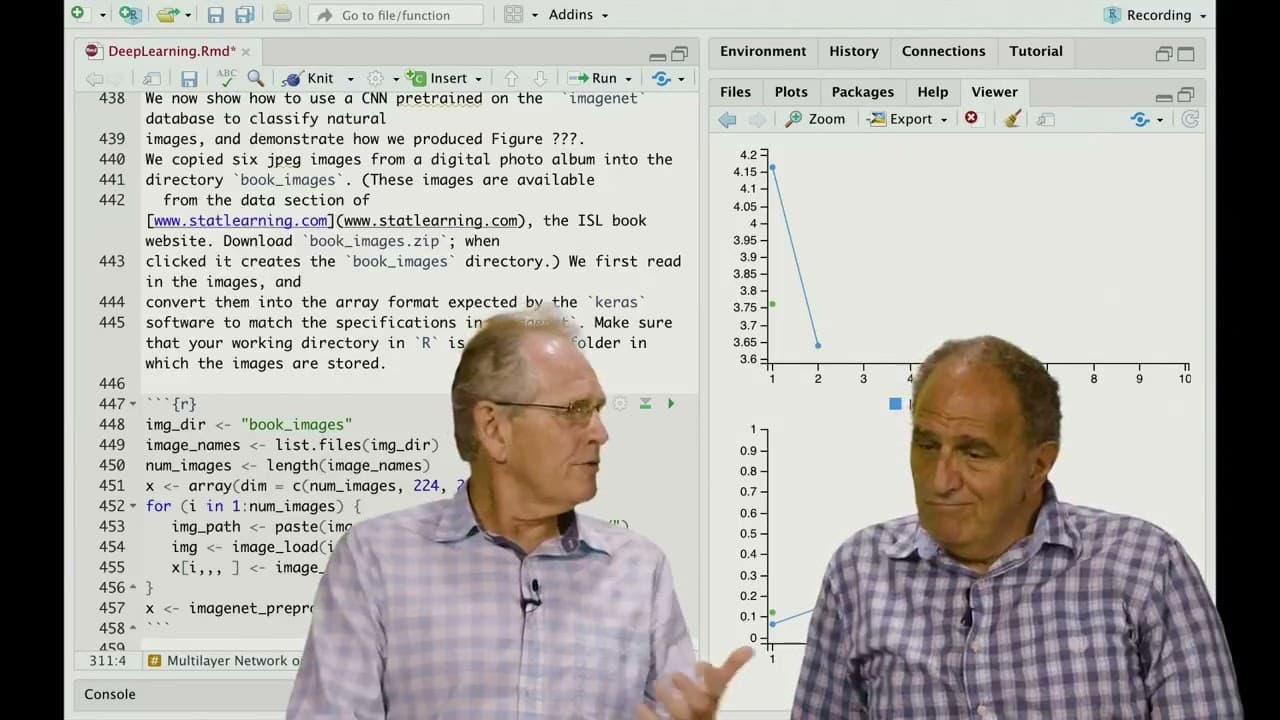
This content discusses the use of convolutional neural networks for image classification, specifically focusing on a dataset with 100 image classes. It also explores the implementation of a pre-trained network for classifying images from a personal photograph album.
Transcript
now we're going to the big daddy convolutional neural networks where we're going to work with the cfa data the image data set and at c4 100 there's 100 image classes and again this data set's available in keras so we read it in and we extract just like before the the training and test data set and look at a summary of of of what we get and as descr... Read More
Key Insights
- 🤝 Convolutional neural networks (CNNs) are highly effective for image classification tasks, particularly when dealing with complex datasets with a large number of classes.
- 😅 One-hot encoding is used to convert categorical variables, such as image classes, into binary vectors for processing by the neural network.
- ❓ Dropout is a regularization technique used in CNN models to reduce overfitting and improve generalization performance.
- 🚂 Pre-trained networks, such as ResNet, trained on large-scale datasets like ImageNet, offer a valuable resource for image classification tasks, allowing for efficient transfer learning and accurate predictions.
- #️⃣ The performance of CNN models can be influenced by factors such as the number of training images, the number of classes, and the complexity of the dataset.
- ✋ Achieving high accuracy in image classification tasks requires continual improvements and the application of new techniques and strategies, as evidenced by the gradual increase in performance observed in competitions.
- 🏛️ CNNs are capable of producing accurate predictions for images from personal photograph albums, even when the image classes are not part of the original training dataset.
Install to Summarize YouTube Videos and Get Transcripts
Explore YouTube Video Summarizer or Get YouTube Transcript Extractor
Questions & Answers
Q: How do convolutional neural networks (CNNs) differ from other types of neural networks?
CNNs are specifically designed for processing grid-like data, such as images, by utilizing convolutional filters and pooling layers to extract features hierarchically. This allows them to capture spatial information and patterns in the data more effectively than other types of neural networks.
Q: What is the purpose of one-hot encoding in image classification?
One-hot encoding is used to represent categorical variables, such as image classes, as binary vectors. In the case of image classification, it helps in transforming the response variable (image class) into a format that can be easily processed by the neural network model, enabling accurate predictions.
Q: What does the term "one hot" mean in the context of encoding categorical variables?
"One hot" refers to the binary representation used for encoding categorical variables. Each category or class is represented by a binary vector with all zeros except for one hot (set to 1) corresponding to the category it represents. This allows the neural network to learn and make predictions based on these encoded vectors.
Q: How does regularization, specifically dropout, help improve the performance of CNN models?
Dropout is a regularization technique that randomly sets a fraction of inputs to 0 during training. This helps in preventing overfitting by reducing the interdependencies among neurons, forcing the network to learn more robust and generalized features. It acts as a form of ensemble learning, where different subsets of neurons are activated during each training iteration.
Summary & Key Takeaways
-
The content introduces convolutional neural networks (CNNs) and their use in image classification, highlighting a dataset with 100 image classes.
-
It explains the process of extracting training and test datasets from the dataset and provides insights into the dimensions and characteristics of the data.
-
The content showcases the implementation of a CNN model using Keras, including the use of convolutional filters, max pooling layers, dropout for regularization, and a summary of the model's layers and parameters.
Read in Other Languages (beta)
Share This Summary 📚
Summarize YouTube Videos and Get Video Transcripts with 1-Click
Try YouTube Summary with ChatGPT & Claude or YouTube Transcript Generator
Explore More Summaries from Stanford Online 📚

Summarize YouTube Videos and Get Video Transcripts with 1-Click
Try YouTube Summary with ChatGPT & Claude or YouTube Transcript Generator