Solar eclipses | The Earth-sun-moon system | Middle school Earth and space science | Khan Academy
TL;DR
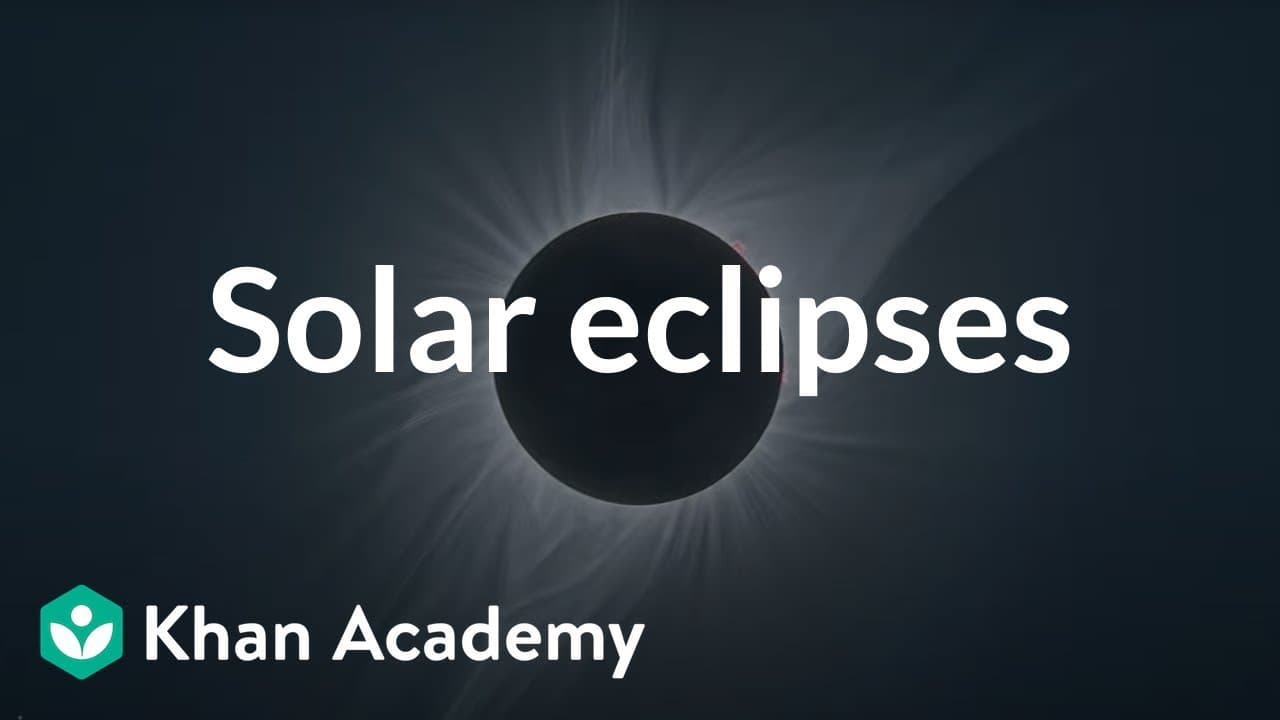
A solar eclipse occurs when the moon blocks the sun's light from reaching a part of earth, causing a temporary shadow. Total solar eclipses happen when the moon completely covers the sun's disk.
Transcript
- [Narrator] Have you ever been minding your own business enjoying the sun when someone steps in front of you and blocks your sunlight? This is pretty much what happens during a solar eclipse except on a planetary scale. As earth revolves around the sun, the moon revolves around earth too. Once in a while, the sun, the moon and earth all line up so... Read More
Key Insights
- 🙂 Solar eclipses occur when the moon blocks the sun's light from reaching a part of earth.
- 🫥 Total solar eclipses allow the outermost layer of the sun's atmosphere (corona) to become visible.
- 👀 Looking directly at the sun during a solar eclipse can cause severe eye damage.
- 🥮 Total solar eclipses last only a few minutes due to the moon's continuous orbit around earth.
- 😎 The sun and the moon appear to be the same size from earth, allowing the moon to cover the sun almost perfectly during an eclipse.
- 🌑 Total solar eclipses only occur during a new moon when the moon is located between the sun and earth.
- 😃 The moon's orbit is gradually getting bigger, resulting in a future where total solar eclipses will no longer be visible from earth.
Install to Summarize YouTube Videos and Get Transcripts
Explore YouTube Video Summarizer or Get YouTube Transcript Extractor
Questions & Answers
Q: What happens during a solar eclipse?
During a solar eclipse, the moon moves between the sun and earth, causing the moon's shadow to fall onto earth and block the sun's light from reaching a certain area.
Q: Can we directly look at the sun during a solar eclipse?
No, looking directly at the sun, even during a solar eclipse, can cause severe and permanent eye damage. It is important to use proper protective eyewear or indirect viewing methods to observe a solar eclipse safely.
Q: Why does the temperature drop during a total solar eclipse?
The temperature drops during a total solar eclipse because the moon blocks solar energy from reaching the earth's surface, resulting in a temporary cooling effect in the area covered by the moon's shadow.
Q: Why don't solar eclipses happen every new moon?
Solar eclipses don't happen every new moon because the plane of the moon's orbit around earth is at a different angle than the plane of earth's orbit around the sun. This misalignment usually causes the moon's shadow to miss earth, preventing an eclipse from occurring.
Summary & Key Takeaways
-
A solar eclipse occurs when the moon passes between the sun and earth, blocking the sun's light from reaching a part of earth.
-
During a total solar eclipse, the moon appears to completely cover the sun's disk, allowing the outermost layer of the sun's atmosphere, called the corona, to become visible.
-
Total solar eclipses last only a few minutes as the moon continues to revolve around earth, eventually allowing the sun to reappear.
Read in Other Languages (beta)
Share This Summary 📚
Summarize YouTube Videos and Get Video Transcripts with 1-Click
Try YouTube Summary with ChatGPT & Claude or YouTube Transcript Generator
Explore More Summaries from Khan Academy 📚



Summarize YouTube Videos and Get Video Transcripts with 1-Click
Try YouTube Summary with ChatGPT & Claude or YouTube Transcript Generator