3D Printing With Filigree Patterns | Two Minute Papers #89
TL;DR
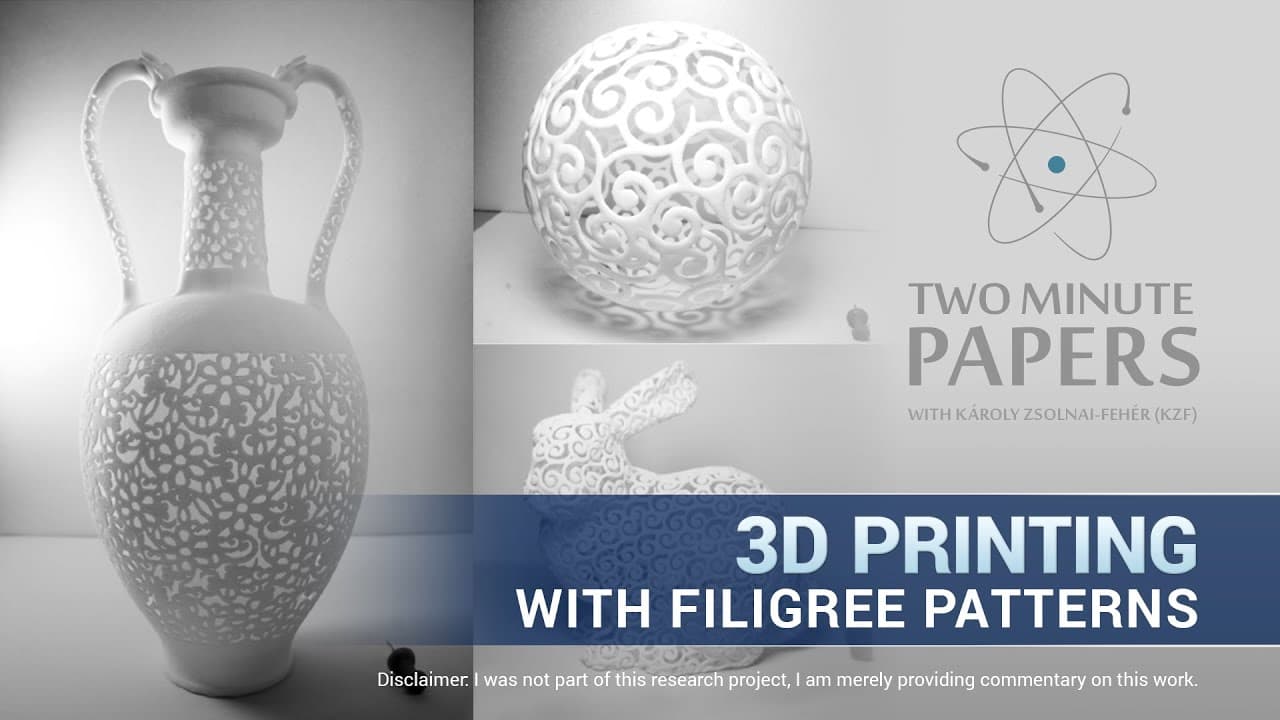
This video discusses a project that uses an optimization approach to create complex 3D printed filigree patterns, minimizing overlapping and maximizing connectivity.
Transcript
Dear Fellow Scholars, this is Two Minute Papers with Károly Zsolnai-Fehér. Filigrees are detailed, thin patterns typically found in jewelry, fabrics and ornaments, and as you may imagine, crafting such motifs on objects is incredibly laborious. This project is about leaving out the craftsmen from the equation by choosing a set of target filigree pa... Read More
Key Insights
- 📽️ Filigrees can be laborious to create on objects, but this project aims to simplify the process through 3D printing and optimization techniques.
- ❓ The optimization approach focuses on minimizing overlap and maximizing connectivity in the arrangement of filigree patterns.
- 🥳 Control fields allow for specifying size, orientation, and desired input filigree ratios, adding complexity to the optimization problem.
- 💦 The project shows significant improvement compared to previous work, reflecting the rapid progress in research.
- 👏 The evaluation and execution of the solution described in the paper are highly praised.
- 🫵 The video acknowledges and appreciates the feedback received from viewers and promises to improve the presentation format.
Install to Summarize YouTube Videos and Get Transcripts
Explore YouTube Video Summarizer or Get YouTube Transcript Extractor
Questions & Answers
Q: What are filigrees and why are they laborious to create on objects?
Filigrees are detailed, thin patterns found in jewelry, fabrics, and ornaments. They are laborious to create because craftsmen have to meticulously craft them on objects.
Q: How does the project eliminate the need for craftsmen in creating filigree patterns?
The project uses an optimization approach to choose a set of target filigree patterns that can be easily 3D printed, eliminating the need for craftsmen's manual work.
Q: What is the challenge in creating these 3D printed filigree patterns?
The challenge is grouping and packing the filigree patterns to evenly cover a surface without overlapping too much and ensuring maximum connectivity between elements.
Q: What factors does the optimization procedure consider to achieve pleasing results?
The optimization procedure takes into account control fields for size and orientation preferences, as well as specifies the ratio of different input filigree elements desired in the final model.
Summary & Key Takeaways
-
Filigrees are intricate patterns found in jewelry, fabrics, and ornaments, and this project aims to create 3D printed filigree patterns without the need for craftsmen.
-
The challenge lies in grouping and packing the filigree patterns to evenly cover a surface, minimizing overlap and ensuring connectivity.
-
The optimization procedure, discussed in detail in the paper, takes into account control fields, size/orientation preferences, and input filigree ratios to achieve pleasing results.
Read in Other Languages (beta)
Share This Summary 📚
Summarize YouTube Videos and Get Video Transcripts with 1-Click
Try YouTube Summary with ChatGPT & Claude or YouTube Transcript Generator
Explore More Summaries from Two Minute Papers 📚




Summarize YouTube Videos and Get Video Transcripts with 1-Click
Try YouTube Summary with ChatGPT & Claude or YouTube Transcript Generator