Introduction to rational and irrational numbers | Algebra I | Khan Academy
TL;DR
Rational numbers can be represented as the ratio of two integers, while irrational numbers cannot.
Transcript
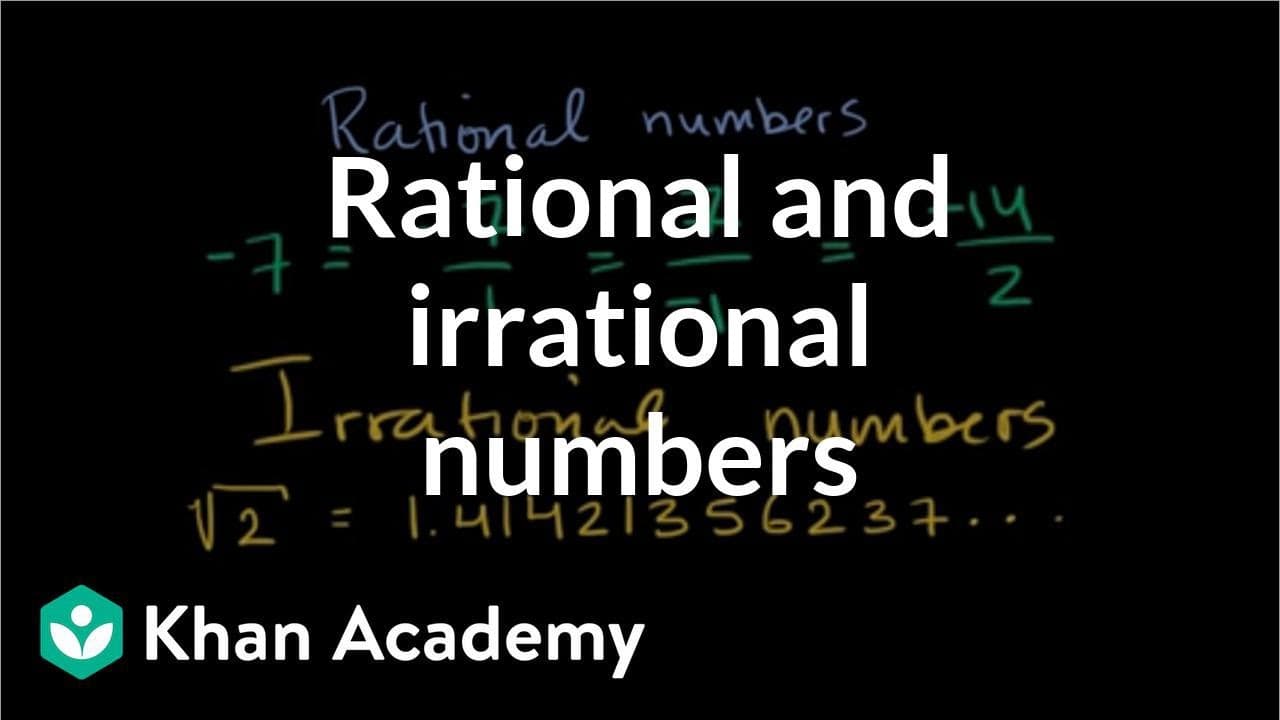
So let's talk a little bit about rational numbers. And the simple way to think about it is any number that can be represented as the ratio of two integers is a rational number. So for example, any integer is a rational number. 1 can be represented as 1/1 or as negative 2 over negative 2 or as 10,000/10,000. In all of these cases, these are all diff... Read More
Key Insights
- 😑 Rational numbers can be expressed as the ratio of two integers.
- #️⃣ Examples of rational numbers include integers and various decimal representations.
- 🚱 Irrational numbers cannot be represented as the ratio of two integers and have non-terminating and non-repeating decimal representations.
- #️⃣ There is always at least one irrational number between any two rational numbers.
- 🍾 Exotic-sounding irrational numbers, such as pi and the golden ratio, are not uncommon in mathematics.
- ❎ The square root of any non-perfect square is an irrational number.
Install to Summarize YouTube Videos and Get Transcripts
Explore YouTube Video Summarizer or Get YouTube Transcript Extractor
Questions & Answers
Q: What is a rational number?
A rational number is any number that can be represented as the ratio of two integers. This includes integers and various decimal representations.
Q: Can irrational numbers be represented as the ratio of two integers?
No, irrational numbers cannot be represented as the ratio of two integers. They have non-terminating and non-repeating decimal representations.
Q: Are there more rational numbers or irrational numbers?
While irrational numbers may seem exotic, there is an infinite number of them, and there is always at least one irrational number between any two rational numbers. Therefore, it is not accurate to say that there are fewer irrational numbers than rational numbers.
Q: What are some examples of irrational numbers?
Examples of irrational numbers include pi, e, the square root of 2, and the golden ratio. These numbers have decimal representations that neither terminate nor repeat.
Summary & Key Takeaways
-
Rational numbers can be represented as the ratio of two integers, examples include integers, finite non-repeating decimals, and repeating decimals.
-
Irrational numbers, such as pi, e, square root of 2, and the golden ratio, cannot be represented as the ratio of two integers.
-
There is always at least one irrational number between any two rational numbers.
Read in Other Languages (beta)
Share This Summary 📚
Summarize YouTube Videos and Get Video Transcripts with 1-Click
Try YouTube Summary with ChatGPT & Claude or YouTube Transcript Generator
Explore More Summaries from Khan Academy 📚



Summarize YouTube Videos and Get Video Transcripts with 1-Click
Try YouTube Summary with ChatGPT & Claude or YouTube Transcript Generator