Filmwise Condensation - Boiling and Condensation - Heat Transfer
TL;DR
Film-wise condensation occurs when a thin film of fluid forms over a surface during condensation, reducing the overall heat transfer rate compared to drop-wise condensation.
Transcript
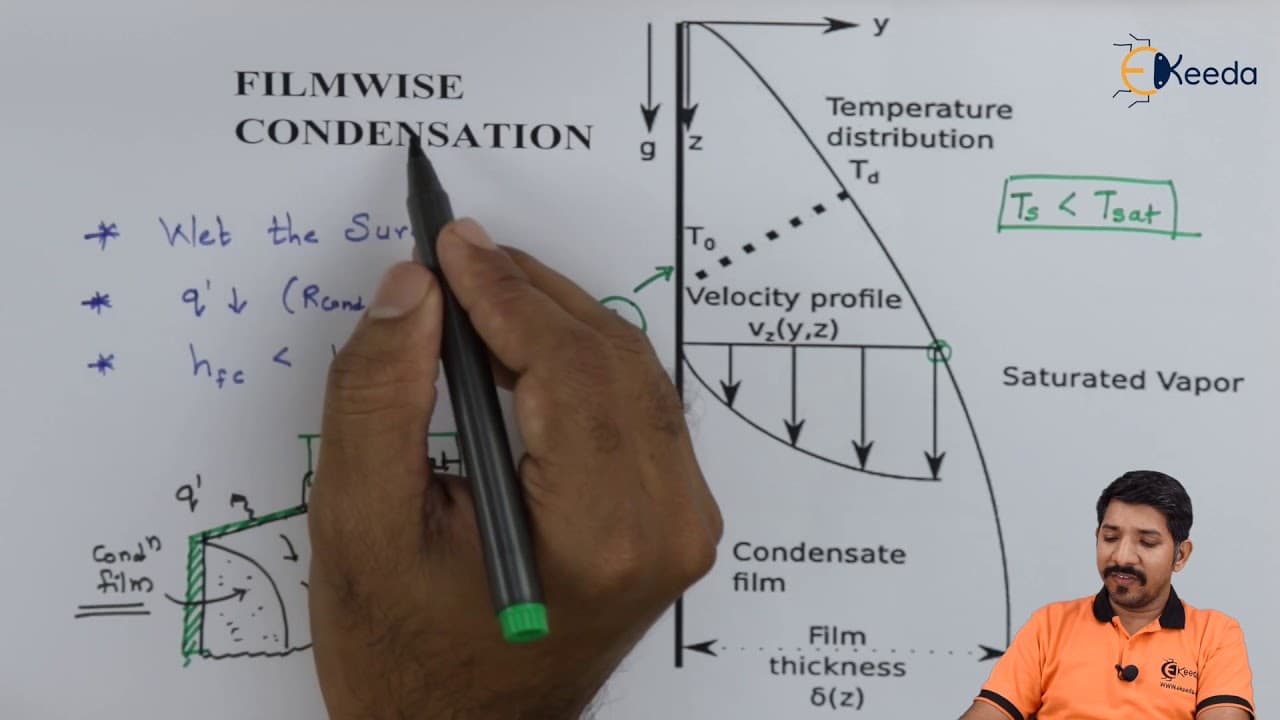
click the bell icon to get latest videos from equator hello friends we have seen what do you mean by the condensation and what are its type we know that there are two types of condensation film-wise and drop boys in this topic we are going to talk about the film wise condensation let us consider the surface temperature is PS and let us say that yes... Read More
Key Insights
- 🎥 Film-wise condensation forms a thin film of fluid over a surface, covering the entire surface.
- 🔃 The heat transfer rate is reduced in film-wise condensation compared to drop-wise condensation.
- 🥵 Film-wise condensation introduces thermal resistance through conduction and convection, further slowing down heat transfer.
- ❤️🩹 The velocity profile in film-wise condensation shows the highest velocity at the end where shear is continuous.
- 🔃 Film-wise condensation leads to a lower heat transfer coefficient compared to drop-wise condensation.
- 🎥 Understanding film-wise condensation is essential for deriving its characteristics.
- 🎥 Film-wise condensation is characterized by the complete coverage of the surface by the fluid film.
Install to Summarize YouTube Videos and Get Transcripts
Explore YouTube Video Summarizer or Get YouTube Transcript Extractor
Questions & Answers
Q: What is film-wise condensation?
Film-wise condensation refers to the formation of a thin film of fluid over a surface during condensation, covering the entire surface.
Q: How does film-wise condensation affect heat transfer?
Film-wise condensation reduces the overall heat transfer rate compared to drop-wise condensation due to the introduction of thermal resistance through conduction and convection.
Q: What are the significance and silent features of film-wise condensation?
Film-wise condensation significance lies in its ability to cover the entire surface, while its silent feature is the reduction in heat transfer rate due to thermal resistance.
Q: How does the heat transfer coefficient differ between film-wise and drop-wise condensation?
The heat transfer coefficient is lower in film-wise condensation compared to drop-wise condensation due to the reduced overall heat transfer rate.
Summary & Key Takeaways
-
Film-wise condensation involves the formation of a thin film of fluid over a surface during condensation.
-
The entire surface is covered by the fluid film, which reduces the heat transfer rate.
-
Film condensation introduces thermal resistance through conduction and convection, further slowing down heat transfer.
Read in Other Languages (beta)
Share This Summary 📚
Summarize YouTube Videos and Get Video Transcripts with 1-Click
Try YouTube Summary with ChatGPT & Claude or YouTube Transcript Generator
Explore More Summaries from Ekeeda 📚


Summarize YouTube Videos and Get Video Transcripts with 1-Click
Try YouTube Summary with ChatGPT & Claude or YouTube Transcript Generator