Why heat increases entropy | Energy and enzymes | Biology | Khan Academy
TL;DR
Heat leads to an increase in entropy, resulting in less useful energy in the universe.
Transcript
- [Voiceover] In the video on the second law of thermodynamics I talk about how the entropy of the universe is constantly increasing, that it's not going to decrease. And another way of thinking about it is that the energy in the universe, more and more of it is going towards entropy, it's becoming less and less useful. And the argument that I use,... Read More
Key Insights
- ❓ The entropy of the universe constantly increases, and the energy in the universe becomes less useful.
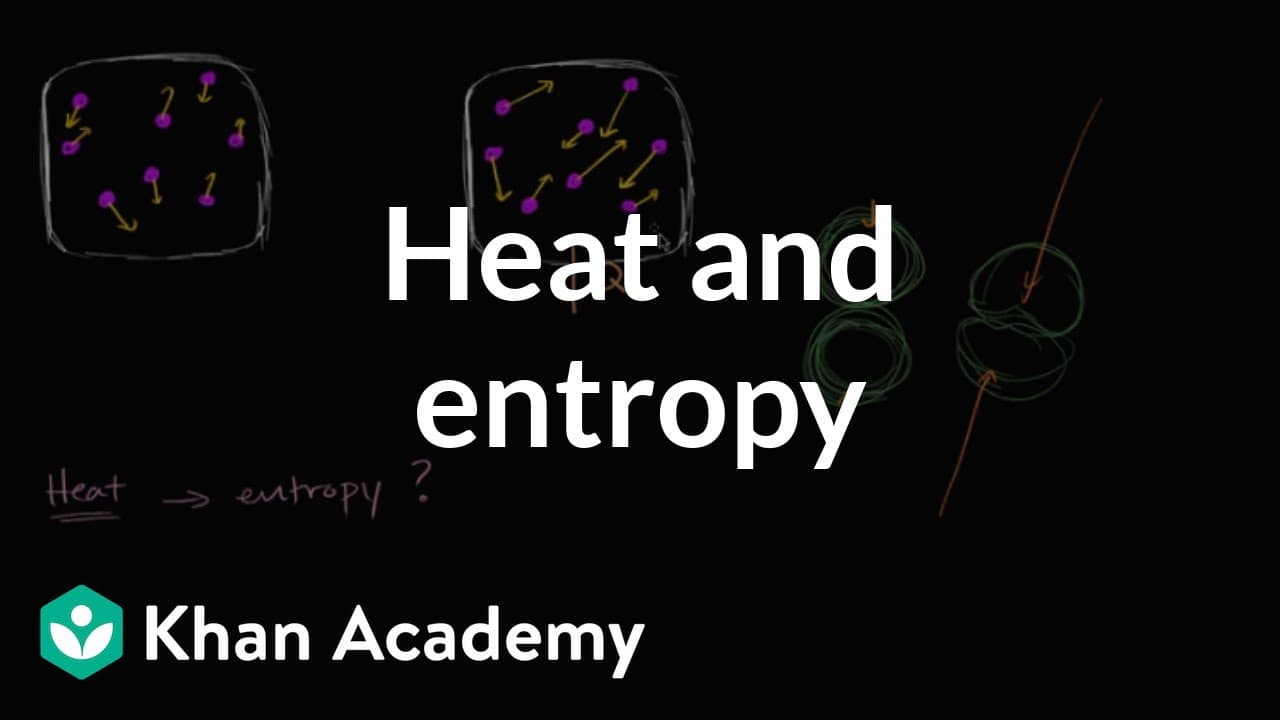
- 🥵 Heat transfer increases the temperature and average kinetic energy of molecules, resulting in more disorder or entropy.
- 🥵 Heat can be converted into work, but no heat-based system can be 100% efficient, and some heat always contributes to increased entropy.
- 🎭 Both heat and work occur at the boundary of a system, but heat leads to increased disorder within the system, while work can be used to perform useful tasks.
Install to Summarize YouTube Videos and Get Transcripts
Explore YouTube Video Summarizer or Get YouTube Transcript Extractor
Questions & Answers
Q: How does heat lead to an increase in entropy?
Heat transfer into a closed system increases the temperature and average kinetic energy of molecules, leading to more possible states the system can take on, resulting in increased disorder or entropy.
Q: Can heat be used to do work?
Yes, heat can be used to do work, as seen in engines such as combustion engines. However, no heat-based system can be 100% efficient, and some heat is always converted into increased disorder or entropy.
Q: What is the relationship between heat and work in thermodynamics?
Both heat and work occur at the boundary of a system. Heat is the transfer of thermal energy that results in increased entropy within the system, while work is the displacement of objects due to forces applied by molecules, which can also contribute to increased disorder.
Q: How does the generation of heat in everyday life contribute to the entropy of the universe?
The processes in our bodies, such as cellular activities, generate heat, increasing the overall entropy of the universe. This leads to a decrease in the usefulness of energy in the universe.
Summary & Key Takeaways
-
Heat transfer into a closed system leads to an increase in temperature and average kinetic energy of molecules, resulting in more disorder or entropy.
-
Heat can be used to do work, as seen in engines, but no heat-based system can be 100% efficient and some heat is always converted into increased disorder.
-
Both heat and work occur at the boundary of a system, but heat contributes to increased entropy within the system.
Read in Other Languages (beta)
Share This Summary 📚
Summarize YouTube Videos and Get Video Transcripts with 1-Click
Try YouTube Summary with ChatGPT & Claude or YouTube Transcript Generator
Explore More Summaries from Khan Academy 📚



Summarize YouTube Videos and Get Video Transcripts with 1-Click
Try YouTube Summary with ChatGPT & Claude or YouTube Transcript Generator