Capacitors (9 of 11) in Parallel, Calculating Voltage Drop
TL;DR
Capacitors in parallel share the same voltage as the battery they are connected to, regardless of capacitance differences.
Transcript
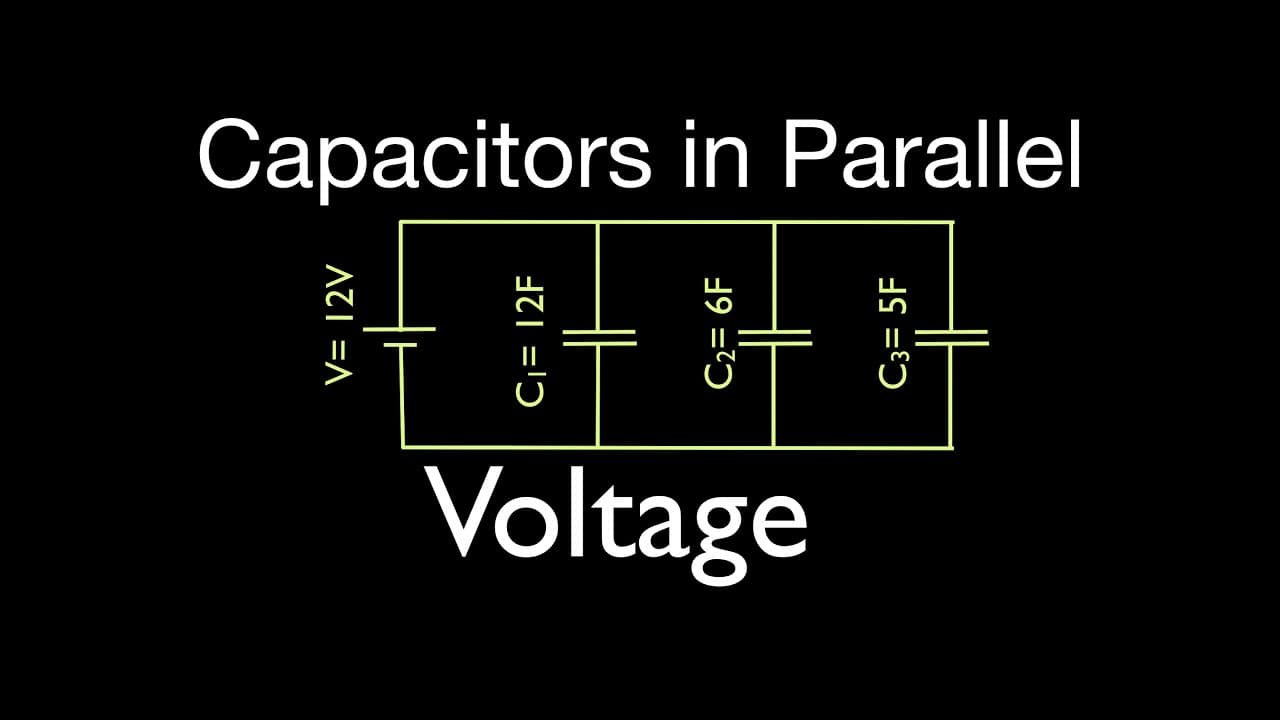
okay in today's video I am going to go over voltage for parallel capacitors and this is the circuit we're going to use we have three capacitors c1 c2 and c3 they are twelve six and five farad capacitance respectively and we have a 12 volt battery now of course this rule applies to any number of parallel capacitors whether we have one two three four... Read More
Key Insights
- ⚡ Capacitors in parallel share the same voltage as the battery they are connected to.
- ⚡ Different capacitance values do not alter the voltage in parallel capacitors.
- ⚡ The potential difference across each capacitor in parallel is equal to the battery's voltage.
Install to Summarize YouTube Videos and Get Transcripts
Explore YouTube Video Summarizer or Get YouTube Transcript Extractor
Questions & Answers
Q: How does voltage work in parallel capacitors?
In parallel capacitors, each capacitor connected directly to the battery will have the same voltage as the battery, irrespective of their capacitance values. This means the potential difference across each capacitor will be equal to the battery's voltage.
Q: Do capacitance values affect the voltage of parallel capacitors?
No, the capacitance values of parallel capacitors do not impact the voltage they receive. As long as they are connected in parallel, they will share the same voltage as the battery they are connected to.
Q: What happens if additional components are added to the circuit?
If resistors or other components are added between the capacitors and the battery in a parallel circuit, it may impact the voltage distribution, but in a simple parallel capacitor setup, the voltage remains constant.
Q: Why is it essential for capacitors in parallel to have the same voltage?
Capacitors in parallel need to have the same voltage to ensure a balanced distribution of charge and energy storage. This allows for consistent performance in a parallel capacitor setup.
Summary & Key Takeaways
-
Three capacitors (C1, C2, C3) with different capacitances (12F, 6F, 5F) are connected in parallel to a 12V battery.
-
Each capacitor connected directly to the battery has the same voltage as the battery, regardless of their individual capacitance.
-
The potential difference or voltage across each capacitor is equal to the voltage of the battery when connected in parallel.
Read in Other Languages (beta)
Share This Summary 📚
Summarize YouTube Videos and Get Video Transcripts with 1-Click
Try YouTube Summary with ChatGPT & Claude or YouTube Transcript Generator
Explore More Summaries from Step by Step Science 📚




Summarize YouTube Videos and Get Video Transcripts with 1-Click
Try YouTube Summary with ChatGPT & Claude or YouTube Transcript Generator