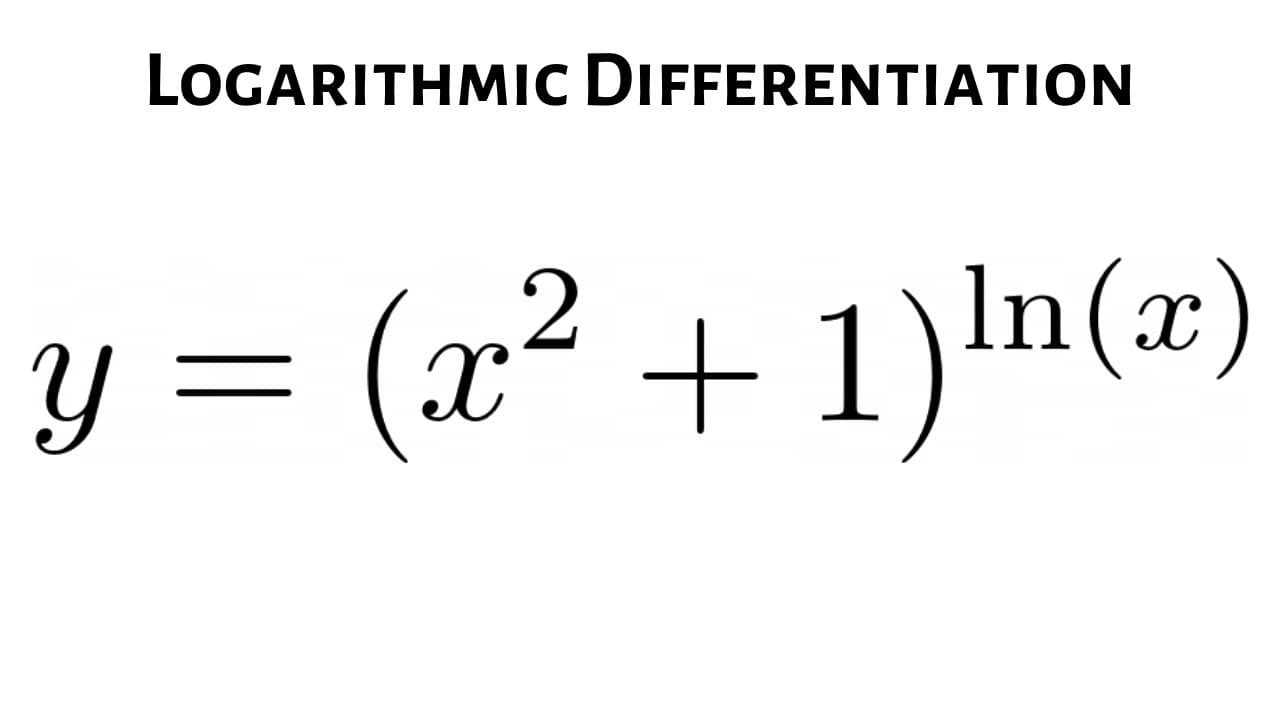
Differentiate using Logarithmic Differentiation to Find dy/dx for y = (x^2 + 1)^(ln(x))
TL;DR
Using logarithmic differentiation to find the derivative of a complex function involving natural logarithms.
Transcript
in this problem we have this function y equals x squared plus 1 to the ln x and we have to find the derivative so i am thinking maybe a good way to do it is to use logarithmic differentiation so logarithmic differentiation says that you first take the natural log on both sides so this is the natural log of y equals the natural log of the right hand... Read More
Key Insights
- ❓ Logarithmic differentiation simplifies complex functions by using properties of natural logarithms.
- 👻 The power rule allows for easier differentiation by bringing down exponents in front of logarithms.
- 📏 Product rule and chain rule are essential in finding derivatives of functions with multiple components.
Install to Summarize YouTube Videos and Get Transcripts
Explore YouTube Video Summarizer or Get YouTube Transcript Extractor
Questions & Answers
Q: What is logarithmic differentiation and how does it help find derivatives?
Logarithmic differentiation involves taking natural logarithms of both sides of a function to simplify and find derivatives in complex functions more efficiently than traditional differentiation methods.
Q: How does the power rule for logarithms come into play during logarithmic differentiation?
The power rule allows exponents from the natural logarithm function to be brought down in front of the logarithm, making differentiation easier and more streamlined in complex functions.
Q: Why is the product rule used in finding the derivative of the given function?
The product rule is utilized because the function involves two separate components, the natural logarithm of x and x squared plus 1, necessitating the differentiation of each part separately and then combining the results.
Q: How is the chain rule applied in finding the derivative of ln(x squared plus 1)?
The chain rule is employed when finding the derivative of ln(x squared plus 1), where the derivative of the outer function (natural logarithm) is multiplied by the derivative of the inner function (x squared plus 1).
Summary & Key Takeaways
-
Logarithmic differentiation involves taking the natural log of both sides of the function to simplify and find the derivative.
-
Property of logs allows for easier differentiation by bringing down exponents using the power rule.
-
Using the product rule and chain rule for derivatives, the final solution involves substituting the original function back into the derivative formula.
Read in Other Languages (beta)
Share This Summary 📚
Summarize YouTube Videos and Get Video Transcripts with 1-Click
Try YouTube Summary with ChatGPT & Claude or YouTube Transcript Generator
Explore More Summaries from The Math Sorcerer 📚


Summarize YouTube Videos and Get Video Transcripts with 1-Click
Try YouTube Summary with ChatGPT & Claude or YouTube Transcript Generator