What Are Focus Groups and How Are They Used in Research?
TL;DR
Focus groups are qualitative research methods that gather a small group of individuals with shared characteristics to discuss a specific topic, generating narrative data through interaction. They are valuable for understanding social norms, exploring sensitive issues, and capturing diverse perspectives, with careful attention to group dynamics vital for effective results.
Transcript
hi welcome back to our series on qualitative research methods I'm Leslie curry from the Yale School of Public Health and this module is on a major qualitative study design focus groups just a brief overview of the modules the goal is to enhance our capacity to conceptualize design and conduct qualitative research in the Health Sciences there are to... Read More
Key Insights
- 🥺 Focus groups allow for interaction and dynamics among participants, leading to a wider range of responses and activation of forgotten details.
- 😒 They are useful for understanding social and cultural norms, exploring sensitive topics, and studying language use in healthcare settings.
- 👥 Group size and composition should be carefully considered in focus group design.
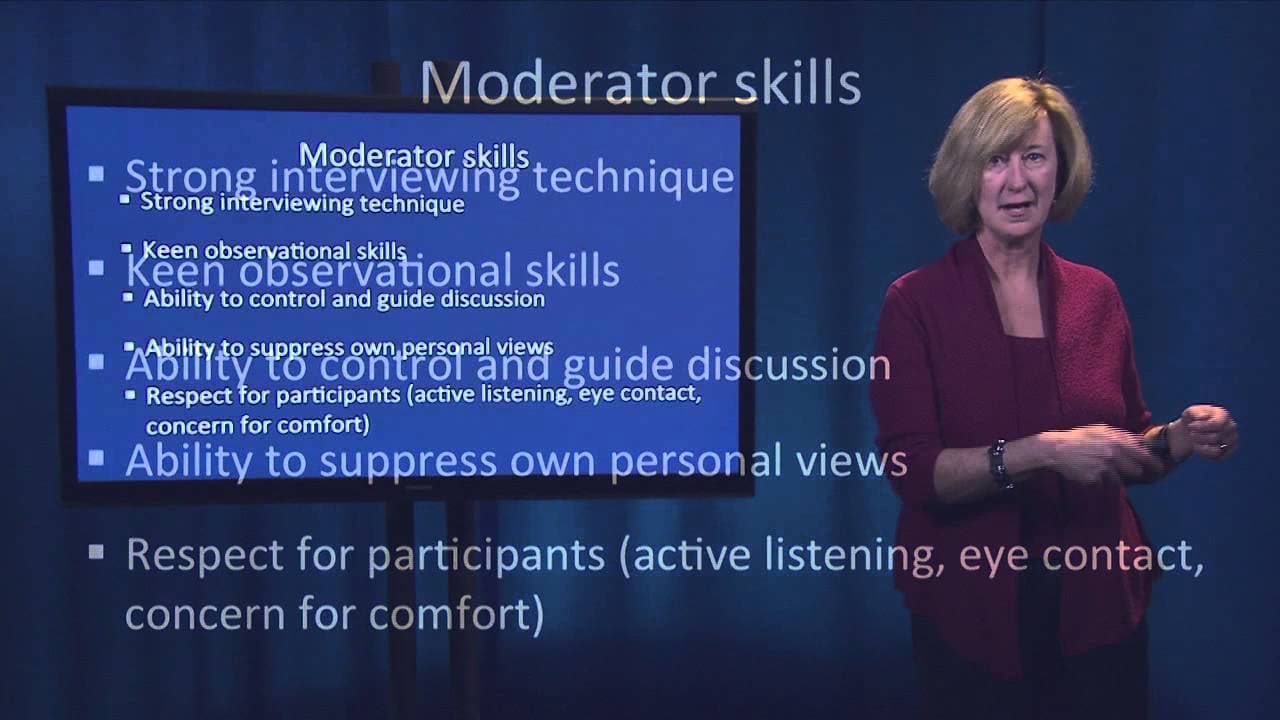
- 🖐️ The moderator plays a crucial role in facilitating the discussion and managing group dynamics.
- 💁 Nonverbal information in the room should be taken into account in data interpretation.
- 👥 Focus group data analysis requires attention to emerging themes at the group level rather than individual responses.
- 👾 Rapport-building and creating a safe space for discussion are essential for successful focus groups.
Install to Summarize YouTube Videos and Get Transcripts
Explore YouTube Video Summarizer or Get YouTube Transcript Extractor
Questions & Answers
Q: What is a focus group?
A focus group is a qualitative research method where a group of individuals with shared characteristics engage in a focused discussion to generate narrative data on a specific topic.
Q: How do focus groups enhance data collection compared to individual interviews?
Focus groups allow for interaction among participants, which can widen the range of responses and activate forgotten details. They also enable sharing and comparing of experiences, generating insights not possible through one-on-one interviews.
Q: When are focus groups useful in the Health Sciences field?
Focus groups are useful for characterizing social and cultural norms, exploring sensitive topics, and studying language use and communication in healthcare settings.
Q: How should focus groups be designed in terms of group size and composition?
The recommended group size is between five to ten participants to maintain dynamics and allow for substantive contributions. Group composition should consider power differentials, homogeneity versus heterogeneity, familiarity among participants, and the need for stratification based on characteristics like gender.
Key Insights:
- Focus groups allow for interaction and dynamics among participants, leading to a wider range of responses and activation of forgotten details.
- They are useful for understanding social and cultural norms, exploring sensitive topics, and studying language use in healthcare settings.
- Group size and composition should be carefully considered in focus group design.
- The moderator plays a crucial role in facilitating the discussion and managing group dynamics.
- Nonverbal information in the room should be taken into account in data interpretation.
- Focus group data analysis requires attention to emerging themes at the group level rather than individual responses.
- Rapport-building and creating a safe space for discussion are essential for successful focus groups.
- Focus groups offer valuable insights when conducted effectively in qualitative research studies.
Summary & Key Takeaways
-
Focus groups involve a group of people with certain characteristics engaging in a focused discussion to generate narrative data.
-
The interaction and dynamics among group members are crucial as they widen the range of responses and activate forgotten details.
-
Focus groups are useful for understanding social and cultural norms, exploring sensitive topics, and studying language use and communication.
Read in Other Languages (beta)
Share This Summary 📚
Summarize YouTube Videos and Get Video Transcripts with 1-Click
Try YouTube Summary with ChatGPT & Claude or YouTube Transcript Generator
Explore More Summaries from Yale University 📚




Summarize YouTube Videos and Get Video Transcripts with 1-Click
Try YouTube Summary with ChatGPT & Claude or YouTube Transcript Generator