Lecture 25: Miscellaneous Attacks
TL;DR
This lecture discusses various types of attacks, including packet sniffing, ARP spoofing, and MAC attacks, and explores their concepts, vulnerabilities, and potential consequences.
Transcript
so in this lecture we shall be talking about some miscellaneous kinds of attacks that can also be mounted so the title of this lecture is miscellaneous attacks now here we shall be talking about something called sniffing later on we shall be looking into this in more detail again so what sniffing is and what are the different types and some of the ... Read More
Key Insights
- ❓ Packet sniffing involves intercepting network packets and can be done passively through hubs or actively in modern networks using switches.
- ❓ Vulnerable protocols that transmit data in clear text, such as HTTP, Telnet, and FTP, can be exploited by packet sniffers.
- 📳 Promiscuous mode and packet decoding are essential components of packet sniffers.
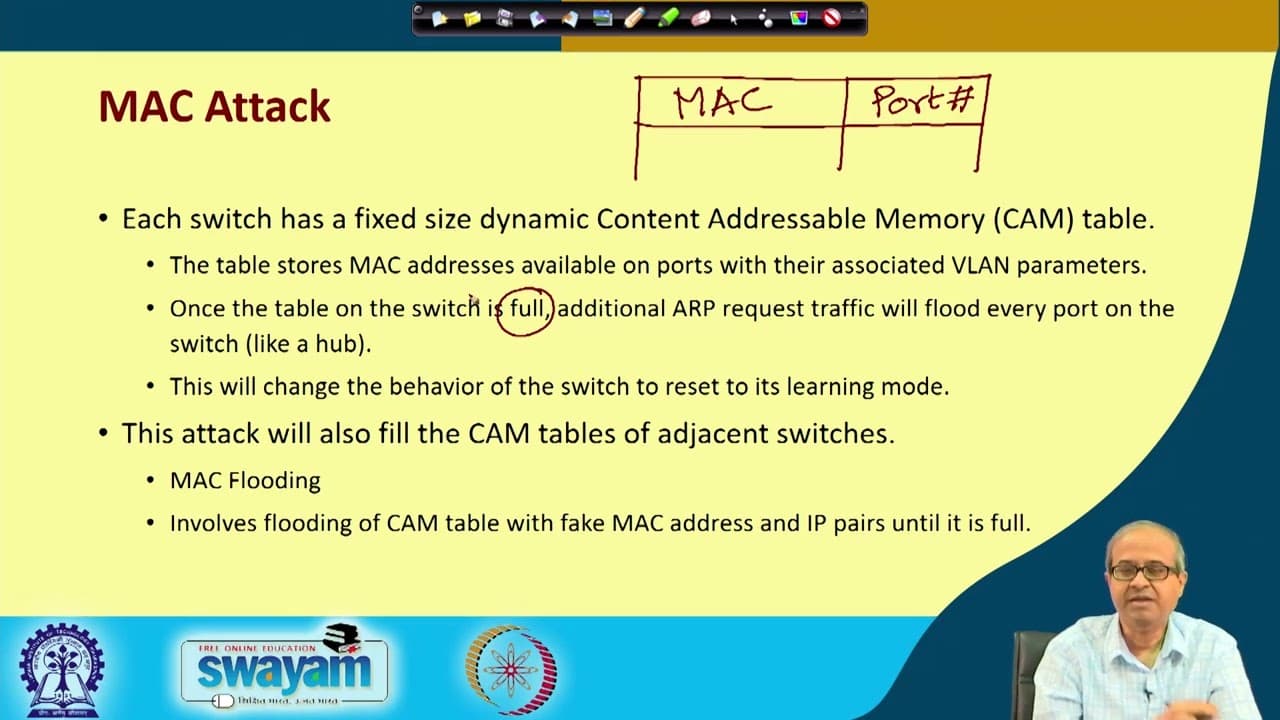
- 👊 MAC attacks exploit vulnerabilities in switches' CAM tables, potentially causing network-wide disruptions.
- 👊 DHCP starvation attacks can exhaust a DHCP server's resources, denying legitimate users access to network configuration information.
- 👻 ARP spoofing allows attackers to redirect network traffic and intercept communication between two machines.
- 👊 MAC flooding attacks overload switches' CAM tables, causing them to function as hubs and flood the network with traffic.
Install to Summarize YouTube Videos and Get Transcripts
Explore YouTube Video Summarizer or Get YouTube Transcript Extractor
Questions & Answers
Q: What is packet sniffing, and how does it work?
Packet sniffing refers to the act of silently listening to network traffic and capturing packets flowing through a shared network. By running a packet sniffer program, an attacker can intercept and read all packets, regardless of their destination.
Q: How does ARP spoofing work, and what are its potential consequences?
ARP spoofing involves forging ARP packets to deceive the network into associating an attacker's MAC address with a different IP address. This allows the attacker to intercept, manipulate, and redirect network traffic, potentially leading to eavesdropping, data modification, or denial of service attacks.
Q: What is a MAC attack, and how does it impact network infrastructure?
MAC attacks exploit vulnerabilities in switches' content addressable memory (CAM) tables. By flooding the table with fake MAC addresses, the switch is overwhelmed and may start functioning as a hub, broadcasting all packets to all ports. This can lead to network congestion, unauthorized access, and compromised security.
Q: How can organizations protect against these attacks?
To protect against packet sniffing, organizations should use encryption for vulnerable protocols such as HTTP, Telnet, POP, and FTP. Implementing strong network access controls, intrusion detection systems, and implementing secure authentication mechanisms can help mitigate ARP spoofing and MAC attacks.
Key Insights:
- Packet sniffing involves intercepting network packets and can be done passively through hubs or actively in modern networks using switches.
- Vulnerable protocols that transmit data in clear text, such as HTTP, Telnet, and FTP, can be exploited by packet sniffers.
- Promiscuous mode and packet decoding are essential components of packet sniffers.
- MAC attacks exploit vulnerabilities in switches' CAM tables, potentially causing network-wide disruptions.
- DHCP starvation attacks can exhaust a DHCP server's resources, denying legitimate users access to network configuration information.
- ARP spoofing allows attackers to redirect network traffic and intercept communication between two machines.
- MAC flooding attacks overload switches' CAM tables, causing them to function as hubs and flood the network with traffic.
- Protecting against these attacks involves using encryption, access controls, intrusion detection systems, and secure authentication mechanisms.
Summary & Key Takeaways
-
Packet sniffing is the act of intercepting and reading network packets, allowing an attacker to gather sensitive information transmitted over a network.
-
ARP spoofing involves forging Address Resolution Protocol (ARP) packets to redirect network traffic, enabling attackers to intercept and manipulate communication between two machines.
-
MAC attacks exploit vulnerabilities in switches' content addressable memory (CAM) tables, potentially causing the switch to function as a hub and flooding the network with traffic.
Read in Other Languages (beta)
Share This Summary 📚
Summarize YouTube Videos and Get Video Transcripts with 1-Click
Try YouTube Summary with ChatGPT & Claude or YouTube Transcript Generator
Explore More Summaries from IIT Kharagpur July 2018 📚






Summarize YouTube Videos and Get Video Transcripts with 1-Click
Try YouTube Summary with ChatGPT & Claude or YouTube Transcript Generator