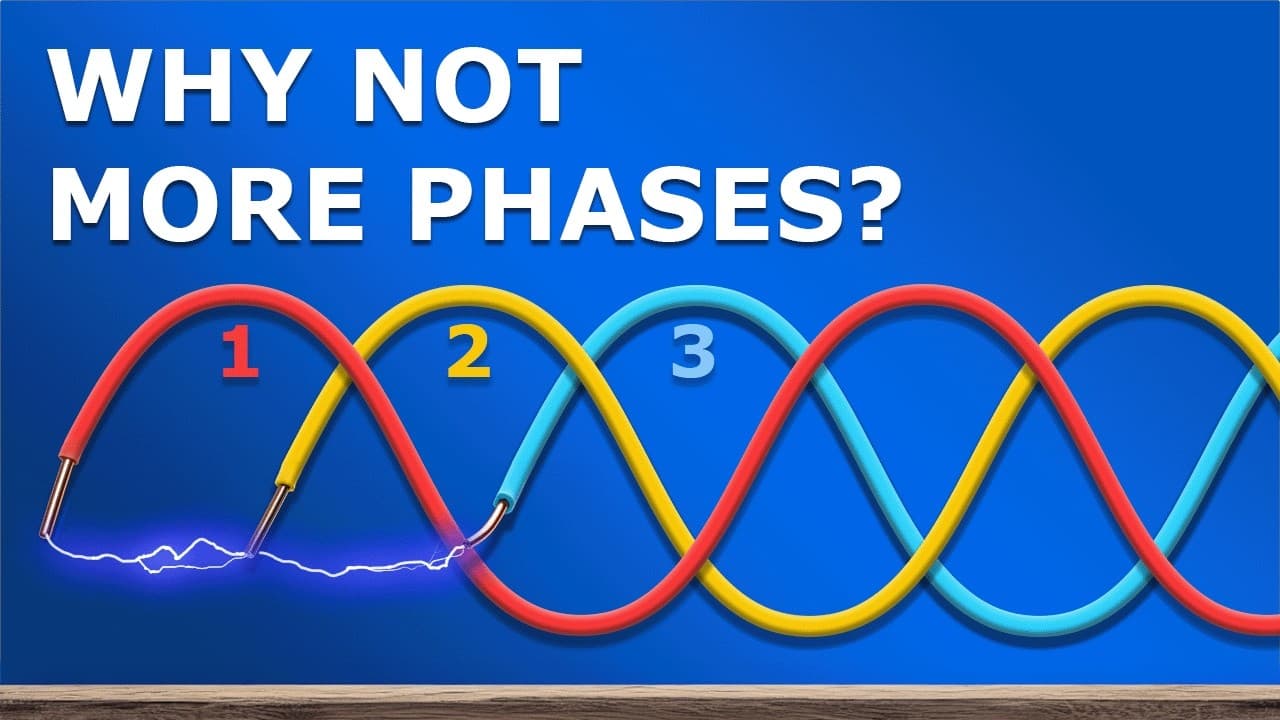
How 3 Phase Power works: why 3 phases?
TL;DR
Explains the mechanics and benefits of three-phase power systems.
Transcript
sponsored by brilliant this Outlet provides 120 volts alternating current if we connect an oscilloscope we find a singlephase 60 HZ sine wave other countries use different voltages and frequencies the AC power is produced by the electrical generator at the power station which is some distance away a generator just converts mechanical energy into el... Read More
Key Insights
- Three-phase power systems produce three separate sine waves, improving power stability and efficiency compared to single-phase systems.
- Generators convert mechanical energy to electrical energy using a rotating magnet and coils, creating alternating current (AC).
- Three-phase systems use coils placed 120° apart to ensure even spacing of sine waves and balanced power output.
- The Y and Delta configurations in three-phase systems have different applications, with Y allowing for a neutral wire and Delta providing more power.
- Three-phase systems are more efficient for industrial applications, while single-phase systems are typically sufficient for residential use.
- Different countries use varying voltages and frequencies, complicating international electrical compatibility.
- The root mean square (RMS) voltage provides a consistent measurement of AC voltage, despite its continuous variation.
- Brilliant offers interactive learning courses in engineering and related fields, helping users build critical thinking skills.
Install to Summarize YouTube Videos and Get Transcripts
Explore YouTube Video Summarizer or Get YouTube Transcript Extractor
Questions & Answers
Q: What is the basic principle behind three-phase power?
Three-phase power systems generate electricity using three separate sine waves, each produced by a coil placed 120° apart within a generator. This setup ensures a more stable and efficient power output compared to single-phase systems, as it balances the electrical load and reduces power fluctuations.
Q: How does a generator produce alternating current?
A generator produces alternating current by converting mechanical energy into electrical energy. It uses a rotating magnet, attached to a rotor shaft, which moves within a stator containing coils of wire. As the magnet rotates, it induces a magnetic field that interacts with electrons in the wire, creating an alternating flow of current.
Q: What are the differences between Y and Delta configurations in three-phase systems?
In three-phase systems, Y configurations allow for a neutral wire, which is useful for balancing loads and providing single-phase power. Delta configurations, on the other hand, connect loads across two phases, offering higher power output. However, Delta is primarily used for balanced three-phase loads without the need for a neutral wire.
Q: Why are three-phase systems preferred for industrial applications?
Three-phase systems are preferred for industrial applications due to their ability to deliver consistent and higher power output. They enable smoother operation of large equipment, such as motors and heaters, by distributing the electrical load evenly across three phases, reducing power fluctuations and enhancing efficiency.
Q: How does the root mean square (RMS) voltage provide a consistent measurement?
RMS voltage provides a consistent measurement by calculating the equivalent DC voltage that would produce the same amount of heat as the AC voltage. It involves squaring the instantaneous voltages, taking their mean, and then finding the square root of this mean value. This approach accounts for the continuous variation in AC voltage.
Q: What challenges arise from varying voltages and frequencies in different countries?
Varying voltages and frequencies across countries create compatibility challenges for electrical devices and systems. This requires specialized equipment, like transformers and converters, to adapt and ensure safe operation. Additionally, it complicates the synchronization of power networks and the design of international electrical infrastructure.
Q: How does Brilliant's learning platform benefit engineering students?
Brilliant's learning platform benefits engineering students by offering interactive courses that emphasize hands-on problem-solving rather than rote memorization. It provides visual and engaging content on topics like math, data analysis, and programming, helping students build critical thinking skills essential for engineering and technical fields.
Q: Why is single-phase power typically sufficient for residential use?
Single-phase power is typically sufficient for residential use because homes generally have lower power demands compared to industrial settings. Most household appliances and electronics operate efficiently on single-phase power, which is simpler and more cost-effective to install and maintain for residential properties.
Summary & Key Takeaways
-
The video explains the mechanics of three-phase power systems, highlighting their efficiency and stability advantages over single-phase systems. It describes how generators produce AC electricity using rotating magnets and coils, and the importance of placing coils 120° apart for balanced power output.
-
Three-phase systems can be configured in Y or Delta formations, each with specific applications. Y configurations allow for a neutral wire, while Delta provides higher power output. These systems are widely used in industrial settings, while single-phase systems suffice for residential use.
-
Brilliant offers interactive courses in engineering, math, and programming, emphasizing hands-on problem-solving. The video also discusses the challenges of international electrical compatibility due to varying voltages and frequencies, and explains the concept of RMS voltage for consistent AC measurement.
Read in Other Languages (beta)
Share This Summary 📚
Summarize YouTube Videos and Get Video Transcripts with 1-Click
Try YouTube Summary with ChatGPT & Claude or YouTube Transcript Generator
Explore More Summaries from The Engineering Mindset 📚
Summarize YouTube Videos and Get Video Transcripts with 1-Click
Try YouTube Summary with ChatGPT & Claude or YouTube Transcript Generator