Stanford CS330: Multi-Task and Meta-Learning, 2019 | Lecture 9 - Lifelong Learning
TL;DR
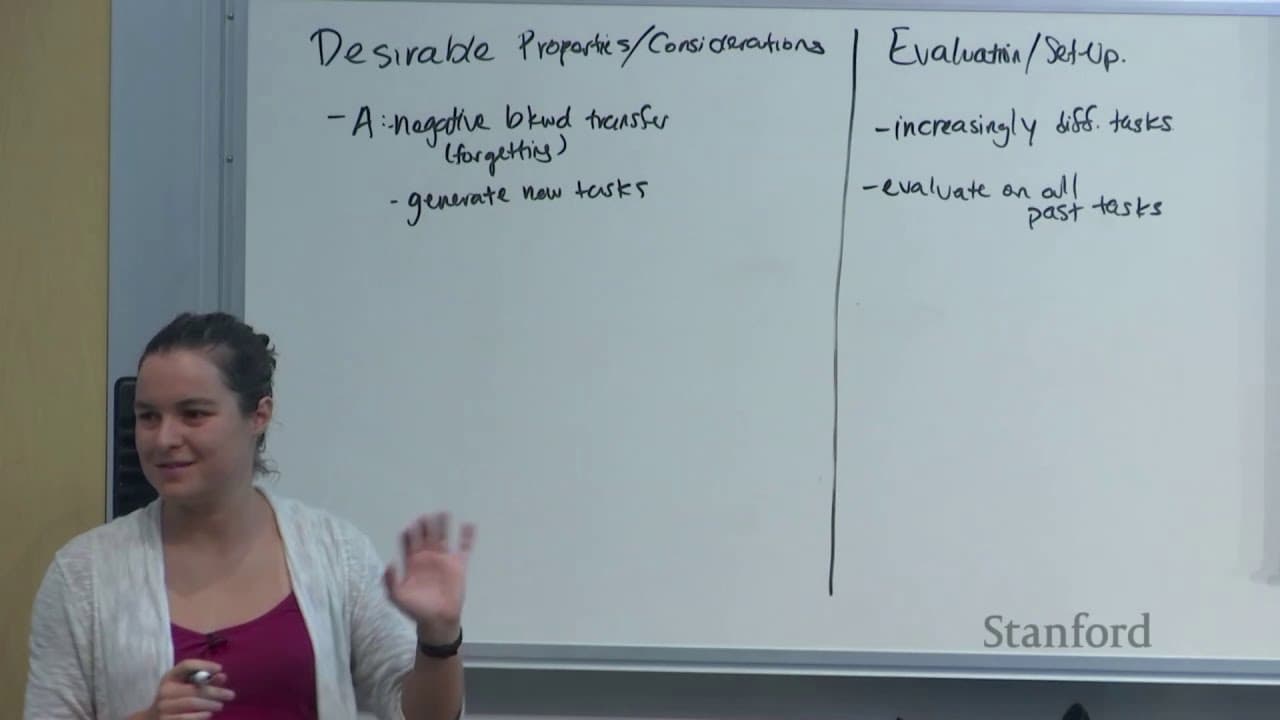
Lifelong learning involves continuous learning, adaptation, and generalization to new tasks, with metrics like regret and positive/negative transfer used to evaluate algorithms.
Transcript
So today, we'll be talking about lifelong learning. Um, and all- it's first logistics, uh, the project milestones are due on Wednesday, uh, and next week we have two guest lectures, uh, by Jeff Clune and Sergey Levine and I, uh, highly encourage you to inten- attend in person. I think that their talks will be, uh, pretty neat talking about, uh, pro... Read More
Key Insights
- 👶 Lifelong learning involves continuous learning and adaptation to new tasks.
- 📈 Evaluating lifelong learning algorithms can be done through regret and positive/negative transfer metrics.
- 😥 Basic approaches include storing all data or taking one gradient step on each new data point.
Install to Summarize YouTube Videos and Get Transcripts
Explore YouTube Video Summarizer or Get YouTube Transcript Extractor
Questions & Answers
Q: What are the two basic approaches to lifelong learning?
The two basic approaches are storing all data and continuously training on it, or taking one gradient step on each new data point.
Q: How can we evaluate the performance of lifelong learning algorithms?
Performance can be evaluated based on regret, the difference between cumulative loss and optimal loss, and positive/negative transfer, comparing performance on current and previous tasks.
Q: What is the advantage of continuously fine-tuning parameters in lifelong learning?
Continuous fine-tuning allows for faster adaptation to new tasks and environments, but it may also lead to forgetting of previous tasks if not done carefully.
Summary & Key Takeaways
-
Lifelong learning involves continuous learning and adaptation in an incremental or online fashion.
-
Basic approaches to lifelong learning include storing all data and continuously training on it, or taking one gradient step on each new data point.
-
More advanced approaches involve meta-learning to initialize parameters and online inference to identify tasks and update parameters accordingly.
Read in Other Languages (beta)
Share This Summary 📚
Summarize YouTube Videos and Get Video Transcripts with 1-Click
Try YouTube Summary with ChatGPT & Claude or YouTube Transcript Generator
Explore More Summaries from Stanford Online 📚
Summarize YouTube Videos and Get Video Transcripts with 1-Click
Try YouTube Summary with ChatGPT & Claude or YouTube Transcript Generator