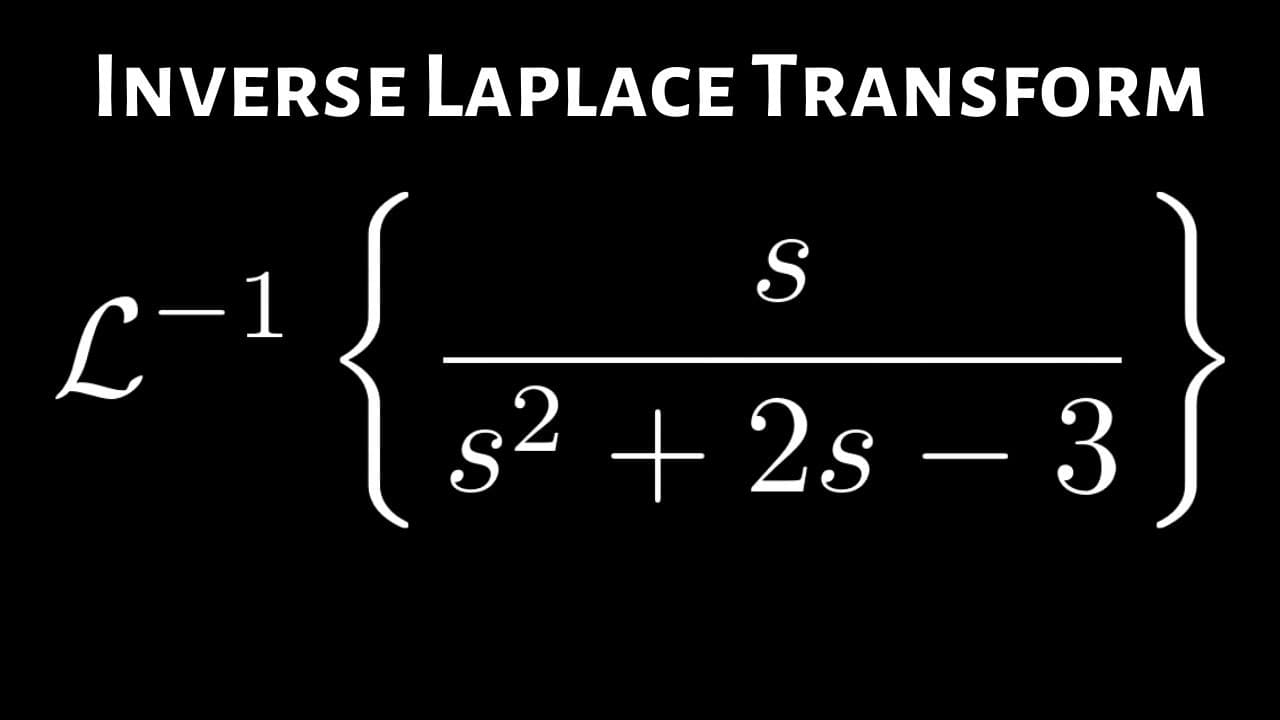
Inverse Laplace Transform of s/(s^2 + 2s - 3) again:)
TL;DR
Learn how to find the inverse Laplace of an expression using partial fractions and the cover-up method.
Transcript
hi everyone in this video we're going to find the inverse Laplace of this expression the first thing we'll do is we'll rewrite this piece here so this is s over and this should factor so let's try so looks like we need two numbers that multiply it's negative three and add to 2 so I'm thinking three and one yep and I think the three has to be positi... Read More
Key Insights
- 😑 Rewriting expressions to factor plays a crucial role in simplifying calculations for finding inverses.
- 📔 The cover-up method streamlines the process of determining partial fractions efficiently.
- 👻 Utilizing distinct linear factors allows for easier decomposition into individual fractions.
- 😀 The inverse Laplace formula for 1 over s - a simplifies the calculation of the final result.
- 🦻 Application of specific numbers to cover up terms aids in finding the values accurately.
- ❓ Understanding the significance of Heaviside in developing mathematical methods enhances problem-solving techniques.
- 🤗 The cover-up method, with its hands-on approach, provides a practical way to solve complex expressions.
Install to Summarize YouTube Videos and Get Transcripts
Explore YouTube Video Summarizer or Get YouTube Transcript Extractor
Questions & Answers
Q: What is the cover-up method, and how is it used in finding partial fractions?
The cover-up method involves covering up the terms under A and B, then determining the values by substituting specific numbers that make the denominators zero. It simplifies the process of finding the partial fractions.
Q: Why are distinct linear factors crucial in using the cover-up method for partial fractions?
Distinct linear factors are important as they allow for separate fractions (A/s - 1 and B/s + 3) to be determined using the cover-up method, providing a more straightforward approach to finding the values of A and B.
Q: How does the formula for the inverse Laplace of 1 over s - a contribute to solving the expression?
The formula, e to the aT, simplifies the process of finding the inverse Laplace by providing a direct solution based on the given expression, helping to determine the final result quickly.
Q: What significance does Oliver Heaviside hold in terms of the cover-up method and the inverse Laplace formula?
Oliver Heaviside's contributions led to the development of the cover-up method and the inverse Laplace formula, simplifying complex calculations and providing efficient ways to solve mathematical expressions.
Summary & Key Takeaways
-
Rewriting the given expression to factor it and preparing for partial fractions.
-
Utilizing the cover-up method with distinct linear factors A and B to find the values.
-
Applying the formula for the inverse Laplace of 1 over s - a to get the final result.
Read in Other Languages (beta)
Share This Summary 📚
Summarize YouTube Videos and Get Video Transcripts with 1-Click
Try YouTube Summary with ChatGPT & Claude or YouTube Transcript Generator
Explore More Summaries from The Math Sorcerer 📚


Summarize YouTube Videos and Get Video Transcripts with 1-Click
Try YouTube Summary with ChatGPT & Claude or YouTube Transcript Generator