Van Der Waals Forces
TL;DR
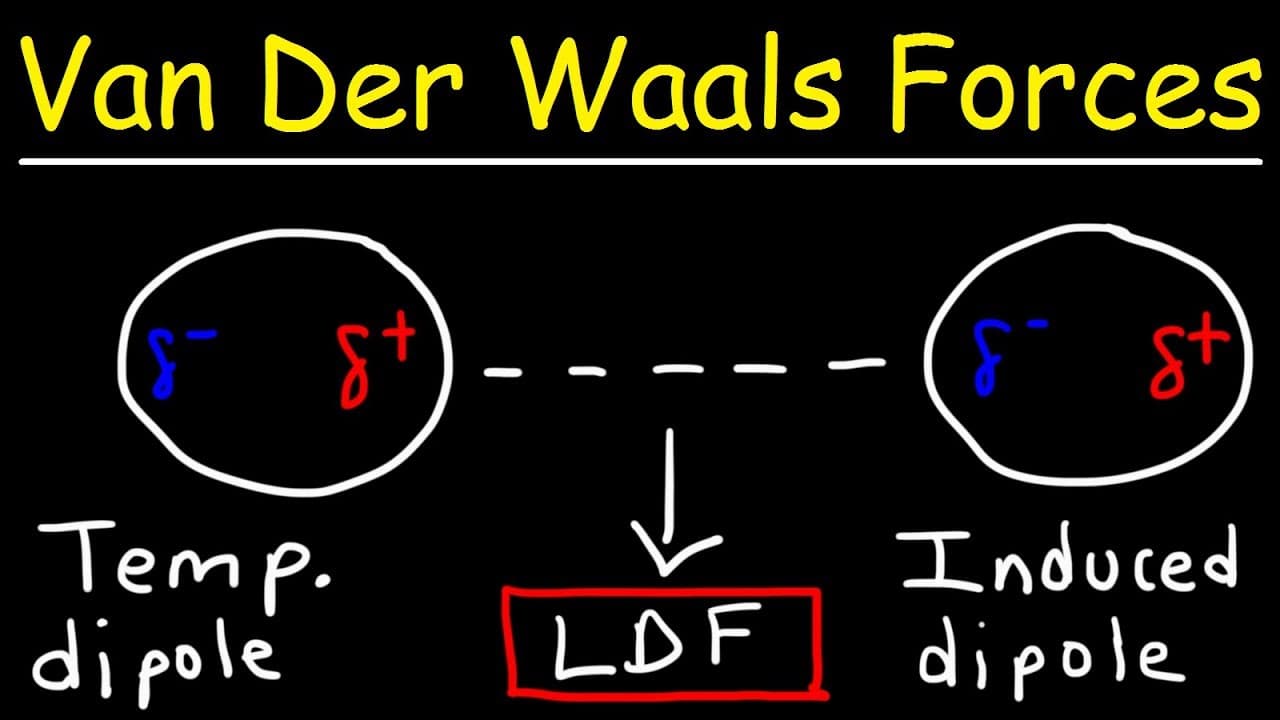
Vander Waal forces, also known as London dispersion forces, are the predominant forces in nonpolar molecules due to temporary dipoles formed by the distribution of electrons.
Transcript
in this lesson we're going to talk about Vander Waal forces and London dispersion forces now these forces they exist in all molecules but there are the predominant forces in nonpolar molecules so let me describe what they are with a visual illustration so let's say we have two atoms with a positive charge at the centre and we know that in the elect... Read More
Key Insights
- ❓ Vander Waal forces and London dispersion forces are the primary intermolecular forces in nonpolar molecules.
- 😶🌫️ Temporary dipoles are formed when electron cloud distribution becomes uneven.
- #️⃣ The likelihood of polarizability and Vander Waal forces increases with the number of electrons in a molecule.
- 😥 Boiling points of nonpolar molecules are directly related to the strength of Vander Waal forces.
- 💆 The molar mass of a molecule determines the number of electrons and, therefore, the strength of Vander Waal forces.
- ❓ Nonpolar hydrocarbons have only carbon and hydrogen bonds and exhibit Vander Waal forces.
Install to Summarize YouTube Videos and Get Transcripts
Explore YouTube Video Summarizer or Get YouTube Transcript Extractor
Questions & Answers
Q: What are Vander Waal forces and why are they important?
Vander Waal forces, or London dispersion forces, are weak intermolecular forces that exist in all molecules, but are more significant in nonpolar molecules. They are important because they contribute to various properties of substances, such as boiling points.
Q: How do temporary dipoles form in nonpolar molecules?
Temporary dipoles occur when the distribution of electrons in an atom becomes uneven due to the constant movement of electrons. This creates a positive side (electron-deficient) and a negative side (electron-rich), resulting in a temporary polarized state.
Q: What is the relationship between molecular weight and boiling point?
As molecular weight increases, the number of electrons also increases. More electrons lead to stronger Vander Waal forces, which require more energy to break during boiling. Therefore, substances with higher molecular weights generally have higher boiling points.
Q: How do Vander Waal forces differ from other intermolecular forces?
Vander Waal forces are weaker than other intermolecular forces, such as hydrogen bonding or dipole-dipole interactions. They are temporary and dependent on the polarizability of the electron cloud in nonpolar molecules.
Summary & Key Takeaways
-
Vander Waal forces and London dispersion forces are the main intermolecular forces in nonpolar molecules.
-
These forces result from the temporary polarization of atom electron clouds, creating temporary dipoles.
-
The likelihood of polarizability and the presence of these forces increase with the number of electrons in a molecule.
Read in Other Languages (beta)
Share This Summary 📚
Summarize YouTube Videos and Get Video Transcripts with 1-Click
Try YouTube Summary with ChatGPT & Claude or YouTube Transcript Generator
Explore More Summaries from The Organic Chemistry Tutor 📚



Summarize YouTube Videos and Get Video Transcripts with 1-Click
Try YouTube Summary with ChatGPT & Claude or YouTube Transcript Generator