Introduction to waves | Mechanical waves and sound | Physics | Khan Academy
TL;DR
A comprehensive explanation of waves, their types, and how disturbances propagate through different mediums.
Transcript
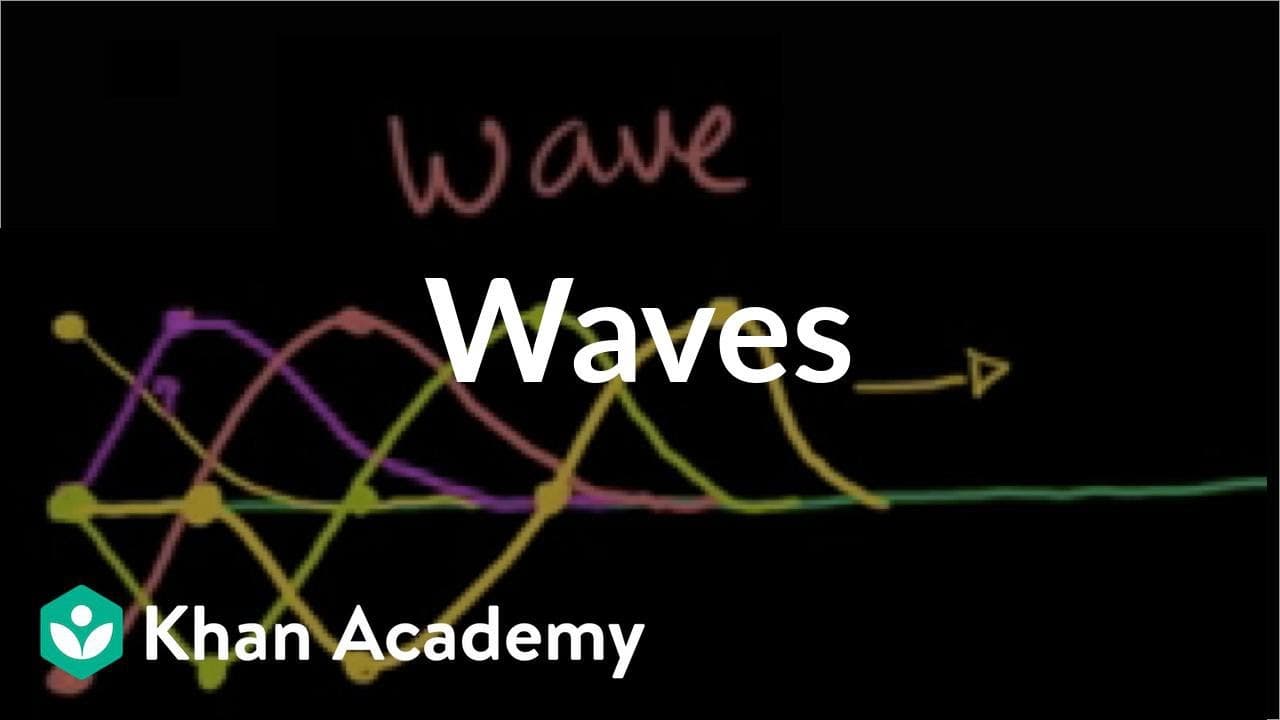
Let's say I've got a rope. That's my rope. And what I'm going to do is, I'm going to take the left end of the rope, and I'm going to jerk it up, and then back down. And we're going to talk about what happens or what possibly gets formed. So if I take it up over here, it's going to, obviously, take the string to the right of it up with it. And the s... Read More
Key Insights
- 👋 Waves are disturbances that propagate through different mediums and transfer energy.
- 👋 Transverse waves involve up and down movement perpendicular to wave propagation, while longitudinal waves involve compression and rarefaction.
- 👋 Waves can be categorized as wave pulses (one-time disturbance) or periodic waves (repeated disturbances).
- 👾 The definition of a wave is a disturbance propagating through space, transferring energy in the process.
- 👋 Different mediums can have different types of waves (e.g., sound waves through air, transverse waves through a rope).
- 👋 Mathematically, compression waves and transverse waves have similarities, despite their different visualizations.
- 👋 Waves can occur both with and without a medium, with examples like sound waves and electromagnetic waves.
Install to Summarize YouTube Videos and Get Transcripts
Explore YouTube Video Summarizer or Get YouTube Transcript Extractor
Questions & Answers
Q: How are transverse waves different from longitudinal waves?
Transverse waves involve movement perpendicular to the direction of wave propagation, while longitudinal waves involve movement in the same direction as wave propagation.
Q: What is a wave pulse?
A wave pulse refers to a single disturbance created by a one-time movement, like jerking a rope in one direction and back.
Q: What is a periodic wave?
A periodic wave is created by repeated movements, maintaining a consistent wavelength and frequency.
Q: Can waves occur without a medium?
Yes, waves can propagate through a vacuum, as seen in electromagnetic waves.
Summary & Key Takeaways
-
This video explains the concept of waves using the example of a rope being jerked up and down.
-
Waves can be transverse (like the rope example) or longitudinal (like sound waves) in nature.
-
Waves are defined as disturbances propagating through space, transferring energy in the process.
Read in Other Languages (beta)
Share This Summary 📚
Summarize YouTube Videos and Get Video Transcripts with 1-Click
Try YouTube Summary with ChatGPT & Claude or YouTube Transcript Generator
Explore More Summaries from Khan Academy 📚



Summarize YouTube Videos and Get Video Transcripts with 1-Click
Try YouTube Summary with ChatGPT & Claude or YouTube Transcript Generator