Stanford CS109 Probability for Computer Scientists I General Inference I 2022 I Lecture 15

TL;DR
Rejection sampling is an algorithm used for inferring conditional probabilities in Bayesian networks, allowing the calculation of complex probability queries.
Transcript
happy Friday cs19 how are you guys doing today awesome I appreciate that I also appreciate it because I know it's a Friday and I know it's a Friday before the midterm so wow do I appreciate you guys coming to class thank you so much um a couple quick things before we jump into things because it's a Friday I'll start by telling a story as always um ... Read More
Key Insights
- ❓ Rejection sampling is an algorithm for solving probability problems in Bayesian networks.
- 🌥️ Conditional probabilities can be calculated by generating a large number of fake samples and using counting techniques to filter and calculate probabilities.
- 😒 Rejection sampling can handle continuous random variables through the use of rounding.
- ❓ The accuracy of rejection sampling depends on the sample size and the quality of the Bayesian network.
Install to Summarize YouTube Videos and Get Transcripts
Explore YouTube Video Summarizer or Get YouTube Transcript Extractor
Questions & Answers
Q: How does rejection sampling work?
Rejection sampling involves generating a large number of fake samples from the joint distribution of a Bayesian network. These samples are then filtered based on the given observation and used to calculate conditional probabilities.
Q: Can rejection sampling handle continuous random variables?
Yes, rejection sampling can handle continuous random variables. However, due to the need for exact matches in the observation, rounding is often applied to the continuous values to make them fit the discrete framework of rejection sampling.
Q: How accurate is rejection sampling?
The accuracy of rejection sampling depends on the quality of the Bayesian network and the sample size. Larger samples provide more accurate results. Additionally, if the observation is rare in the sample, rejection sampling may lead to a small number of remaining samples, reducing accuracy.
Q: How can rejection sampling be used in real-world applications, such as WebMD?
Rejection sampling can be used in WebMD-like applications by constructing a Bayesian network that represents the relationships between symptoms and diseases. By observing certain symptoms, the algorithm can calculate the probability of different diseases and aid in determining potential diagnoses.
Summary & Key Takeaways
-
The lecture introduces rejection sampling, a method for solving probability problems in Bayesian networks.
-
The lecturer shares a personal story about how he met his wife, highlighting the importance of intentional choices in relationships.
-
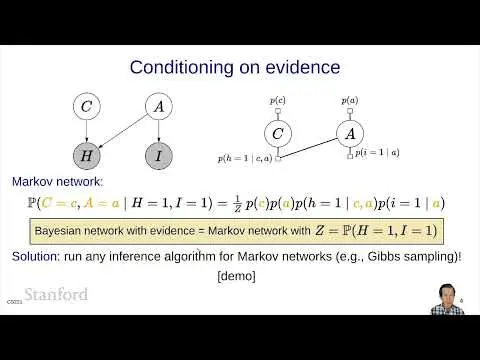
The lecture explains the concept of Bayesian networks and their role in representing probabilistic models.
-
The lecturer discusses the challenges of representing joint probabilities in large-scale problems and introduces rejection sampling as a solution.
-
Rejection sampling involves generating a large number of fake samples from the joint distribution and using counting techniques to calculate conditional probabilities.
Read in Other Languages (beta)
Share This Summary 📚
Summarize YouTube Videos and Get Video Transcripts with 1-Click
Try YouTube Summary with ChatGPT & Claude or YouTube Transcript Generator
Explore More Summaries from Stanford Online 📚


Summarize YouTube Videos and Get Video Transcripts with 1-Click
Try YouTube Summary with ChatGPT & Claude or YouTube Transcript Generator