Problem Metal Oxide Semiconductor Field Effect Transistors - Microwave Transistors and Tunnel Diodes
TL;DR
This video discusses the analysis of a metal-oxide-semiconductor field-effect transistor (MOSFET) in microwave engineering.
Transcript
click the Bell icon to get latest videos from Akira celebrants I welcome you all to this video we are with chapter six of microwave engineering we're a family of microbio bipolar junction transistors we started with first of all understanding the amplification phenomena before that we have also seen various configurations the power frequency limita... Read More
Key Insights
- 🎮 The video discusses the analysis of a MOSFET in microwave engineering, covering various transistor configurations and amplification phenomena.
- ❓ Parameters such as doping concentration, dielectric constants, insulator depth, and operating temperature are crucial for solving MOSFET analysis problems.
- ⚡ Calculating the surface potential, insulator capacitance, and threshold voltage are essential steps in MOSFET analysis.
- 🆘 Formulas and step-by-step instructions are provided to help solve the problem and obtain the required values accurately.
- 🎮 The video emphasizes the importance of understanding MOSFET analysis in microwave engineering applications.
- ❓ Subscribing to the channel will provide more knowledge and details on MOSFET analysis and other subjects in microwave engineering.
Install to Summarize YouTube Videos and Get Transcripts
Explore YouTube Video Summarizer or Get YouTube Transcript Extractor
Questions & Answers
Q: What is the purpose of this video?
This video aims to analyze a specific MOSFET in microwave engineering, addressing calculations related to surface potential, insulator capacitance, and threshold voltage.
Q: What are some of the parameters provided in the problem statement?
The problem statement provides information on doping concentration, dielectric constants, insulator depth, and operating temperature, which are essential for solving the given problem.
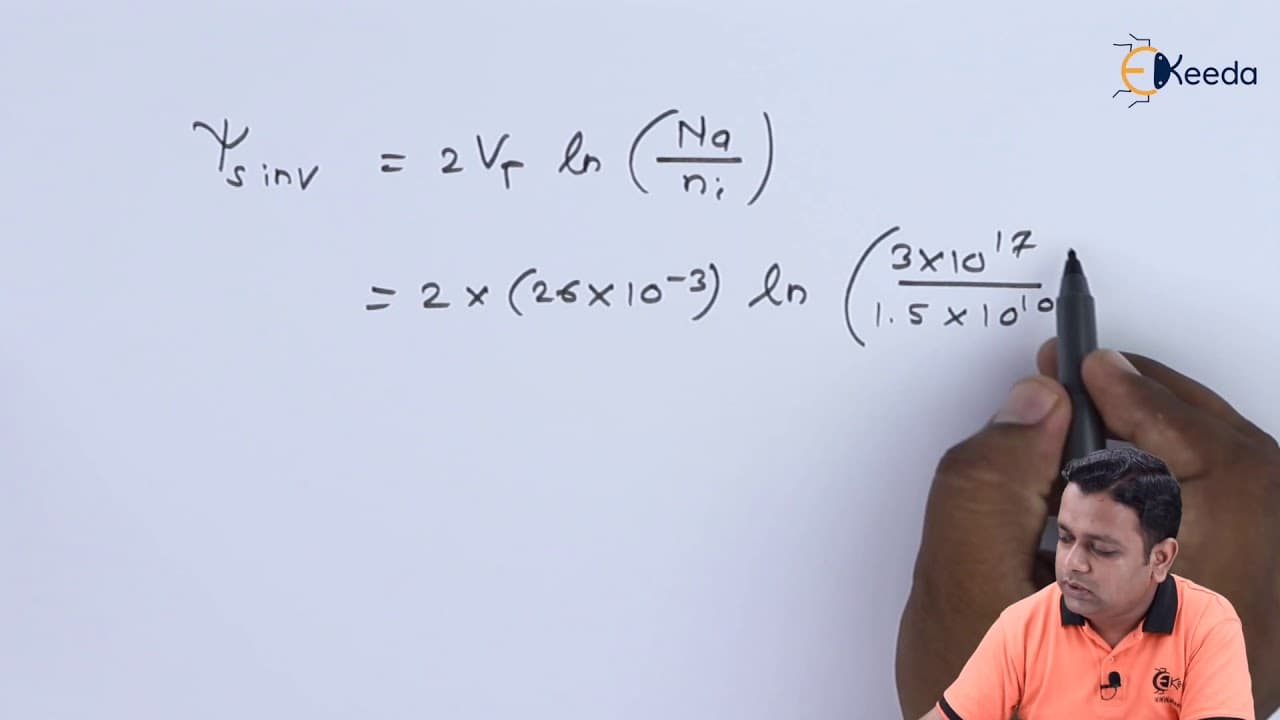
Q: How is the surface potential calculated for the strong inversion?
The surface potential can be calculated using the formula: surface potential = 2 * PT * ln(na/Ni), where PT is a constant, and na and Ni represent the doping concentrations.
Q: What is the formula for determining the insulator capacitance?
The insulator capacitance (C_I) is calculated by dividing the relative dielectric constant (epsilon_s) by the insulator depth (D).
Q: How is the threshold voltage determined in this analysis?
The threshold voltage (VT_H) is calculated using the formula: VT_H = sqrt(2 * VT_B / C_I * epsilon_s * Q * na * X_B), where VT_B is the surface potential at the strong inversion.
Summary & Key Takeaways
-
The video covers the analysis of a MOSFET in microwave engineering, including understanding amplification phenomena and various transistor configurations.
-
The given problem statement involves calculating the surface potential, insulator capacitance, and threshold voltage for a specific MOSFET.
-
The video provides step-by-step instructions on solving the problem and obtaining the required values.
Read in Other Languages (beta)
Share This Summary 📚
Summarize YouTube Videos and Get Video Transcripts with 1-Click
Try YouTube Summary with ChatGPT & Claude or YouTube Transcript Generator
Explore More Summaries from Ekeeda 📚





Summarize YouTube Videos and Get Video Transcripts with 1-Click
Try YouTube Summary with ChatGPT & Claude or YouTube Transcript Generator