Understanding fractions as division | Fractions | 5th grade | Khan Academy
TL;DR
Multiplication and division have an inverse relationship, where multiplication can be seen as grouping objects and division can be seen as splitting objects into equal groups.
Transcript
When we were first exposed to multiplication and division, we saw that they had an inverse relationship. Or another way of thinking about it is that they can undo each other. So for example, if I had 2 times 4, one interpretation of this is I could have four groups of 2. So that is one group of 2, two groups of 2, three groups of 2, and four groups... Read More
Key Insights
- ✖️ Multiplication and division have an inverse relationship, where multiplication can be seen as grouping objects together and division as splitting objects into equal groups.
- ✖️ The relationship between multiplication and division can be applied to fractions, where multiplication and division can be used interchangeably.
- 🗂️ Dividing a numerator by a denominator will always give you the value of the fraction.
Install to Summarize YouTube Videos and Get Transcripts
Explore YouTube Video Summarizer or Get YouTube Transcript Extractor
Questions & Answers
Q: How can multiplication and division be seen as undoing each other?
Multiplication and division have an inverse relationship, where multiplication can be seen as grouping objects together and division can be seen as splitting objects into equal groups. This means that if you multiply two numbers and then divide the product by one of those numbers, you will get the other number.
Q: Can the relationship between multiplication and division be applied to fractions?
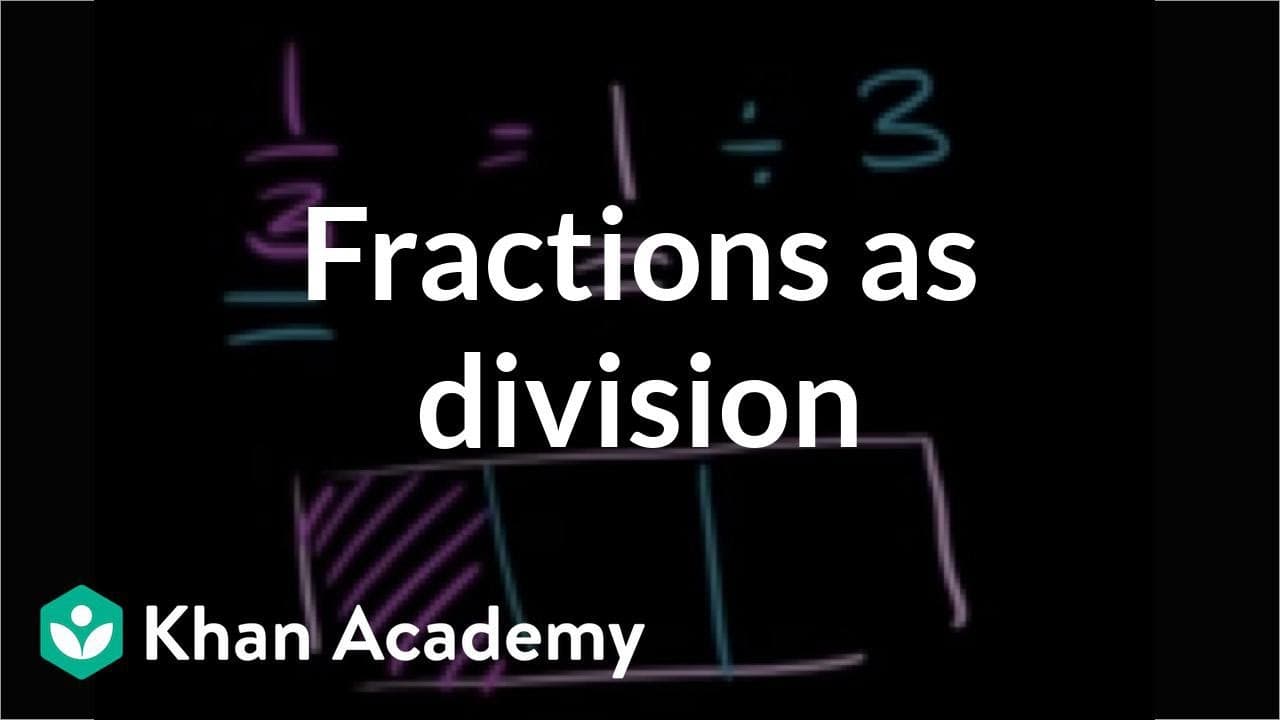
Yes, the relationship between multiplication and division applies to fractions as well. For example, if you multiply 1/3 by 3, you are essentially grouping three 1/3s together to get a whole. Similarly, if you divide 1 by 3, you will get 1/3, as you are dividing a whole into three equal sections.
Q: Is the numerator divided by the denominator always equal to the fraction?
Yes, the numerator divided by the denominator is always equal to the fraction. This is because the fraction symbol can be interpreted as division. So, for any fraction, dividing the numerator by the denominator will give you the value of the fraction.
Q: How does the relationship between multiplication and division apply to a different fraction, such as 3/4?
If you multiply 3/4 by 4, you are essentially grouping four 3/4s together, which results in three wholes. This means that 3 divided by 4 is equal to 3/4, as you are dividing three wholes into four equal groups.
Summary & Key Takeaways
-
Multiplication and division have an inverse relationship, where they can undo each other.
-
Multiplication can be visualized as grouping objects, while division can be visualized as splitting objects into equal groups.
-
This relationship applies to fractions as well, where multiplication and division can be used interchangeably.
Read in Other Languages (beta)
Share This Summary 📚
Summarize YouTube Videos and Get Video Transcripts with 1-Click
Try YouTube Summary with ChatGPT & Claude or YouTube Transcript Generator
Explore More Summaries from Khan Academy 📚



Summarize YouTube Videos and Get Video Transcripts with 1-Click
Try YouTube Summary with ChatGPT & Claude or YouTube Transcript Generator