Why Australia bottles up its air
TL;DR
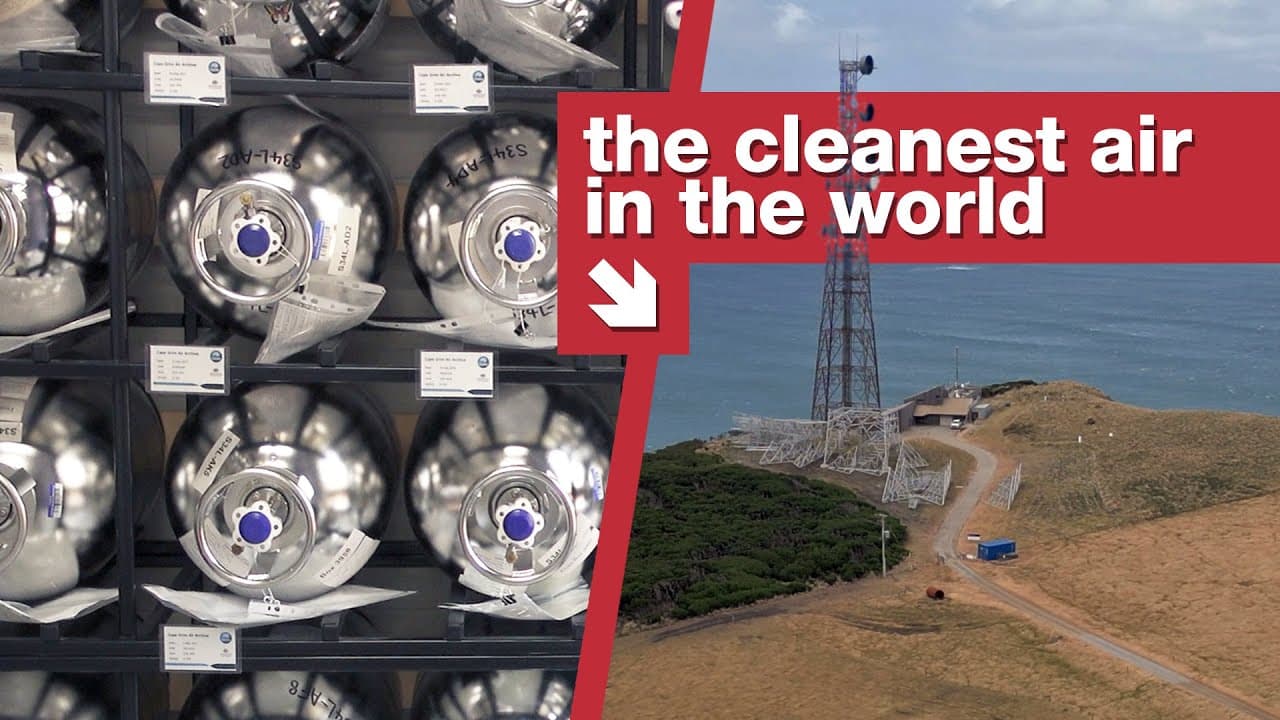
The Australian government agency, CSIRO, and the Bureau of Meteorology collect and store air samples from Tasmania's Cape Grim, which has the cleanest air in the world, to create an archive for future research on greenhouse gases and air quality.
Transcript
Every few months, a team from the Australian Government science agency, CSIRO, and the Australian Bureau of Meteorology will bottle up air from here, at the northern tip of Tasmania, and send it off to be archived. A few days ago, back on the Australian mainland, in a suburb of Melbourne, I interviewed one of the team at the Air Archive to explain ... Read More
Key Insights
- 💨 Cape Grim, Tasmania, has the cleanest air in the world when the winds blow from the south-west, without contamination from land or pollution sources.
- 🫢 The air archive is a valuable resource for studying and monitoring greenhouse gases, especially as most major sources of these gases are located in the northern hemisphere.
- 😒 Cryogenic storage allows for the pressurized tanks to be filled without the use of pumps, ensuring the air samples remain uncontaminated.
- 🫢 Tests on the air samples stored in the archive have helped build a historical record of greenhouse gases like CFCs and their replacements, providing important data for understanding their impact on the environment.
- 👱 The air archive includes air samples collected from old scuba tanks donated by the public, expanding the collection back to 1956.
- 🫢 The archive enables researchers to test old air samples using modern equipment, allowing them to study the composition and levels of trace gases with great precision.
- 👱 Regular measurements and analysis are conducted to ensure the air samples in the archive remain representative of the mid-latitudes of the Southern Hemisphere background air.
Install to Summarize YouTube Videos and Get Transcripts
Explore YouTube Video Summarizer or Get YouTube Transcript Extractor
Questions & Answers
Q: How is the air collected and stored in the archive?
Air samples are collected in pressurized tanks using a cryogenic method, where the air is cooled and compressed. The tanks are then stored without any additional drying to avoid contamination.
Q: How do researchers ensure that the air in the tanks remains unchanged over time?
Regular measurements and analysis are conducted on the air samples to ensure that there are no changes or drifts in the composition. Concerns about microbial contamination or chemical reactions are addressed through these tests.
Q: What is the purpose of the air archive?
The air samples in the archive can be used for future research on greenhouse gases and air quality. Researchers can access the archive to test for new contaminants or study historical levels of gases such as CFCs.
Q: How far back does the air archive go?
The air archive initially started in 1978 but has since expanded to include air samples dating back to 1956. Older scuba tanks donated by the public have contributed to this historic collection.
Key Insights:
- Cape Grim, Tasmania, has the cleanest air in the world when the winds blow from the south-west, without contamination from land or pollution sources.
- The air archive is a valuable resource for studying and monitoring greenhouse gases, especially as most major sources of these gases are located in the northern hemisphere.
- Cryogenic storage allows for the pressurized tanks to be filled without the use of pumps, ensuring the air samples remain uncontaminated.
- Tests on the air samples stored in the archive have helped build a historical record of greenhouse gases like CFCs and their replacements, providing important data for understanding their impact on the environment.
- The air archive includes air samples collected from old scuba tanks donated by the public, expanding the collection back to 1956.
- The archive enables researchers to test old air samples using modern equipment, allowing them to study the composition and levels of trace gases with great precision.
- Regular measurements and analysis are conducted to ensure the air samples in the archive remain representative of the mid-latitudes of the Southern Hemisphere background air.
- The air archive serves as an important resource for future research, as it allows scientists to study air quality and greenhouse gases without the need for new samples.
Summary & Key Takeaways
-
The Australian government collects air samples from Cape Grim, Tasmania, known for having the cleanest air in the world.
-
The air samples are stored in pressurized tanks and can be used for research on greenhouse gases and air quality.
-
The archive also includes old scuba tanks donated by the public, allowing researchers to study air samples dating back to 1956.
Read in Other Languages (beta)
Share This Summary 📚
Summarize YouTube Videos and Get Video Transcripts with 1-Click
Try YouTube Summary with ChatGPT & Claude or YouTube Transcript Generator
Explore More Summaries from Tom Scott 📚





Summarize YouTube Videos and Get Video Transcripts with 1-Click
Try YouTube Summary with ChatGPT & Claude or YouTube Transcript Generator