How Does a PN Junction Form in a Diode?
TL;DR
A PN junction forms when p-type and n-type semiconductor regions meet, creating a depletion region where charge carriers are depleted. This depletion region acts as a barrier to electron movement, requiring a specific voltage to allow electrons to cross. Understanding this formation is essential for grasping how diodes operate in electronic circuits.
Transcript
In our previous tutorials, we’ve discussed the basics of semiconductors, band gap, current carriers, and its classification. We learned that in order for a semiconductor material to be useful, it needs to be doped with an impurity atom and it could be a pentavalent atom to produce an n-type material or a trivalent atom to come up with a p-type mate... Read More
Key Insights
- 🅰️ Semiconductor materials need to be doped with impurity atoms to create p-type and n-type regions.
- 💁 A PN junction is formed at the boundary between the p and n regions of a semiconductor device.
- 🈶 The depletion region is created when free electrons from the n region combine with holes in the p region near the junction, resulting in a layer of positive and negative charges.
- 🧑🏭 The depletion region acts as a barrier to electron movement, due to the electric field created by the positive and negative charges.
- 👻 A certain amount of voltage, equal to the barrier potential, is required to allow electrons to overcome the barriers in the depletion region.
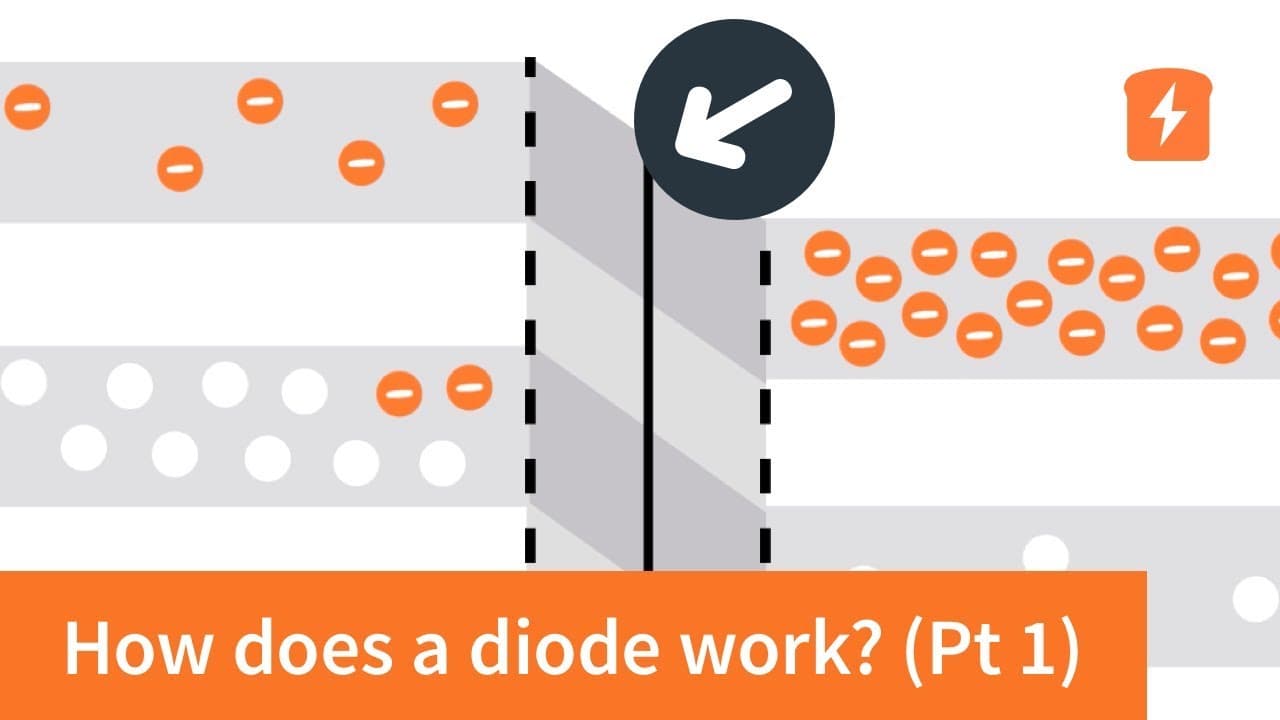
- 🥘 The energy levels in the n region are initially lower than in the p region, allowing temporary electron diffusion across the junction.
- 😵 As the depletion region forms, the energy levels align, creating an energy "hill" that electrons must overcome to cross the junction.
Install to Summarize YouTube Videos and Get Transcripts
Explore YouTube Video Summarizer or Get YouTube Transcript Extractor
Questions & Answers
Q: What is the purpose of doping a semiconductor material with impurity atoms?
Doping introduces extra charge carriers into the material, creating p-type and n-type regions that are necessary for the formation of a PN junction.
Q: How does a PN junction work as a barrier for electron movement?
The positive and negative charges in the depletion region create an electric field that blocks the free electrons from flowing across the junction, acting as a barrier.
Q: What happens when the depletion region is formed?
The depletion region expands until the total negative charge repels further diffusion of electrons into the p region, creating a region where charge carriers are depleted.
Q: How does the energy diagram of a PN junction change during formation?
Initially, the energy levels in the n region are noticeably lower than in the p region, allowing free electrons to temporarily cross the junction. But as the depletion region forms, the energy levels align and create a barrier for electron movement.
Key Insights:
- Semiconductor materials need to be doped with impurity atoms to create p-type and n-type regions.
- A PN junction is formed at the boundary between the p and n regions of a semiconductor device.
- The depletion region is created when free electrons from the n region combine with holes in the p region near the junction, resulting in a layer of positive and negative charges.
- The depletion region acts as a barrier to electron movement, due to the electric field created by the positive and negative charges.
- A certain amount of voltage, equal to the barrier potential, is required to allow electrons to overcome the barriers in the depletion region.
- The energy levels in the n region are initially lower than in the p region, allowing temporary electron diffusion across the junction.
- As the depletion region forms, the energy levels align, creating an energy "hill" that electrons must overcome to cross the junction.
- The energy diagram of a PN junction shows the changes in energy levels of the valence and conduction bands in the n and p regions during formation.
Summary & Key Takeaways
-
Semiconductor materials need to be doped with impurity atoms to create useful p-type and n-type regions.
-
A PN junction is formed at the boundary between the p and n regions, creating a depletion region where charge carriers are depleted.
-
The depletion region acts as a barrier to the movement of electrons across the junction, requiring a certain amount of voltage to overcome it.
Read in Other Languages (beta)
Share This Summary 📚
Summarize YouTube Videos and Get Video Transcripts with 1-Click
Try YouTube Summary with ChatGPT & Claude or YouTube Transcript Generator
Explore More Summaries from CircuitBread 📚
Summarize YouTube Videos and Get Video Transcripts with 1-Click
Try YouTube Summary with ChatGPT & Claude or YouTube Transcript Generator