How to Graph Sine and Cosine Functions with Ease
TL;DR
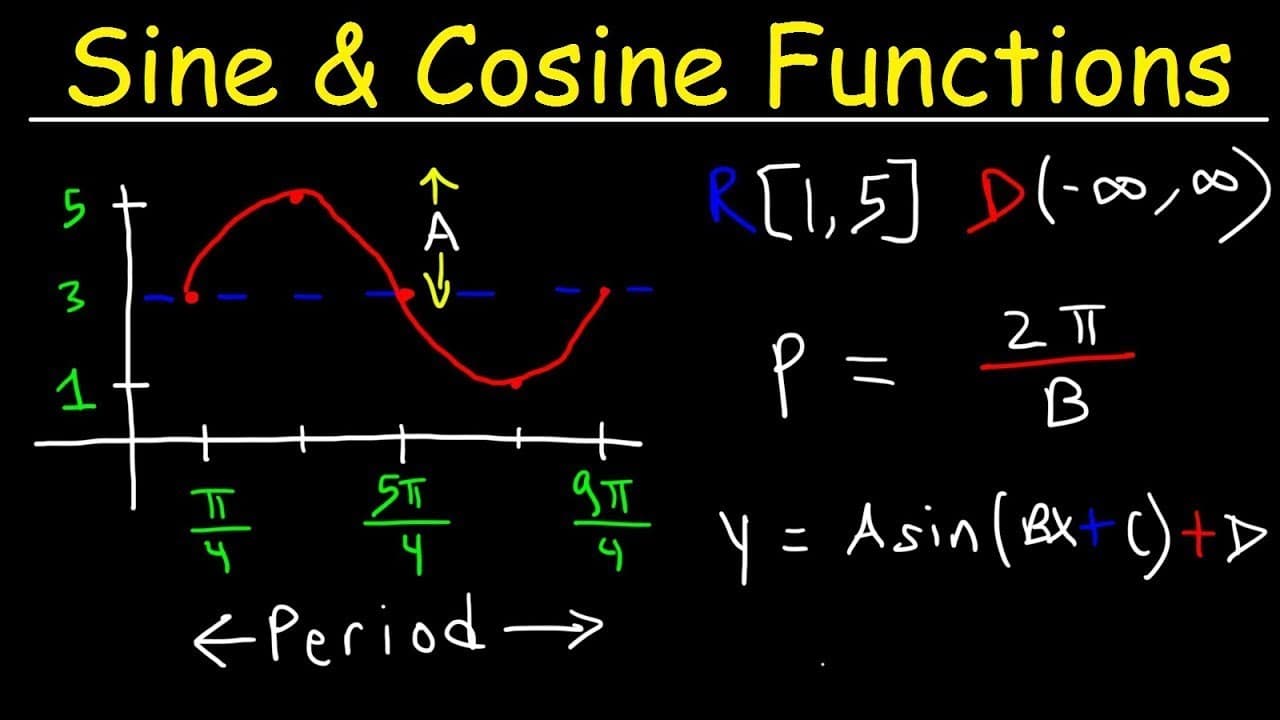
To graph sine and cosine functions, identify key parameters like amplitude and period. For one cycle, the sine function starts at the midline, peaks, descends back to the midline, and repeats, while cosine starts at the peak. A negative sign flips the graph over the x-axis, and the phase shift determines the wave's starting point.
Transcript
now let's talk about graphing trigonometric functions let's start with the sine function sine x sine x is basically a sinusoidal function it's a sine wave and that's how it looks like at least that's one period this ends at two pi that's one cycle of the wave now let's say if you put a negative in front of the sine function it's going to flip over ... Read More
Key Insights
- 🤪 Sine functions have a sinusoidal shape, starting at the center and going up, down, and then back to the center.
- ☺️ Negative sine functions flip the graph over the x-axis, starting from the origin.
- 🖕 Cosine functions start at the top, go to the middle, then to the bottom, and repeat.
- ❎ Negative cosine functions start from the bottom and follow a similar pattern as cosine.
- 👋 Amplitude determines the height of the wave, while the period determines how long it takes to complete a full cycle.
- 🚥 Fractions in the period formula result in horizontal stretching or compressing of the graph.
- 👈 Phase shifts define the starting point of the wave on the x-axis.
Install to Summarize YouTube Videos and Get Transcripts
Explore YouTube Video Summarizer or Get YouTube Transcript Extractor
Questions & Answers
Q: How does the amplitude affect the graph of a sine wave?
The amplitude, represented by "a" in the formula a*sin(bx), determines the height of the wave. A larger amplitude stretches the graph vertically, while a smaller amplitude compresses it.
Q: What is the domain and range of a sine or cosine wave?
The domain is all real numbers, while the range is determined by the amplitude. For example, a sine wave with an amplitude of 1 will have a range from -1 to 1.
Q: How can we find the period of a sine or cosine function?
The period, represented by "b" in the formula a*sin(bx), is found by dividing 2π by the value of "b."
Q: What is the effect of a phase shift on a sine or cosine wave?
A phase shift, represented by "c" in the formula a*sin(bx+c), determines the horizontal shift of the graph. It starts the wave at a specific point on the x-axis.
Summary & Key Takeaways
-
Trigonometric functions, such as sine and cosine, can be graphed to show their patterns and behaviors.
-
One period of a sine function starts at the center, goes up to the peak, back down to the center, and then repeats. A negative sign flips the graph over the x-axis.
-
One period of a cosine function starts at the top, goes to the middle, then down to the bottom, and repeats. A negative sign flips the graph over the x-axis.
Read in Other Languages (beta)
Share This Summary 📚
Summarize YouTube Videos and Get Video Transcripts with 1-Click
Try YouTube Summary with ChatGPT & Claude or YouTube Transcript Generator
Explore More Summaries from The Organic Chemistry Tutor 📚
Summarize YouTube Videos and Get Video Transcripts with 1-Click
Try YouTube Summary with ChatGPT & Claude or YouTube Transcript Generator