How to Calculate the Transfer Function in Control Systems
TL;DR
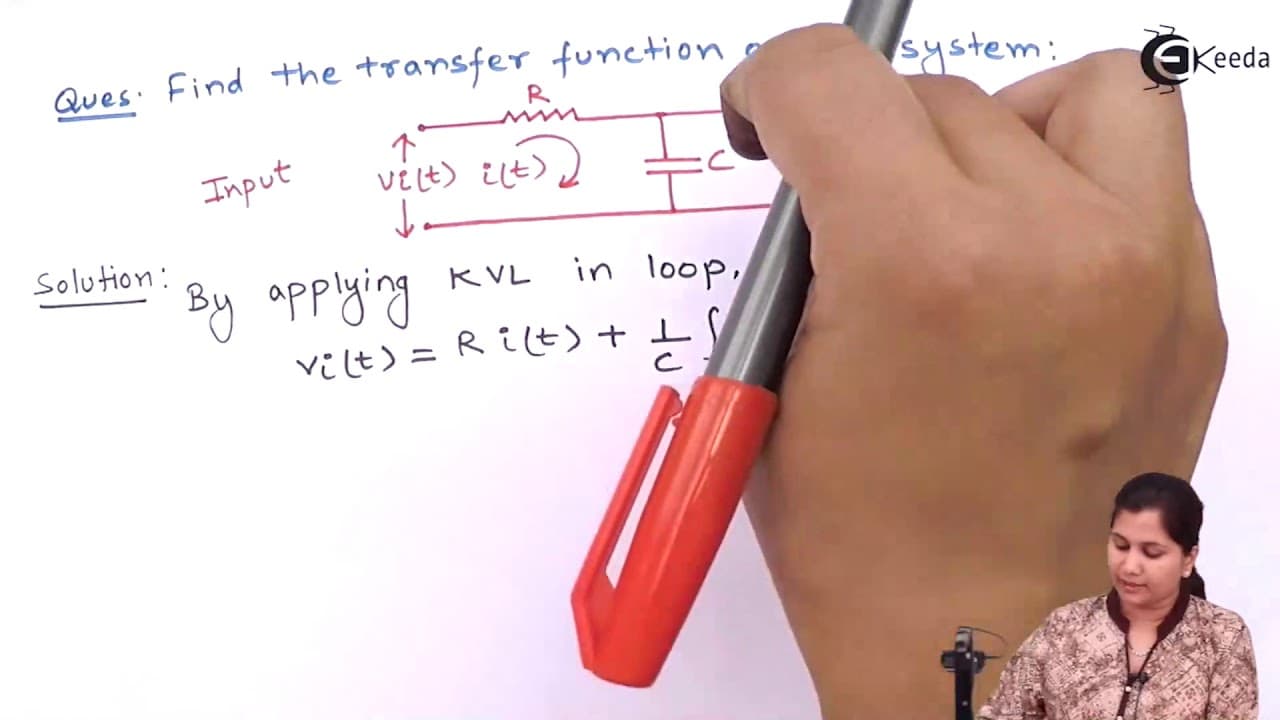
To calculate the transfer function of a control system, use Kirchoff's voltage law to derive the equations for input and output voltages, then apply Laplace transforms. The resulting transfer function generally takes the form 1/(1+sCR), where CR represents the system's time constant, crucial for analyzing system response and stability.
Transcript
hello friends in this video we are going to solve a problem on finding the transfer function of a system so this is the question and we have to find out the transfer function of the system the circuit is given to us so this is the current flowing in the circuit that is id so for finding the transfer function first determine that what is your input ... Read More
Key Insights
- 👮 The transfer function of a system can be found by applying Kirchoff's voltage law and Laplace transforms.
- ⚡ Kirchoff's voltage law is used to derive equations for the input and output voltages of the circuit.
- 🥡 The Laplace transforms of these equations are then taken to find the transfer function.
- 😑 The transfer function is expressed as 1/(1+scr), with scr representing the time constant of the system.
- 🐎 The time constant determines the speed at which the system responds to changes in the input.
- 🎮 The transfer function is a valuable tool for analyzing and designing control systems.
- ❓ The transfer function provides insights into the frequency response and stability of the system.
Install to Summarize YouTube Videos and Get Transcripts
Explore YouTube Video Summarizer or Get YouTube Transcript Extractor
Questions & Answers
Q: What is Kirchoff's voltage law?
Kirchoff's voltage law states that in a closed loop, the sum of the voltages is equal to zero. In the video, this law is applied to derive equations for the input and output voltages of the circuit.
Q: What are Laplace transforms used for?
Laplace transforms are mathematical tools that allow us to solve differential equations in the frequency domain. In this video, Laplace transforms are applied to the equations derived from Kirchoff's voltage law to find the transfer function of the system.
Q: How is the transfer function defined?
The transfer function is defined as the ratio of the Laplace transform of the output voltage to the Laplace transform of the input voltage. In this video, the transfer function is found to be 1/(1+scr), where scr is the time constant of the system.
Q: What is the significance of the time constant in the transfer function?
The time constant represents the time it takes for the system to reach approximately 63.2% of its final value in response to a step input. It plays a crucial role in determining the behavior and stability of the system.
Summary & Key Takeaways
-
The video demonstrates how to use Kirchoff's voltage law to derive equations for the input and output voltages of a circuit.
-
The Laplace transforms of these equations are then used to calculate the transfer function of the system.
-
The transfer function is found to be 1/(1+scr), where scr is the time constant of the system.
Read in Other Languages (beta)
Share This Summary 📚
Summarize YouTube Videos and Get Video Transcripts with 1-Click
Try YouTube Summary with ChatGPT & Claude or YouTube Transcript Generator
Explore More Summaries from Ekeeda 📚





Summarize YouTube Videos and Get Video Transcripts with 1-Click
Try YouTube Summary with ChatGPT & Claude or YouTube Transcript Generator