Products
Features
YouTube Video Summarizer
Summarize YouTube videos
Web & PDF Highlighter
Highlight web pages & PDFs
Chat with PDF
Ask any PDF questions with AI
Ask AI Clone
Chat with your highlights & memories
Audio Transcriber
Transcribe audio files to text
Glasp Reader
Read and highlight articles
Kindle Highlight Export
Export your Kindle highlights
Idea Hatch
Hatch ideas from your highlights
Integrations
Obsidian Plugin
Notion Integration
Pocket Integration
Instapaper Integration
Medium Integration
Readwise Integration
Snipd Integration
Hypothesis Integration
Apps & Extensions
Chrome Extension
Safari Extension
Edge Add-ons
Firefox Add-ons
iOS App
Android App
Discover
Discover
Ideas
Discover new ideas and insights
Articles
Curated articles and insights
Books
Book recommendations by great minds
Posts
Essays and notes from readers
Quotes
Inspiring quotes collection
Videos
Curated videos and summaries
Explore Glasp
Glasp Newsletter
Weekly insights and updates
Glasp Talk
Interview series with great minds
Glasp Blog
Latest news and articles
Glasp Use Cases
Learn how others use Glasp
Build & Support
Glasp API
Access Glasp's API for developers
MCP Connector
Connect Glasp to Claude & ChatGPT
Community
Glasp Reddit Community
Students
Student discount and benefits
FAQs
Frequently Asked Questions
AboutPricing
DashboardLog inSign up

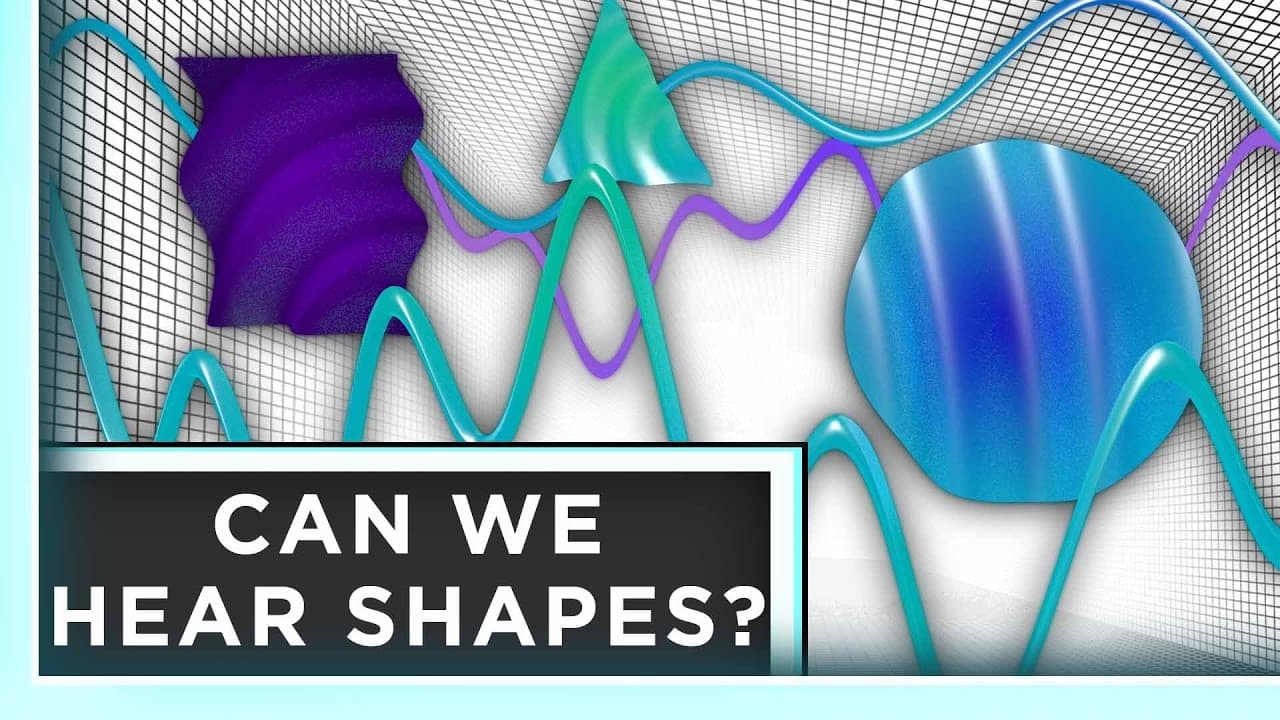
Can We Hear Shapes? | Infinite Series | PBS Digital Studios
156.6K views
•
December 22, 2016
by
PBS Infinite Series
YouTube video player
Can We Hear Shapes? | Infinite Series | PBS Digital Studios

TL;DR

Exploring how vibrations create sound through sine waves, harmonics, and Fourier series.

Transcript

[MUSIC PLAYING] Can you hear the shape of a drum? This question, can one hear the shape of a drum, was famously asked by mathematician Mark Kac in 1966 and eventually resolved in 1992. When he talked about a drum, he really meant a simple piece of fabric stretched over a fixed boundary without the cylindrical body attached to it. But before we get... Read More

Key Insights

  • 👋 Sound production relies on vibrating strings creating pure sine wave tones.
  • 🥌 Harmonics enhance the musical tones produced by vibrating strings.
  • 👋 Fourier series explains how all string vibrations are a sum of basic sine waves.
  • 🛢️ The shape of a drum influences the frequencies it produces.
  • 👋 Mathematical concepts like eigenvalues and eigenfunctions help simplify complex wave equations.
  • 🛢️ Two-dimensional drums can have multiple shapes that produce similar frequencies.
  • 👂 The mathematics behind sound production involves calculus equations and simplification.

Install to Summarize YouTube Videos and Get Transcripts

Explore YouTube Video Summarizer or Get YouTube Transcript Extractor

Questions & Answers

Q: How are sound waves produced through vibrating strings?

Sound waves are created by vibrating strings that generate simple wave shapes and pure tones, with the lowest frequency being the dominant sound.

Q: What role do harmonics play in creating musical tones?

Harmonics, higher frequencies related to the fundamental frequency, contribute to the overall pleasant musical tone produced by a vibrating string.

Q: How do sine waves and Fourier series relate to sound production?

Sine waves are the building blocks for all string vibrations, with Fourier series explaining how complex wave patterns are a combination of pure tones with different amplitudes.

Q: Can the shape of a drum affect the frequencies it produces?

Yes, the shape of a drum determines the frequencies it generates, which are a combination of component waves, allowing us to understand the sounds it makes.

Summary & Key Takeaways

  • The content delves into how simple wave shapes and sine waves form the basis of sound production.

  • It explains how musical tones are created through combinations of pure tones with harmonically-related frequencies.

  • The concept of Fourier series is introduced, highlighting how all string vibrations are a sum of basic sine waves.


Read in Other Languages (beta)

English

Share This Summary 📚

Summarize YouTube Videos and Get Video Transcripts with 1-Click

Download browser extensions on:

Try YouTube Summary with ChatGPT & Claude or YouTube Transcript Generator

Explore More Summaries from PBS Infinite Series 📚

Splitting Rent with Triangles | Infinite Series thumbnail
Splitting Rent with Triangles | Infinite Series
PBS Infinite Series
Higher-Dimensional Tic-Tac-Toe | Infinite Series thumbnail
Higher-Dimensional Tic-Tac-Toe | Infinite Series
PBS Infinite Series
This Video was Not Encrypted with RSA | Infinite Series thumbnail
This Video was Not Encrypted with RSA | Infinite Series
PBS Infinite Series
Voting Systems and the Condorcet Paradox | Infinite Series thumbnail
Voting Systems and the Condorcet Paradox | Infinite Series
PBS Infinite Series
What Is the Cops and Robbers Theorem in Graph Theory? thumbnail
What Is the Cops and Robbers Theorem in Graph Theory?
PBS Infinite Series
The Multiplication Multiverse | Infinite Series thumbnail
The Multiplication Multiverse | Infinite Series
PBS Infinite Series

Summarize YouTube Videos and Get Video Transcripts with 1-Click

Download browser extensions on:

Try YouTube Summary with ChatGPT & Claude or YouTube Transcript Generator

Apps & Extensions

  • Chrome Extension
  • Safari Extension
  • Edge Add-ons
  • Firefox Add-ons
  • iOS App
  • Android App

Key Features

  • YouTube Video Summarizer
  • Web & PDF Summarizer
  • Web & PDF Highlighter
  • Chat with PDF
  • Ask AI Clone
  • Audio Transcriber
  • Glasp Reader
  • Kindle Highlight Export
  • Idea Hatch

Integrations

  • Obsidian Plugin
  • Notion Integration
  • Pocket Integration
  • Instapaper Integration
  • Medium Integration
  • Readwise Integration
  • Snipd Integration
  • Hypothesis Integration

More Features

  • APIs
  • MCP Connector
  • Blog & Post
  • Embed Links
  • Image Highlight
  • Personality Test
  • Quote Shots

Company

  • About us
  • Blog
  • Community
  • FAQs
  • Job Board
  • Newsletter
  • Pricing
Terms

•

Privacy

•

Guidelines

© 2026 Glasp Inc. All rights reserved.