Products
Features
YouTube Video Summarizer
Summarize YouTube videos
Web & PDF Highlighter
Highlight web pages & PDFs
Chat with PDF
Ask any PDF questions with AI
Ask AI Clone
Chat with your highlights & memories
Audio Transcriber
Transcribe audio files to text
Glasp Reader
Read and highlight articles
Kindle Highlight Export
Export your Kindle highlights
Idea Hatch
Hatch ideas from your highlights
Integrations
Obsidian Plugin
Notion Integration
Pocket Integration
Instapaper Integration
Medium Integration
Readwise Integration
Snipd Integration
Hypothesis Integration
Apps & Extensions
Chrome Extension
Safari Extension
Edge Add-ons
Firefox Add-ons
iOS App
Android App
Discover
Discover
Ideas
Discover new ideas and insights
Articles
Curated articles and insights
Books
Book recommendations by great minds
Posts
Essays and notes from readers
Quotes
Inspiring quotes collection
Videos
Curated videos and summaries
Explore Glasp
Glasp Newsletter
Weekly insights and updates
Glasp Talk
Interview series with great minds
Glasp Blog
Latest news and articles
Glasp Use Cases
Learn how others use Glasp
Build & Support
Glasp API
Access Glasp's API for developers
MCP Connector
Connect Glasp to Claude & ChatGPT
Community
Glasp Reddit Community
Students
Student discount and benefits
FAQs
Frequently Asked Questions
AboutPricing
DashboardLog inSign up

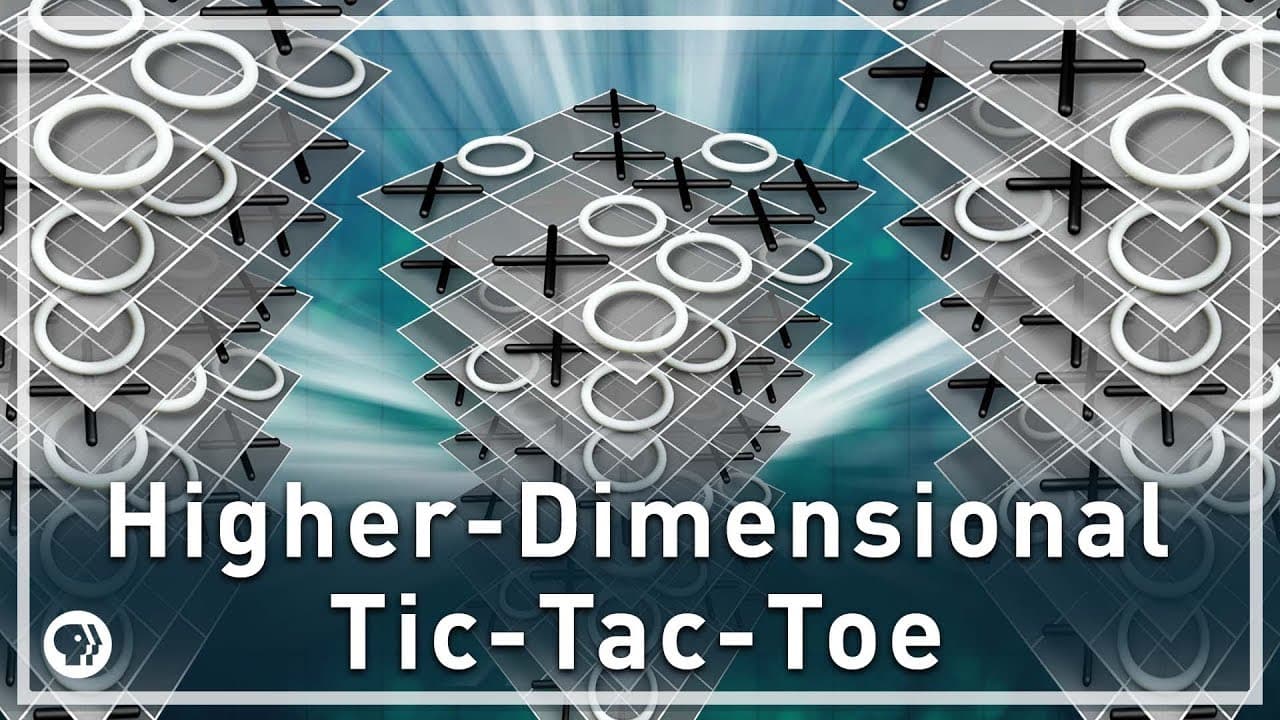
Higher-Dimensional Tic-Tac-Toe | Infinite Series
166.9K views
•
September 21, 2017
by
PBS Infinite Series
YouTube video player
Higher-Dimensional Tic-Tac-Toe | Infinite Series

TL;DR

Analyzing variations of Tic-Tac-Toe with increased dimensions and widths to determine optimal gameplay strategies.

Transcript

INSTRUCTOR: This episode is brought to you by Curiosity Stream. Regular tic-tac-toe can get a bit boring. If both players are playing optimally, it always ends in a draw. But what happens if you increase the width of the board, or increase the dimension of the board, or increase both? Tic-tac-toe is a classic game. Two players, x and o, take altern... Read More

Key Insights

  • 😉 Increasing board width creates more opportunities for first player wins.
  • 🥺 Optimal play leads to predictable outcomes in Tic-Tac-Toe variations.
  • 🎹 Strategic blocking is key to securing a draw in extended dimension boards.
  • 😉 The Hales-Jewett Theorem suggests eventual X wins in fixed width boards.
  • 🪄 Magic cutoffs remain a mathematical mystery in Tic-Tac-Toe theory.
  • 😉 Dimension increase favors X wins, while width increase aids in draws.
  • 🎮 Tic-Tac-Toe variations provide insights into combinatorial gameplay strategies.

Install to Summarize YouTube Videos and Get Transcripts

Explore YouTube Video Summarizer or Get YouTube Transcript Extractor

Questions & Answers

Q: How does increasing the width and dimension of the Tic-Tac-Toe board affect gameplay?

Increasing the width and dimension of the board creates more winning possibilities for the first player while making it easier for the second player to force a draw.

Q: Can a player force a win in a 5 by 5 Tic-Tac-Toe board under optimal play?

No, under optimal play, a 5 by 5 Tic-Tac-Toe game will always end in a draw, as there is no way for either player to force a win due to effective blocking strategies.

Q: What is the significance of the Hales-Jewett Theorem in the context of Tic-Tac-Toe?

The Hales-Jewett Theorem states that eventually, for a fixed width, there will be a dimension where the game cannot end in a draw, indicating a winning strategy for X.

Q: What is the open question regarding the magic cutoffs in Tic-Tac-Toe gameplay?

The open question concerns determining the exact dimension at which a board of a specific width switches from being a draw to a win for the first player, highlighting an ongoing mystery in Tic-Tac-Toe analysis.

Summary & Key Takeaways

  • Regular Tic-Tac-Toe is a draw with optimal play.

  • Increasing width and dimension of the board alters gameplay dynamics.

  • Winning strategies for players in different size Tic-Tac-Toe boards are explored.


Read in Other Languages (beta)

English

Share This Summary 📚

Summarize YouTube Videos and Get Video Transcripts with 1-Click

Download browser extensions on:

Try YouTube Summary with ChatGPT & Claude or YouTube Transcript Generator

Explore More Summaries from PBS Infinite Series 📚
Making Probability Mathematical | Infinite Series thumbnail
Making Probability Mathematical | Infinite Series
PBS Infinite Series
Singularities Explained | Infinite Series thumbnail
Singularities Explained | Infinite Series
PBS Infinite Series
Can a Chess Piece Explain Markov Chains? | Infinite Series thumbnail
Can a Chess Piece Explain Markov Chains? | Infinite Series
PBS Infinite Series
How to Break Cryptography | Infinite Series thumbnail
How to Break Cryptography | Infinite Series
PBS Infinite Series
Building an Infinite Bridge | Infinite Series thumbnail
Building an Infinite Bridge | Infinite Series
PBS Infinite Series
What Is the Cops and Robbers Theorem in Graph Theory? thumbnail
What Is the Cops and Robbers Theorem in Graph Theory?
PBS Infinite Series

Summarize YouTube Videos and Get Video Transcripts with 1-Click

Download browser extensions on:

Try YouTube Summary with ChatGPT & Claude or YouTube Transcript Generator

Apps & Extensions

  • Chrome Extension
  • Safari Extension
  • Edge Add-ons
  • Firefox Add-ons
  • iOS App
  • Android App

Key Features

  • YouTube Video Summarizer
  • Web & PDF Summarizer
  • Web & PDF Highlighter
  • Chat with PDF
  • Ask AI Clone
  • Audio Transcriber
  • Glasp Reader
  • Kindle Highlight Export
  • Idea Hatch

Integrations

  • Obsidian Plugin
  • Notion Integration
  • Pocket Integration
  • Instapaper Integration
  • Medium Integration
  • Readwise Integration
  • Snipd Integration
  • Hypothesis Integration

More Features

  • APIs
  • MCP Connector
  • Blog & Post
  • Embed Links
  • Image Highlight
  • Personality Test
  • Quote Shots

Company

  • About us
  • Blog
  • Community
  • FAQs
  • Job Board
  • Newsletter
  • Pricing
Terms

•

Privacy

•

Guidelines

© 2026 Glasp Inc. All rights reserved.