4 2 SDL on what a translation memory is
TL;DR
Translation memory is a database that stores previously translated segments and helps translators work faster and improve translation quality.
Transcript
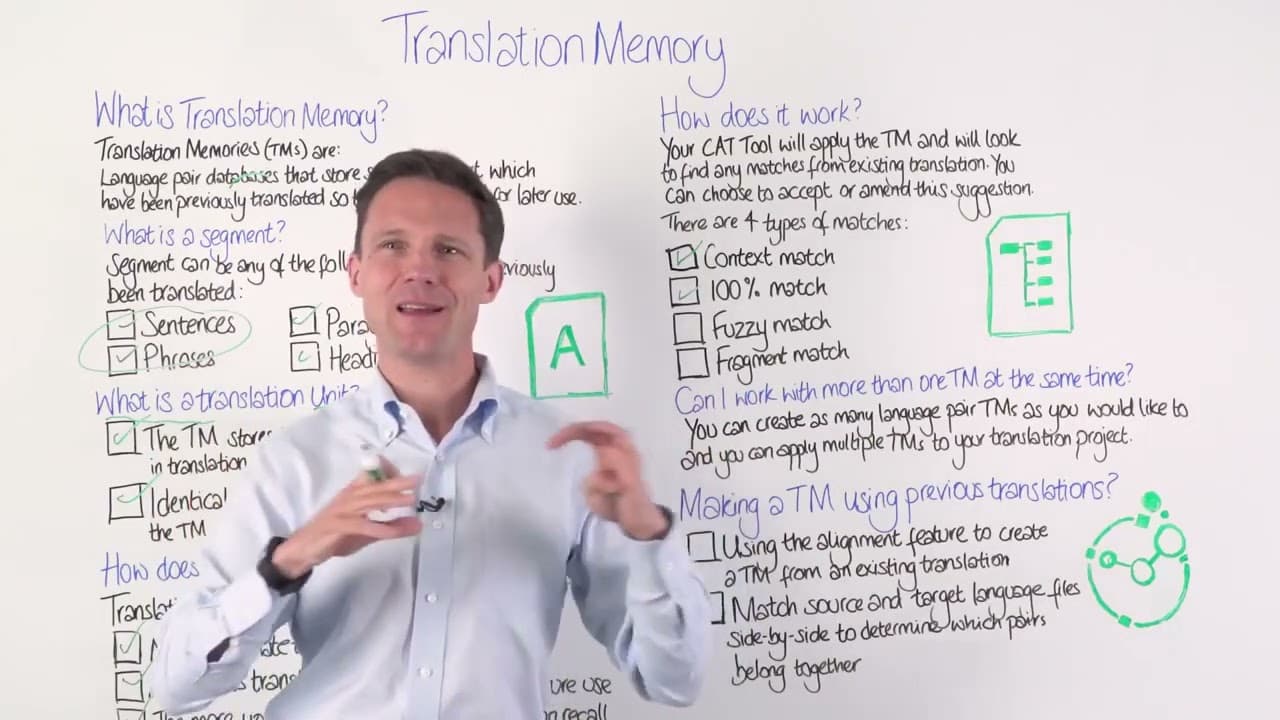
I'm Massimo from SDL. And today I'm here to talk about a translation memory. So what is a translation memory? It's a language pair database that stores a segments of text which had been previously translated. So they can be recalled for later use. I don't know how much sense this makes for you. So we're going to try to explain all of these few key ... Read More
Key Insights
- 🏪 Translation memory is a database that stores previously translated segments, such as sentences, phrases, and paragraphs.
- ⌛ It helps translators by suggesting similar translations for sentences they have translated before, saving time and ensuring consistency in translation quality.
- 🏪 Different types of matches, such as context matches, 100% matches, fuzzy matches, and fragment matches, determine the level of similarity between a current translation sentence and stored segments in the translation memory.
- 💦 Translation memories can be used across various languages and can quickly build up as translators continue to work.
- 👻 Alignment tools allow translators to create a translation memory from their existing translations, even if they were done manually.
- 👍 Translation memory improves translation efficiency by eliminating the need to translate the same sentence multiple times and providing previously approved and quality translations for reuse.
- ⚾ Translation memories can be prioritized based on project requirements and can be used simultaneously to maximize match possibilities.
Install to Summarize YouTube Videos and Get Transcripts
Explore YouTube Video Summarizer or Get YouTube Transcript Extractor
Questions & Answers
Q: What is a translation memory?
A translation memory is a database that stores previously translated segments of text, such as sentences, phrases, and paragraphs, for future use.
Q: How does translation memory help translators?
Translation memory suggests similar translations for sentences that have been translated before, saving time and ensuring consistency in translation quality.
Q: What are the different types of matches in translation memory?
The different types of matches in translation memory are context matches, 100% matches, fuzzy matches, and fragment matches, each providing varying levels of similarity to the current translation sentence.
Q: Can multiple translation memories be used simultaneously?
Yes, multiple translation memories can be used simultaneously, and a CAT tool can prioritize certain memories over others based on the project requirements.
Summary & Key Takeaways
-
Translation memory is a database that stores previously translated segments of text, such as sentences, phrases, and paragraphs.
-
It helps translators by suggesting similar translations for sentences they have translated before, saving time and ensuring consistency.
-
Different types of matches, including context matches, 100% matches, fuzzy matches, and fragment matches, help translators find the most suitable translation for each sentence.
Read in Other Languages (beta)
Share This Summary 📚
Summarize YouTube Videos and Get Video Transcripts with 1-Click
Try YouTube Summary with ChatGPT & Claude or YouTube Transcript Generator
Explore More Summaries from Anthony Pym 📚



Summarize YouTube Videos and Get Video Transcripts with 1-Click
Try YouTube Summary with ChatGPT & Claude or YouTube Transcript Generator