Probability Formulas, Symbols & Notations - Marginal, Joint, & Conditional Probabilities
TL;DR
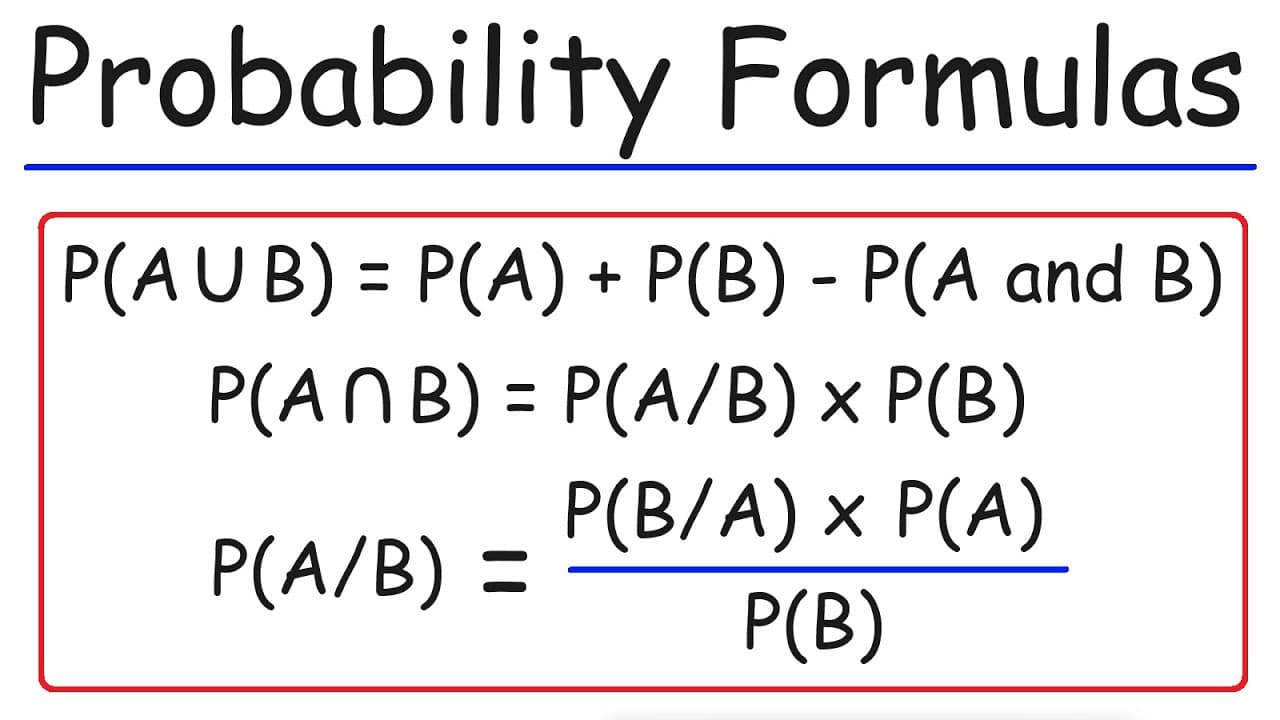
Learn about various probability formulas and concepts, including marginal probability, union probability, joint probability, conditional probability, negation probability, and independent and dependent events.
Transcript
in this video I want to give you all of the formulas that you need to know if you're learning probability in school we're going to talk about the different types of symbols and notations you need to be familiar with as well as the different types of probabilities that are out there like marginal probability Union probability joint probability condi... Read More
Key Insights
- 🇪🇺 Probability calculations often involve formulas such as marginal probability, union probability, joint probability, conditional probability, and negation probability.
- ❓ Events can be independent, meaning the probability of one event does not affect the probability of another, or dependent, meaning the probability of one event is influenced by the occurrence of another.
- 📏 Formulas such as Bayes' theorem and the addition and multiplication rules are used to calculate probabilities in different scenarios.
- ❓ The complement of an event, known as negation probability, can be calculated by subtracting the probability of the event from 1.
Install to Summarize YouTube Videos and Get Transcripts
Explore YouTube Video Summarizer or Get YouTube Transcript Extractor
Questions & Answers
Q: What is marginal probability?
Marginal probability is the probability of a single event occurring independently of other events. It is calculated by dividing the number of successful outcomes by the total number of possible outcomes.
Q: How do you calculate union probability?
Union probability is the probability that either event A or event B will occur, or both. It is calculated by adding the number of elements in event A to the number of elements in event B, without counting any shared elements twice.
Q: What is the difference between independent and dependent events?
Independent events are events that do not depend on each other, meaning the probability of one event occurring does not affect the probability of the other event. Dependent events, on the other hand, are events whose probability is affected by the occurrence of another event.
Q: How do you calculate conditional probability?
Conditional probability is the probability of event A occurring given that event B has already occurred. It is calculated by dividing the joint probability of events A and B by the marginal probability of event B.
Summary & Key Takeaways
-
Marginal probability is the probability of a single event occurring independently of other events.
-
Union probability is the probability that either event A or event B will occur, or both.
-
Joint probability is the probability that both events A and B will occur simultaneously.
-
Conditional probability is the probability of event A occurring given that event B has already occurred.
-
Negation probability is the probability of the complement of an event occurring.
-
Independent events are events that do not depend on each other, while dependent events do.
Read in Other Languages (beta)
Share This Summary 📚
Summarize YouTube Videos and Get Video Transcripts with 1-Click
Try YouTube Summary with ChatGPT & Claude or YouTube Transcript Generator
Explore More Summaries from The Organic Chemistry Tutor 📚



Summarize YouTube Videos and Get Video Transcripts with 1-Click
Try YouTube Summary with ChatGPT & Claude or YouTube Transcript Generator