Extreme value theorem | Existence theorems | AP Calculus AB | Khan Academy
TL;DR
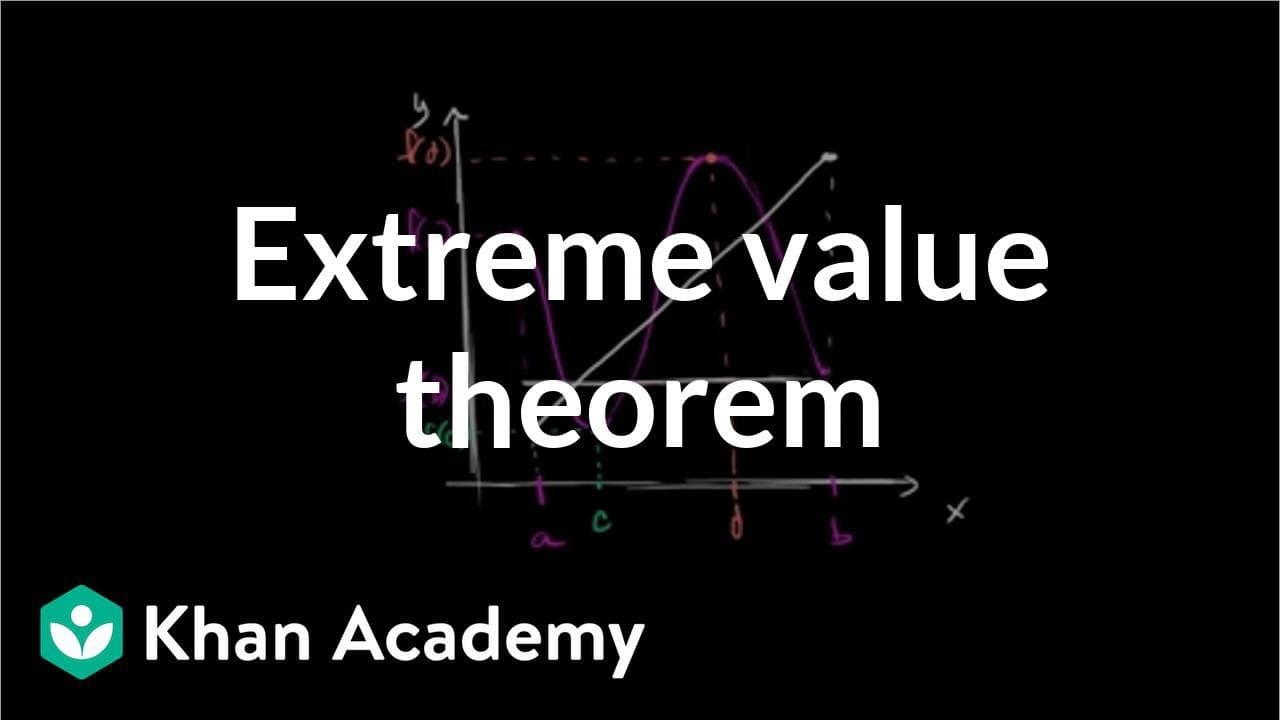
The Extreme Value Theorem states that if a function is continuous over a closed interval, there will exist an absolute maximum and minimum value for that function within the interval.
Transcript
So we'll now think about the extreme value theorem. Which we'll see is a bit of common sense. But in all of these theorems it's always fun to think about the edge cases. Why is it laid out the way it is? And that might give us a little bit more intuition about it. So the extreme value theorem says if we have some function that is continuous over a ... Read More
Key Insights
- 😚 The Extreme Value Theorem guarantees the existence of absolute maximum and minimum values for a continuous function over a closed interval.
- 📈 Continuity is important because it ensures a smooth and connected graph without abrupt changes.
- 😚 Including the endpoints in the closed interval allows for consideration of the values at these points as potential extreme values.
- 🚱 A non-continuous function may not have a well-defined or easily identifiable maximum or minimum value within the interval.
Install to Summarize YouTube Videos and Get Transcripts
Explore YouTube Video Summarizer or Get YouTube Transcript Extractor
Questions & Answers
Q: What is the Extreme Value Theorem?
The Extreme Value Theorem states that a continuous function over a closed interval will have an absolute maximum and minimum value within that interval.
Q: Why does the continuity of the function matter?
Continuity ensures that there are no abrupt jumps or breaks in the function, allowing for a clear identification of the maximum and minimum values within the interval.
Q: Why is it necessary to have a closed interval?
A closed interval includes the endpoints, making them candidates for the absolute maximum and minimum values, providing a complete picture of the function within the interval.
Q: Can you provide an example of a non-continuous function?
A non-continuous function over a closed interval would make it difficult or impossible to determine an absolute maximum or minimum value. One example could be a function that is undefined at certain points within the interval.
Summary & Key Takeaways
-
The Extreme Value Theorem states that for a continuous function over a closed interval, there will always be an absolute maximum and minimum value.
-
This theorem helps us understand the existence of extreme values within a given interval.
-
The continuity of the function and inclusion of the interval's endpoints are crucial in determining the absolute maximum and minimum values.
Read in Other Languages (beta)
Share This Summary 📚
Summarize YouTube Videos and Get Video Transcripts with 1-Click
Try YouTube Summary with ChatGPT & Claude or YouTube Transcript Generator
Explore More Summaries from Khan Academy 📚



Summarize YouTube Videos and Get Video Transcripts with 1-Click
Try YouTube Summary with ChatGPT & Claude or YouTube Transcript Generator