Why this red state made preschool free
TL;DR
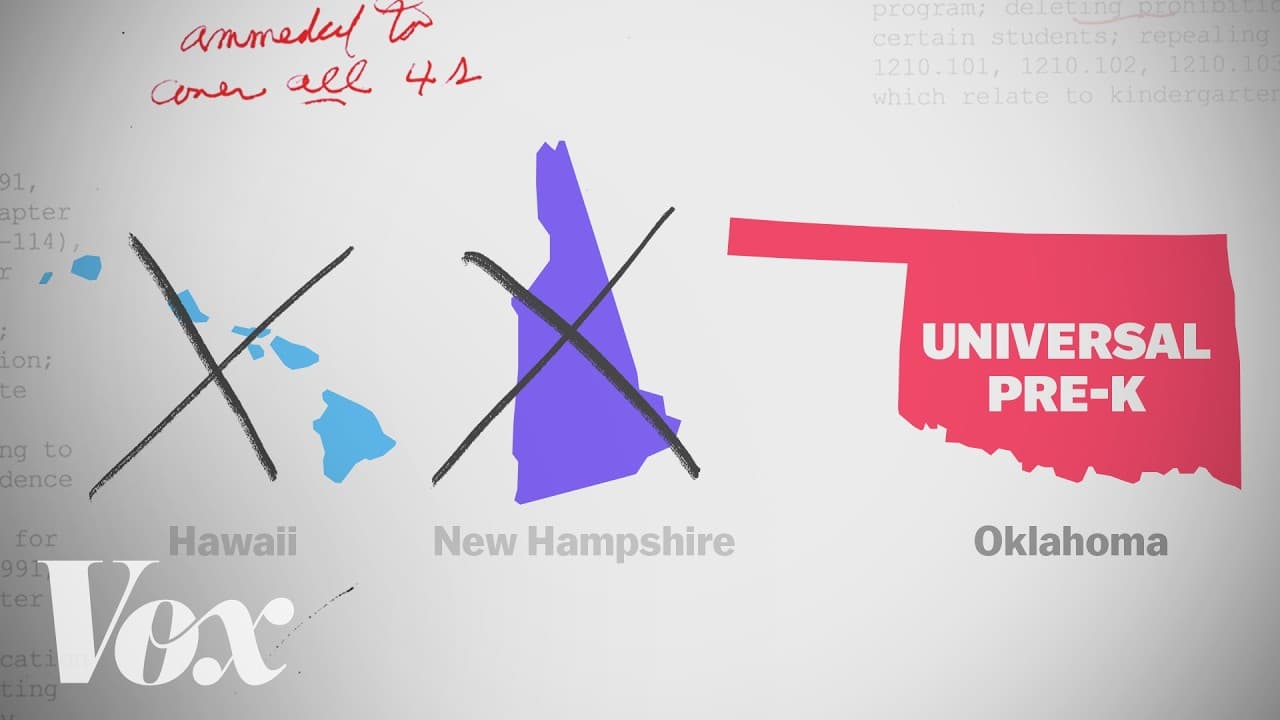
Oklahoma offers free, high-quality pre-K, setting a model for others.
Transcript
In the US, free public school typically has 13 grades and begins with kindergarten at age five. It's been this way for a long time, but some say that free public school should start at age four – universal pre-K. Free or cheap education for four-year-olds is already a reality in many wealthy countries around the world. But in the US, universal pre-... Read More
Key Insights
- Oklahoma's universal pre-K program is a pioneering initiative in a conservative state, offering free, high-quality education for four-year-olds since 1998.
- The program was implemented through strategic political maneuvering, leveraging a loophole in kindergarten funding laws to incentivize the inclusion of four-year-olds.
- Oklahoma's approach contrasts with most US states, where pre-K programs prioritize low-income families and are not universally available.
- The integration of Head Start with public schools in Oklahoma ensures resource sharing and a seamless transition for children into elementary education.
- Decades of research highlight the benefits of early childhood education, showing improved school readiness and social skills among participants.
- The private childcare industry often opposes universal pre-K due to potential financial impacts, as four-year-olds are a profitable age group.
- Oklahoma's program succeeded without bankrupting private childcare centers by allowing schools to contract with existing providers, ensuring standards are met.
- Despite political differences, Oklahoma's universal pre-K is widely accepted and celebrated, with potential expansion to include three-year-olds being considered.
Install to Summarize YouTube Videos and Get Transcripts
Explore YouTube Video Summarizer or Get YouTube Transcript Extractor
Questions & Answers
Q: How did Oklahoma manage to implement universal pre-K?
Oklahoma implemented universal pre-K through strategic political maneuvering, exploiting a loophole in the kindergarten funding law. This allowed school districts to double their funding by offering two half-day programs, incentivizing the inclusion of four-year-olds. The program was presented as voluntary, avoiding opposition and ensuring its passage.
Q: What role did Head Start play in Oklahoma's pre-K program?
In Oklahoma, Head Start schools are closely linked with public elementary schools, sharing resources and facilities. This integration ensures a seamless transition for children and maximizes educational benefits. The collaboration with Head Start helped maintain high standards and provided a model for other states to follow.
Q: Why is universal pre-K controversial among private childcare providers?
Universal pre-K is controversial among private childcare providers because four-year-olds are a profitable age group due to lower teacher-to-child ratios. Removing them from private care can threaten the financial viability of these centers, as they subsidize the more expensive care required for younger children.
Q: What are the benefits of early childhood education according to research?
Research indicates that early childhood education offers numerous benefits, including improved school readiness, better social skills, and long-term academic success. Children who participate in high-quality pre-K programs are better prepared for kindergarten and exhibit enhanced cognitive and emotional development.
Q: How did Oklahoma's pre-K program affect the community?
Oklahoma's pre-K program positively impacted the community by providing accessible early education, improving school readiness, and supporting working parents with childcare needs. The program's success fostered community pride and demonstrated the benefits of investing in early childhood education, leading to broad acceptance across political lines.
Q: What challenges do states face in implementing universal pre-K?
States face several challenges in implementing universal pre-K, including securing funding, constructing new facilities, and hiring qualified teachers. Additionally, political opposition and concerns from private childcare providers can hinder progress. However, Oklahoma's success shows that strategic planning and community support can overcome these obstacles.
Q: Why did Oklahoma's pre-K program receive bipartisan support?
Oklahoma's pre-K program received bipartisan support due to its demonstrated success in improving educational outcomes and community well-being. The program was carefully presented to avoid political controversy, focusing on its benefits rather than ideological differences, leading to widespread acceptance and support.
Q: What future expansions are being considered for Oklahoma's pre-K program?
Oklahoma is considering expanding its pre-K program to include three-year-olds, although this proposal faces challenges due to potential impacts on private childcare centers. The fact that a Republican lawmaker introduced the expansion bill highlights the program's success and acceptance, suggesting a promising future for early childhood education in the state.
Summary & Key Takeaways
-
Oklahoma's universal pre-K program, established in 1998, offers free, high-quality education to four-year-olds, setting a model for other states. The program was implemented through strategic political maneuvering and has been widely accepted across the political spectrum.
-
The integration of Head Start with public schools in Oklahoma ensures resource sharing and a seamless transition for children into elementary education. Research shows that early childhood education improves school readiness and social skills, benefiting children long-term.
-
Despite initial concerns from the private childcare industry, Oklahoma's program succeeded without financial detriment to these centers. The program's success has led to discussions about expanding it to include three-year-olds, highlighting its broad acceptance and effectiveness.
Read in Other Languages (beta)
Share This Summary 📚
Summarize YouTube Videos and Get Video Transcripts with 1-Click
Try YouTube Summary with ChatGPT & Claude or YouTube Transcript Generator
Explore More Summaries from Vox 📚


Summarize YouTube Videos and Get Video Transcripts with 1-Click
Try YouTube Summary with ChatGPT & Claude or YouTube Transcript Generator