Intro to Dense Vectors for NLP and Vision
TL;DR
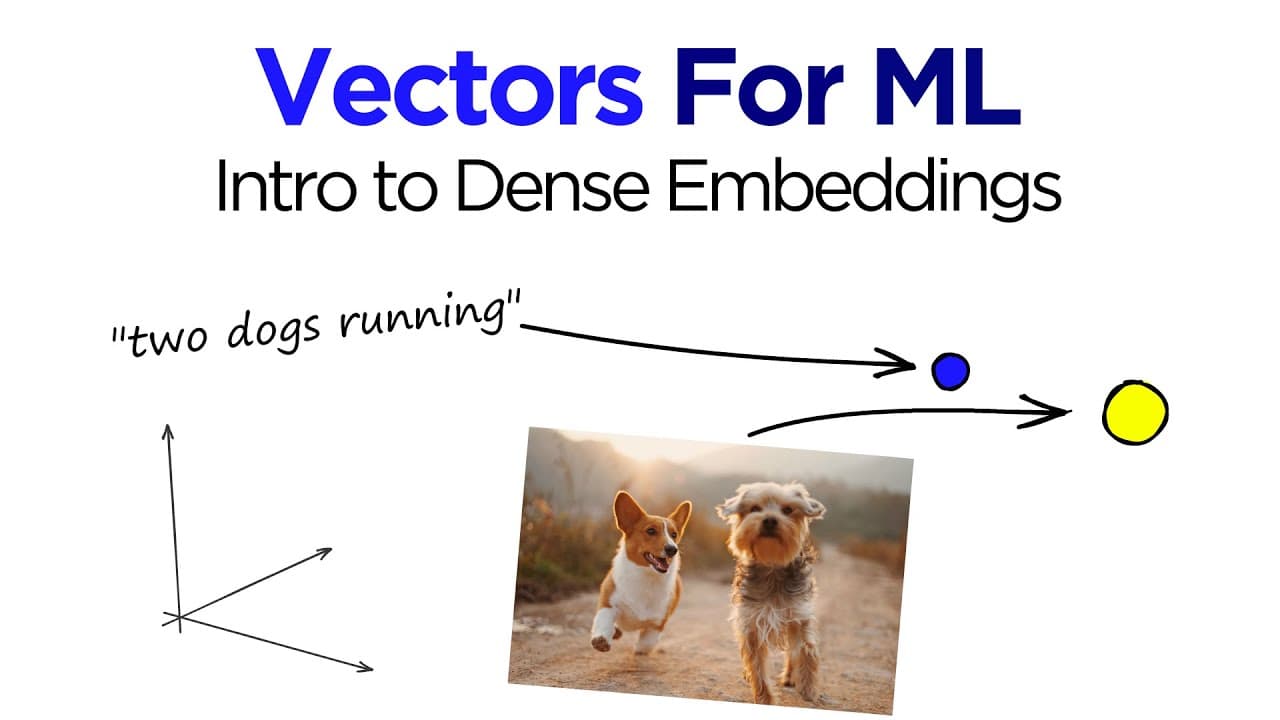
This video provides an overview of embedding methods, focusing on dense vectors and embeddings for NLP, sentence embeddings, dense passage retrievers, and image-text embeddings using the vision transformer.
Transcript
and welcome to this video we're going to start a new series on embedding methods for for nlp but we're also going to have a look at other embedding methods as well so mainly we're going to be focusing on on language dents and beddings we might have look at sparse embeddings but we've already covered that before so i'm not 100 sure on that but defin... Read More
Key Insights
- 🔑 Dense vectors provide a numerical representation of the semantic meaning behind text, while sparse vectors are more focused on the syntax and individual words.
- 🔑 Word embeddings, like Word2Vec, cluster similar words together in a high-dimensional space, allowing for arithmetic operations on words.
- ❓ Sentence embeddings enable the representation of whole sentences or paragraphs as dense vectors, facilitating comparisons and similarity calculations.
- ⁉️ Facebook AI's Dense Passage Retriever (DPR) combines question and context encoders to efficiently retrieve relevant passages for question-answering tasks.
Install to Summarize YouTube Videos and Get Transcripts
Explore YouTube Video Summarizer or Get YouTube Transcript Extractor
Questions & Answers
Q: How are dense vectors different from sparse vectors in representing text?
Sparse vectors focus on syntax and individual words, making it difficult to capture the semantic meaning of text. Dense vectors, on the other hand, represent the semantic meaning and can effectively compare the semantics of different sentences, even if they have no shared words.
Q: What is the purpose of sentence embeddings?
Sentence embeddings represent a whole sentence or paragraph as a dense vector, allowing for comparison and similarity calculations between sentences based on their meaning. This is useful for tasks like sentence similarity, question-answering, and dense passage retrieval.
Q: How does Facebook AI's Dense Passage Retriever (DPR) work?
DPR uses two parallel encoders, a question encoder, and a context encoder, trained together to map questions and contexts into a shared vector space. It then retrieves the most similar context for a given question, enabling efficient question-answering.
Q: What is the application of the vision transformer in image-text embeddings?
The vision transformer can be used to encode images and captions into a shared vector space. By training them together, we can compare images and captions based on their similarity, allowing for tasks such as image retrieval or generating captions for images.
Key Insights:
- Dense vectors provide a numerical representation of the semantic meaning behind text, while sparse vectors are more focused on the syntax and individual words.
- Word embeddings, like Word2Vec, cluster similar words together in a high-dimensional space, allowing for arithmetic operations on words.
- Sentence embeddings enable the representation of whole sentences or paragraphs as dense vectors, facilitating comparisons and similarity calculations.
- Facebook AI's Dense Passage Retriever (DPR) combines question and context encoders to efficiently retrieve relevant passages for question-answering tasks.
- The vision transformer can be used to create embeddings for images and captions, allowing for cross-media comparisons and tasks such as image retrieval or caption generation.
Summary & Key Takeaways
-
The video discusses the use of dense vectors as a numerical representation of the semantic meaning behind text, and how they are more effective than sparse vectors for capturing the semantics of text.
-
It introduces word embeddings like Word2Vec and shows how similar words are clustered together in a high-dimensional space.
-
The video explains sentence embeddings and demonstrates how to build them using the Sentence Transformers library.
-
It explores question answering using Facebook AI's Dense Passage Retriever (DPR) and covers the code implementation.
-
Lastly, it discusses the application of the vision transformer for image-text embeddings and provides a demonstration using the CLIP model.
Read in Other Languages (beta)
Share This Summary 📚
Summarize YouTube Videos and Get Video Transcripts with 1-Click
Try YouTube Summary with ChatGPT & Claude or YouTube Transcript Generator
Explore More Summaries from James Briggs 📚




Summarize YouTube Videos and Get Video Transcripts with 1-Click
Try YouTube Summary with ChatGPT & Claude or YouTube Transcript Generator