Numerical on Voltage Multiplier Circuit - High Voltage Engineering
TL;DR
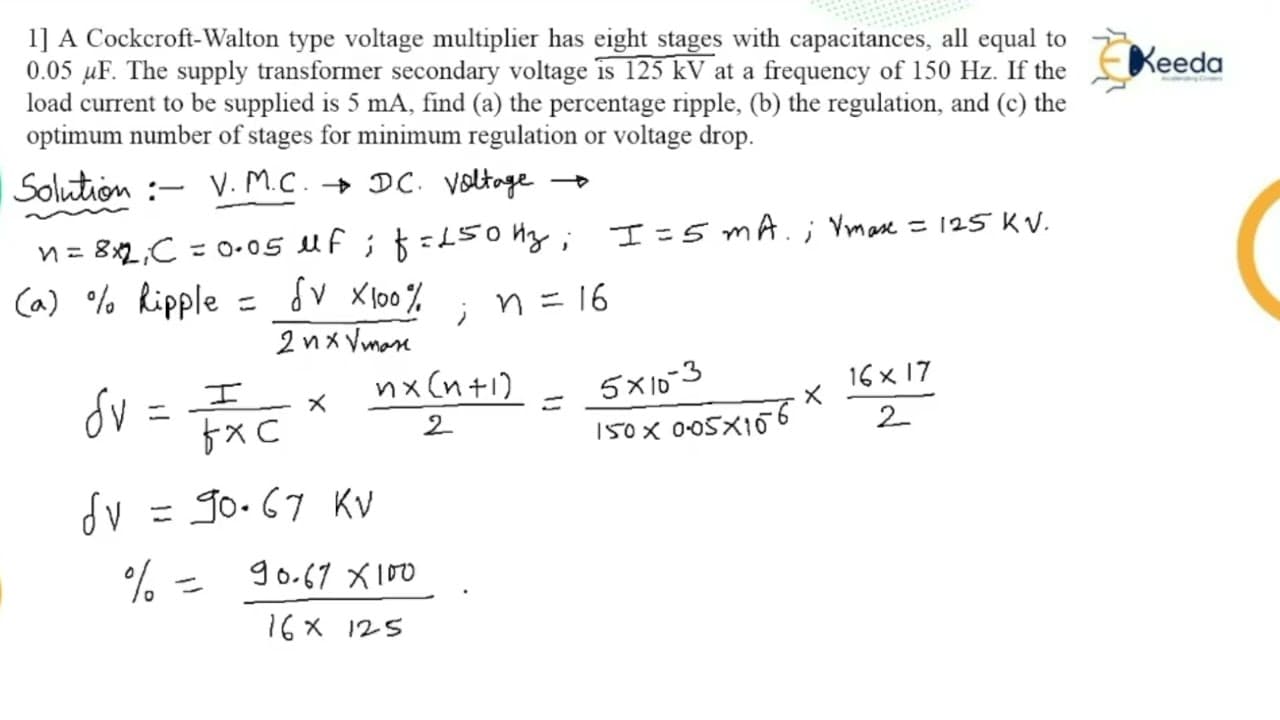
This lecture discusses numerical problems related to high voltage generation, specifically focused on the Cockcroft-Walton voltage multiplier circuit.
Transcript
hello friends welcome to the lecture series on high voltage engineering in this lecture we will be discussing the numericals on the different topics of high voltage generation specifically the cockcroft walton voltage multiplier circuit so this is the lecture series or the lecture on voltage multiplier circuit so let us begin the list of formulae m... Read More
Key Insights
- ⚡ The lecture focuses on numerical problems related to high voltage generation using the Cockcroft-Walton voltage multiplier circuit.
- ⚡ The Cockcroft-Walton voltage multiplier circuit is the last circuit in the high voltage generation process, following the voltage doubler or cascaded voltage double circuit.
- ⚡ The numerical problem discussed involves an 8-stage Cockcroft-Walton voltage multiplier circuit, with given values for capacitance, supply transformer voltage, and load current.
- ❓ The lecture provides equations and formulas required to solve the numerical problems, including the calculation of percentage ripple and regulation.
- ❓ The percentage ripple for the given circuit is calculated to be 4.53%.
- ⚡ The regulation of the voltage multiplier circuit is found to be 12.4%.
- 💦 The lecture also discusses the concept of the optimum number of stages for maximum regulation or voltage drop, which is calculated to be approximately 14 stages.
Install to Summarize YouTube Videos and Get Transcripts
Explore YouTube Video Summarizer or Get YouTube Transcript Extractor
Questions & Answers
Q: What is the voltage multiplier circuit discussed in this lecture?
The voltage multiplier circuit discussed in this lecture is the Cockcroft-Walton voltage multiplier circuit, which is the last circuit in high voltage generation after the voltage doubler or cascaded voltage double circuit. It consists of multiple stages that determine the output voltage.
Q: How many stages are given in the numerical problem?
The numerical problem involves an 8-stage Cockcroft-Walton voltage multiplier circuit.
Q: How is the percentage ripple calculated for the given circuit?
The percentage ripple is calculated using the equation del v divided by 2n, where del v is the voltage drop, 2n is the number of stages, and v max is the maximum voltage. In this case, with a maximum voltage of 125 kV and 8 stages, the percentage ripple is calculated to be 4.53%.
Q: What is the equation for calculating the regulation of the voltage multiplier circuit?
The equation for calculating the regulation is delta v divided by 2n times v max, multiplied by 100%. Delta v, the voltage drop, can be calculated using the equation i divided by f times c, multiplied by 2/3n^3 + n^2/2 - n/6. With the given values, the regulation is calculated to be 12.4%.
Summary & Key Takeaways
-
This lecture series focuses on solving numerical problems related to high voltage generation, specifically the Cockcroft-Walton voltage multiplier circuit.
-
The lecturer provides a list of formulas and equations required to solve the numerical problems.
-
The numerical problem discussed in this lecture involves an 8-stage Cockcroft-Walton voltage multiplier circuit, with given values for capacitance, supply transformer voltage, and load current.
Read in Other Languages (beta)
Share This Summary 📚
Summarize YouTube Videos and Get Video Transcripts with 1-Click
Try YouTube Summary with ChatGPT & Claude or YouTube Transcript Generator
Explore More Summaries from Ekeeda 📚



Summarize YouTube Videos and Get Video Transcripts with 1-Click
Try YouTube Summary with ChatGPT & Claude or YouTube Transcript Generator