What is Cynefin? What is the Cynefin Framework?
TL;DR
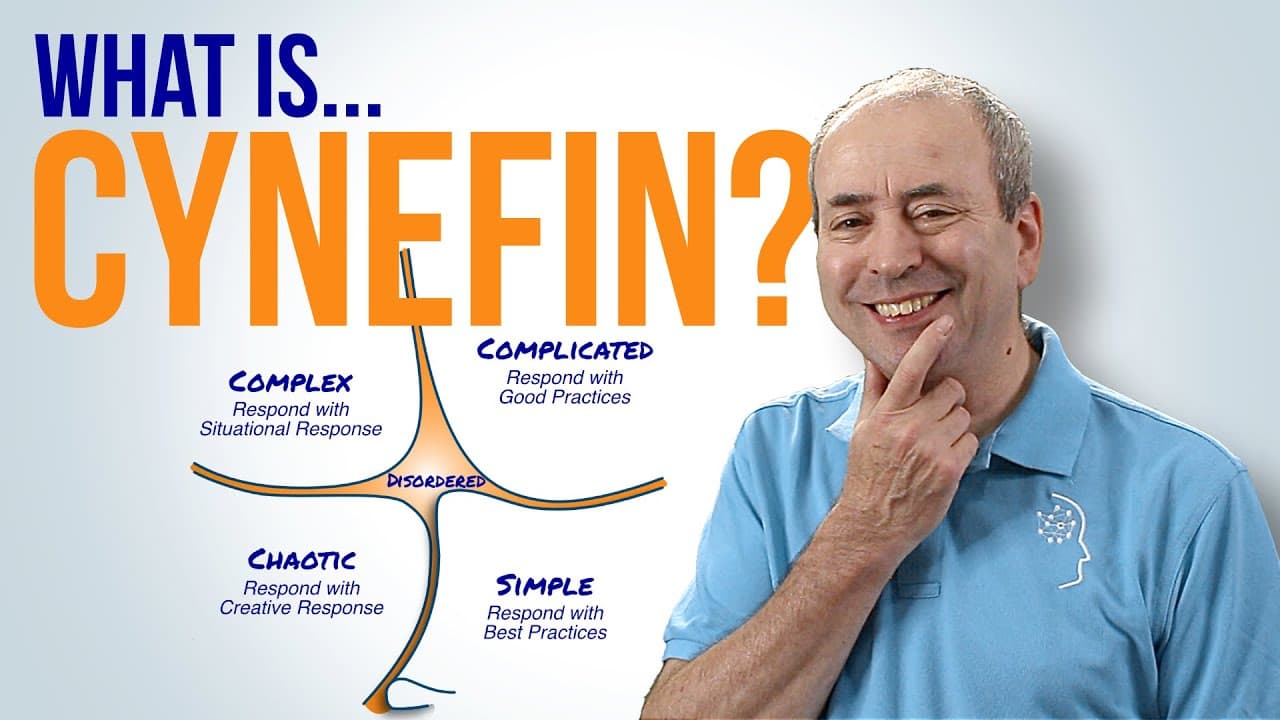
The Connecting Framework is a model that assesses problem-solving approaches based on different domains: simple, complicated, complex, chaotic, and disordered.
Transcript
in this video i want to answer the question what is the connecting framework the connecting framework is a model for the different kinds of problems that we can face and as a result it is a way to assess the appropriate approach that we should take to problem solving and decision making the canadian framework was developed by dave snowden and a gre... Read More
Key Insights
- 💄 The Connecting Framework offers a model for assessing and approaching different problem-solving and decision-making situations.
- 👋 Simple problems in the Connecting Framework have observable cause and effect relationships and can be resolved with repeatable best practices.
- ✖️ The complicated domain requires expert analysis, while the complex domain necessitates multi-disciplinary teamwork and situational responses.
- 🤔 Chaotic problems call for creative and innovative thinking, while the disordered domain lacks clarity and requires careful assessment.
- 🦔 Boundaries between domains in the Connecting Framework can be continuous, except for the boundary between simple and chaotic problems, which is represented as a cliff edge.
- ❓ Assessing the situation and understanding the domain are crucial before selecting an appropriate response style.
Install to Summarize YouTube Videos and Get Transcripts
Explore YouTube Video Summarizer or Get YouTube Transcript Extractor
Questions & Answers
Q: What are the main domains in the Connecting Framework for problem-solving and decision making?
The main domains in the Connecting Framework are simple, complicated, complex, chaotic, and disordered. These domains help assess different types of problems and determine appropriate response styles.
Q: Can you provide an example of a problem in the complicated domain?
An example of a problem in the complicated domain could be troubleshooting a complex technological system where multiple interactions and components are involved. It requires expert analysis and understanding to identify valid solutions.
Q: How does the complex domain differ from the complicated domain?
The complex domain is characterized by weak cause and effect relationships, making it difficult to predict outcomes. In contrast, the complicated domain still has cause and effect relationships, but they are harder to spot due to the number of interactions involved.
Q: What is the key difference between the chaotic and disordered domains?
The chaotic domain is characterized by patterns barely glimpsed and overlaid with randomness, making it nearly impossible to find clear solutions. The disordered domain, on the other hand, lacks clarity and can be misinterpreted as belonging to a different domain based on individuals' biases.
Summary & Key Takeaways
-
The Connecting Framework divides problems into different domains: simple (observable cause and effect relationships), complicated (multiple interactions), complex (weak cause and effect relationships), chaotic (unpredictable patterns with randomness), and disordered (lack of clarity).
-
In the simple domain, best practice solutions can be applied based on observations and predictable patterns.
-
The complicated domain requires expert analysis and understanding to find valid solutions, while the complex domain calls for multi-disciplinary teamwork and situational responses. Chaotic problems require creative and innovative thinking, and the disordered domain lacks clarity.
Read in Other Languages (beta)
Share This Summary 📚
Summarize YouTube Videos and Get Video Transcripts with 1-Click
Try YouTube Summary with ChatGPT & Claude or YouTube Transcript Generator
Explore More Summaries from Online PM Courses - Mike Clayton 📚






Summarize YouTube Videos and Get Video Transcripts with 1-Click
Try YouTube Summary with ChatGPT & Claude or YouTube Transcript Generator