Continuity and change in the Gilded Age | Period 6: 1865-1898 | AP US History | Khan Academy
TL;DR
The Second Industrial Revolution brought major changes to work and living patterns in the United States during the Gilded Age, but cultural ideas about race, immigration, and the economy remained largely unchanged.
Transcript
- [Narrator] The Second Industrial Revolution in the United States ushered in new technologies and new ways of living and working during the Gilded Age. Steel, electricity, and the telephone allowed railroads to crisscross the country, skyscrapers to rise out of cities, factories to hum along long after sunset, and business transactions to take pla... Read More
Key Insights
- 🇺🇸 The Second Industrial Revolution brought significant changes to work and living patterns in the United States during the Gilded Age.
- 💦 Work shifted towards unskilled wage labor, but segregation persisted.
- 🏙️ Cities became crowded, with a diverse influx of migrants.
- 🐎 Cultural ideas about race, immigration, and the economy remained largely unchanged and, in some cases, regressed.
- 🚨 Efforts to reform industrial capitalism were only beginning to emerge, with major social improvements coming later during the Progressive Era.
Install to Summarize YouTube Videos and Get Transcripts
Explore YouTube Video Summarizer or Get YouTube Transcript Extractor
Questions & Answers
Q: How did work and business change during the Gilded Age?
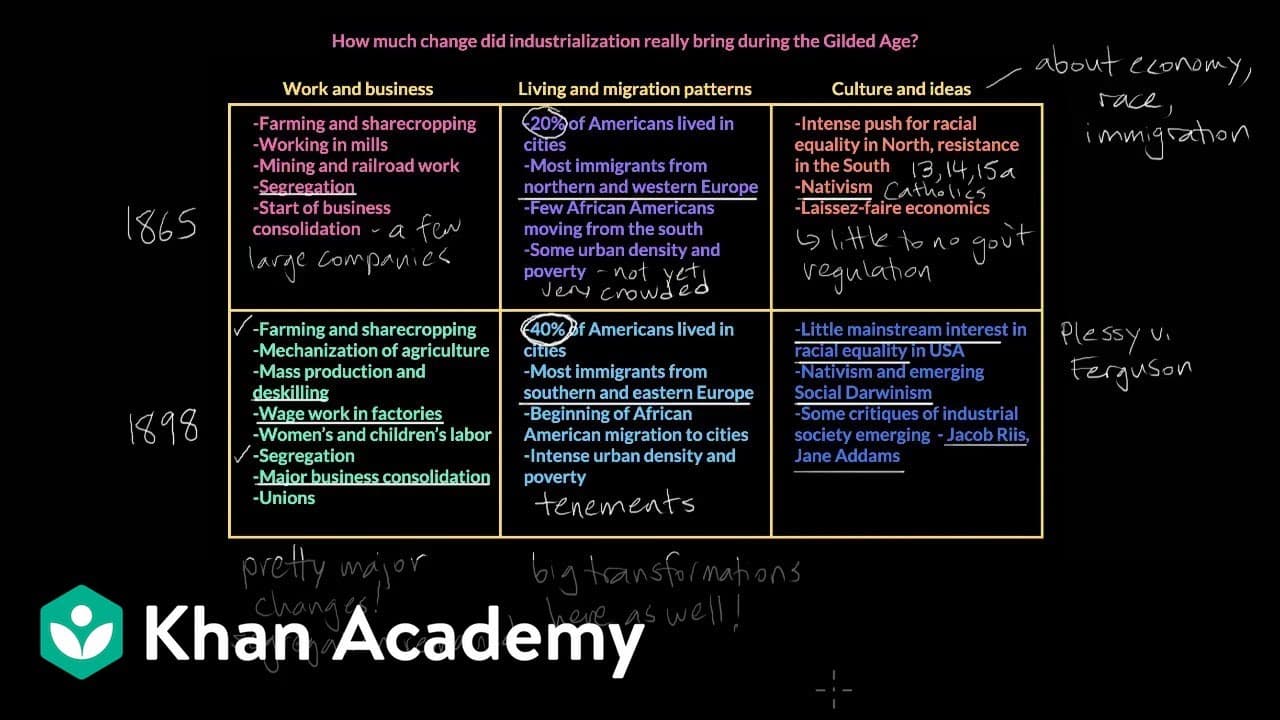
Work transitioned from primarily farming to unskilled wage work in factories. Big corporations emerged, but work remained segregated, and the process of transitioning from farms to factories was incomplete.
Q: What were the living and migration patterns during the Gilded Age?
The percentage of the population living in cities nearly doubled, with many migrants coming from Southern and Eastern Europe. African Americans also began to migrate northward. Cities became dense, leading to crowded tenements.
Q: Did cultural ideas change during the Gilded Age?
Ideas about racial equality for African Americans regressed, with the rise of Jim Crow laws and segregation. Nativist sentiment intensified. However, a few reformers began questioning the effects of industrialization.
Q: How did the economy and laissez-faire economics evolve during this time?
Laissez-faire economics, where the government had little to no regulation of the market, persisted. Nativism and flawed racial pseudo-science, such as Social Darwinism, intensified, suggesting that those in high positions were the fittest.
Summary & Key Takeaways
-
The Gilded Age marked a time of radical change in the United States, with the introduction of steel, electricity, and the telephone leading to advancements in railroads, skyscrapers, factories, and business transactions.
-
Continuity and change over time is important to understand the extent of change during the Gilded Age. This analysis focuses on changes in work, living patterns, and cultural ideas.
-
In terms of work and business, industrialization led to a shift towards unskilled wage work and big corporations. However, work remained segregated and the transition from farms to factories was incomplete.
Read in Other Languages (beta)
Share This Summary 📚
Summarize YouTube Videos and Get Video Transcripts with 1-Click
Try YouTube Summary with ChatGPT & Claude or YouTube Transcript Generator
Explore More Summaries from Khan Academy 📚



Summarize YouTube Videos and Get Video Transcripts with 1-Click
Try YouTube Summary with ChatGPT & Claude or YouTube Transcript Generator