Confidence interval simulation | Confidence intervals | AP Statistics | Khan Academy
TL;DR
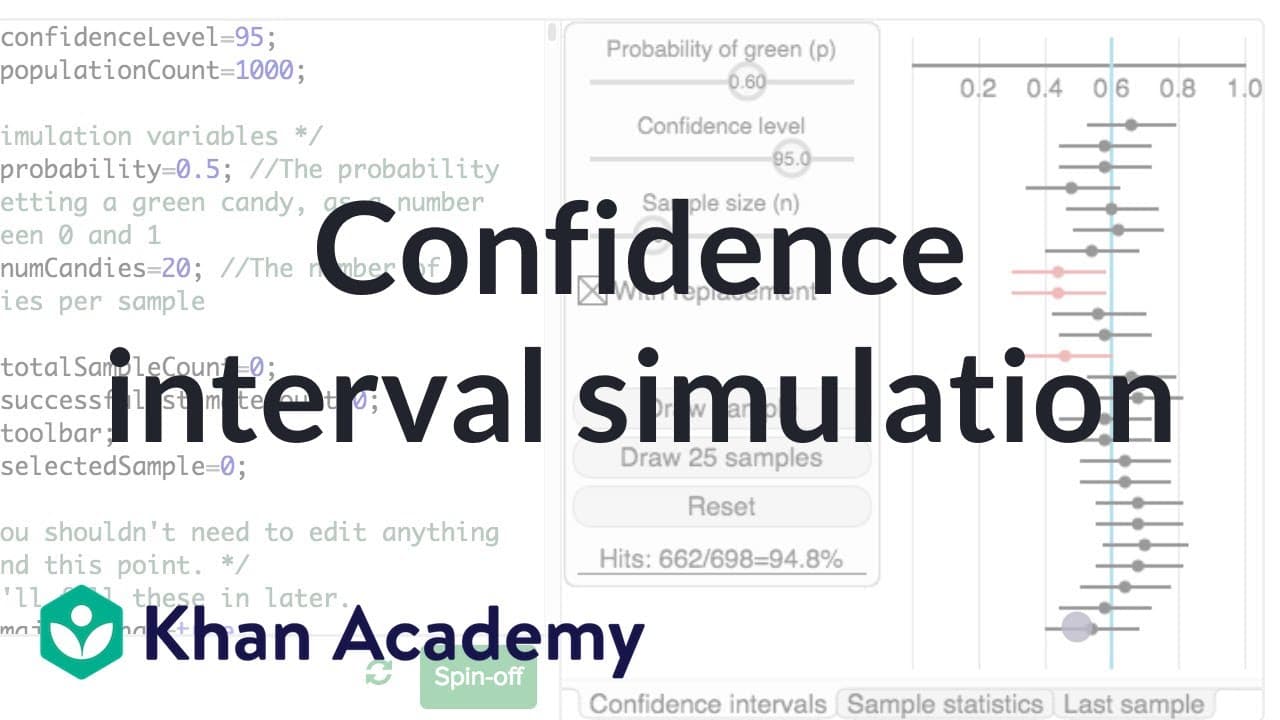
Confidence intervals are used to estimate the range that contains the true population proportion, and this video demonstrates their accuracy and effectiveness using a gumball machine simulation.
Transcript
- [Instructor] The goal of this video is to use this scratch pad on Khan Academy that was written by Khan Academy user Charlotte Allen, in order to get a better intuitive sense of confidence intervals. So here we're dealing with a gumball machine where a certain proportion of the gumballs are going to be green. And so let's say we can set that on i... Read More
Key Insights
- ❓ Confidence intervals provide a measure of uncertainty in estimating the true population proportion.
- 🧡 Confidence intervals are calculated using a confidence level and standard errors to determine the range.
- 🥺 Larger sample sizes lead to narrower confidence intervals and greater precision in estimating the true proportion.
- ⌛ Confidence intervals are accurate in that roughly 95% of the time, they contain the true population parameter.
- ❓ Confidence intervals demonstrate the reliability and effectiveness of this statistical approach.
- 🤩 The key factor in confidence intervals is ensuring an adequate sample size for accurate estimation.
- ❓ The true parameter is occasionally not contained within the confidence interval, but this is infrequent and expected.
Install to Summarize YouTube Videos and Get Transcripts
Explore YouTube Video Summarizer or Get YouTube Transcript Extractor
Questions & Answers
Q: What is the purpose of using confidence intervals?
Confidence intervals help determine the range within which the true population proportion is likely to fall, based on sample estimates and a given confidence level. They provide a measure of the precision and reliability of an estimate.
Q: How are standard errors used in calculating confidence intervals?
Standard errors estimate the variability between different sample estimates and the true population proportion. They are used to estimate the standard deviation and determine the range of the confidence interval.
Q: How does sample size affect the width of confidence intervals?
As the sample size increases, the width of confidence intervals decreases. This is because larger samples provide a more accurate estimate of the true population proportion, resulting in a narrower range.
Q: What does it mean if the true parameter is not contained in a confidence interval?
If the true population proportion is not within the confidence interval, it suggests that the estimate obtained from the sample is not representative of the true value. However, this is expected to occur only around 5% of the time for a 95% confidence level.
Summary & Key Takeaways
-
The video explores the concept of confidence intervals using a gumball machine where the proportion of green gumballs is unknown.
-
Sampling is the method used to estimate the proportion, and different samples result in different estimates.
-
Confidence intervals are used to determine the range within which the true population proportion is likely to reside.
Read in Other Languages (beta)
Share This Summary 📚
Summarize YouTube Videos and Get Video Transcripts with 1-Click
Try YouTube Summary with ChatGPT & Claude or YouTube Transcript Generator
Explore More Summaries from Khan Academy 📚



Summarize YouTube Videos and Get Video Transcripts with 1-Click
Try YouTube Summary with ChatGPT & Claude or YouTube Transcript Generator