Introduction to Grammar and Context Free Grammar - Grammars - Automata Theory
TL;DR
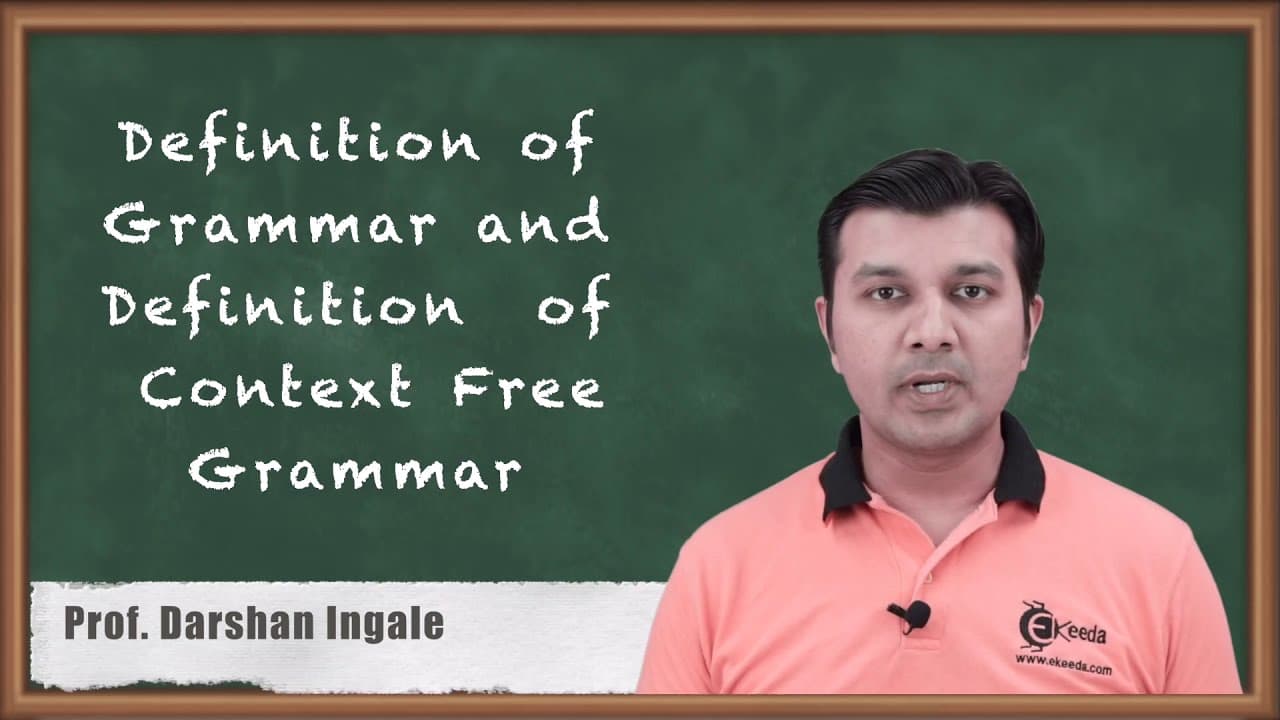
This video provides an introduction to grammars and specifically focuses on context-free grammar, explaining the definition and components of a grammar.
Transcript
hello friends so now we are going to start a new chapter called as grammars now grammars is going to be very simple very interesting at the same time I say a bit difficult to why difficult it will be difficult if you are not observed all my previous sessions because in Ottawa the theory in the TCS subject everything is going to be following what we... Read More
Key Insights
- 📏 Grammars are used to specify the syntax of a language and define the rules for communication.
- 📏 A grammar consists of variables, terminals, production rules, and a start variable.
- 💁 Context-free grammars have productions of the form "variable derives sentential form."
- ⏮️ Understanding previous sessions is crucial for learning about grammars.
- 🥶 Applying production rules allows for the derivation of specific strings in a context-free grammar.
- ❓ CFGs are important in computational linguistics and programming languages.
- 🤬 Terminal symbols represent actual characters or symbols, while variables can be replaced or derived.
Install to Summarize YouTube Videos and Get Transcripts
Explore YouTube Video Summarizer or Get YouTube Transcript Extractor
Questions & Answers
Q: What is the purpose of using a grammar to specify the syntax of a language?
The purpose of using a grammar is to define the rules and structure of a language, allowing for proper communication and interpretation of written or spoken language. Without a grammar, there would be no consistent way to understand and generate meaningful sentences.
Q: What is the difference between variables and terminals in a grammar?
In a grammar, variables represent capital alphabets and are used to derive or replace other symbols. Terminals, on the other hand, represent small case alphabets and cannot be further derived. They are the actual symbols or characters in the language.
Q: How does a context-free grammar differ from other types of grammars?
A context-free grammar (CFG) is a type of grammar where all the productions are of the form "variable derives sentential form." This means that a variable can be replaced with a sentential form consisting of terminals and variables. Other types of grammars, like context-sensitive and regular grammars, have different rules for the productions.
Q: Can you provide an example of a context-free grammar and how it can derive a specific string?
Sure! Let's take the example from the video: S -> ASB, A -> AaB | B, where S is the start variable. Using these production rules, we can derive the string "aabb" by starting with S and applying the appropriate productions: S -> ASB -> AaSB -> AaB -> aabb.
Summary & Key Takeaways
-
The video introduces the concept of grammars and emphasizes the importance of understanding previous sessions to grasp the content.
-
It defines a grammar as a way to specify the syntax of a language and explains the components of a grammar, such as variables, terminals, production rules, and start variable.
-
The video introduces the concept of context-free grammar and explains that all productions in a context-free grammar are of the form "variable derives sentential form."
Read in Other Languages (beta)
Share This Summary 📚
Summarize YouTube Videos and Get Video Transcripts with 1-Click
Try YouTube Summary with ChatGPT & Claude or YouTube Transcript Generator
Explore More Summaries from Ekeeda 📚






Summarize YouTube Videos and Get Video Transcripts with 1-Click
Try YouTube Summary with ChatGPT & Claude or YouTube Transcript Generator