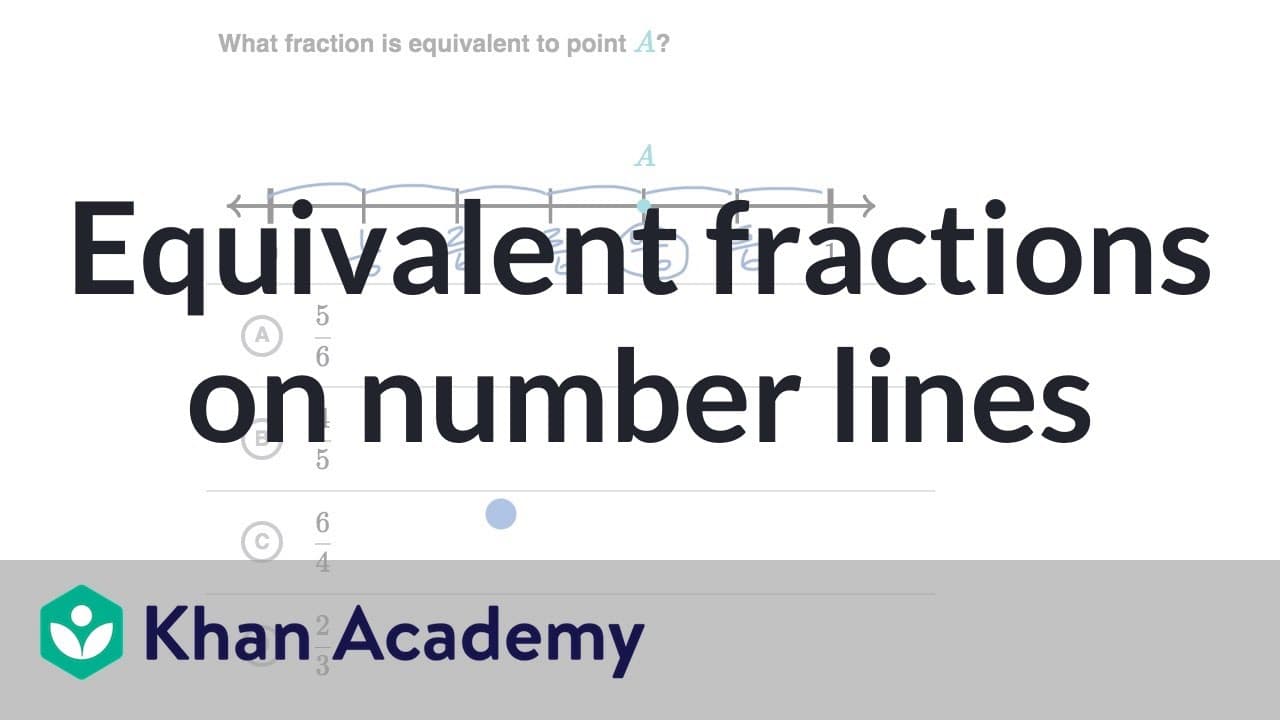
Equivalent fractions on number lines
TL;DR
The video explains how to find equivalent fractions on a number line and provides examples.
Transcript
- [Instructor] So they are telling us that r fifths is equal to eight tenths and we need to figure out what is r going to be equal to and they help us out with this number line where they've put eight tenths on the number line. That makes sense because to go from zero to one, they've split it into one, two, three, four, five, six, seven, eight, nin... Read More
Key Insights
- 🫥 Equivalent fractions can be found by comparing the lengths of jumps on a number line.
- 🔄 Each jump can represent a fraction, and by counting the jumps, the value of a fraction can be determined.
- 👻 Comparing the lengths of jumps allows for the identification of equivalent fractions.
Install to Summarize YouTube Videos and Get Transcripts
Explore YouTube Video Summarizer or Get YouTube Transcript Extractor
Questions & Answers
Q: How can we find equivalent fractions on a number line?
To find equivalent fractions on a number line, we can count the jumps or sections between zero and one to determine the value of each fraction. By comparing the lengths of the jumps, we can identify equivalent fractions.
Q: Why is one fifth equivalent to two tenths?
One fifth is equivalent to two tenths because each jump of a fifth on the number line is equal to two jumps of a tenth. This can be observed by comparing the lengths of the jumps and noting that both fractions represent the same portion of the whole.
Q: How can we determine the fraction equivalent to a specific point on the number line?
To determine the fraction equivalent to a point on the number line, we can count the jumps or sections between zero and one and compare the position of the point to these jumps. By finding the equivalent fraction that aligns with the point, we can determine its value.
Q: Why is two thirds equivalent to four sixths?
Two thirds is equivalent to four sixths because each jump of a third on the number line is equal to two jumps of a sixth. This can be observed by comparing the lengths of the jumps and noting that both fractions represent the same portion of the whole.
Summary & Key Takeaways
-
The video demonstrates finding equivalent fractions on a number line using the example of finding the fraction equivalent to eight tenths.
-
It shows that one fifth is equal to two tenths, and by counting the jumps on the number line, determines that four fifths is equal to eight tenths.
-
Another example is provided to determine the fraction equivalent to point A on the number line, which is found to be two thirds.
Read in Other Languages (beta)
Share This Summary 📚
Summarize YouTube Videos and Get Video Transcripts with 1-Click
Try YouTube Summary with ChatGPT & Claude or YouTube Transcript Generator
Explore More Summaries from Khan Academy 📚



Summarize YouTube Videos and Get Video Transcripts with 1-Click
Try YouTube Summary with ChatGPT & Claude or YouTube Transcript Generator