Solutions of Wave Equations in Cylindrical Coordinates - Microwave Engineering
TL;DR
This video discusses the solutions of wave equations in cylindrical coordinates for microwave signal propagation in a circular waveguide.
Transcript
click the bell icon to get latest videos from akira hello Prince I welcome you all to this video we are with the 9th chapter of microwave engineering where the propagation of or the transmission of microwave signal we can say that has been generated either onto the microwave tube platform or onto this semiconductor platform so is to be done with re... Read More
Key Insights
- 👋 The video focuses on the solutions of wave equations in cylindrical coordinates for microwave signal propagation.
- 😥 Cylindrical coordinates are used to describe the orientation and position of points in three-dimensional space.
- 👋 The Basil's equation is derived from the Helmholtz wave equation in cylindrical coordinates and is used to find solutions for wave equations.
- 🖐️ The NH order basis functions, represented by Bessel functions, play a crucial role in the solution of the Helmholtz equation.
- 👋 The propagation constant and wave number are related to the propagation information in lossless propagation.
Install to Summarize YouTube Videos and Get Transcripts
Explore YouTube Video Summarizer or Get YouTube Transcript Extractor
Questions & Answers
Q: What are cylindrical coordinates and how are they used in microwave engineering?
Cylindrical coordinates involve the use of one axis, the z-axis, while representing points in space. These coordinates are used in microwave engineering to describe the propagation of microwave signals in a circular waveguide.
Q: What is the Basil's equation and what does it represent?
The Basil's equation is a differential equation that arises from the Helmholtz wave equation in cylindrical coordinates. It represents the variation of a scalar function in space and is used to find the solutions for wave equations in cylindrical coordinate systems.
Q: How is the propagation constant related to the wave number and the propagation information?
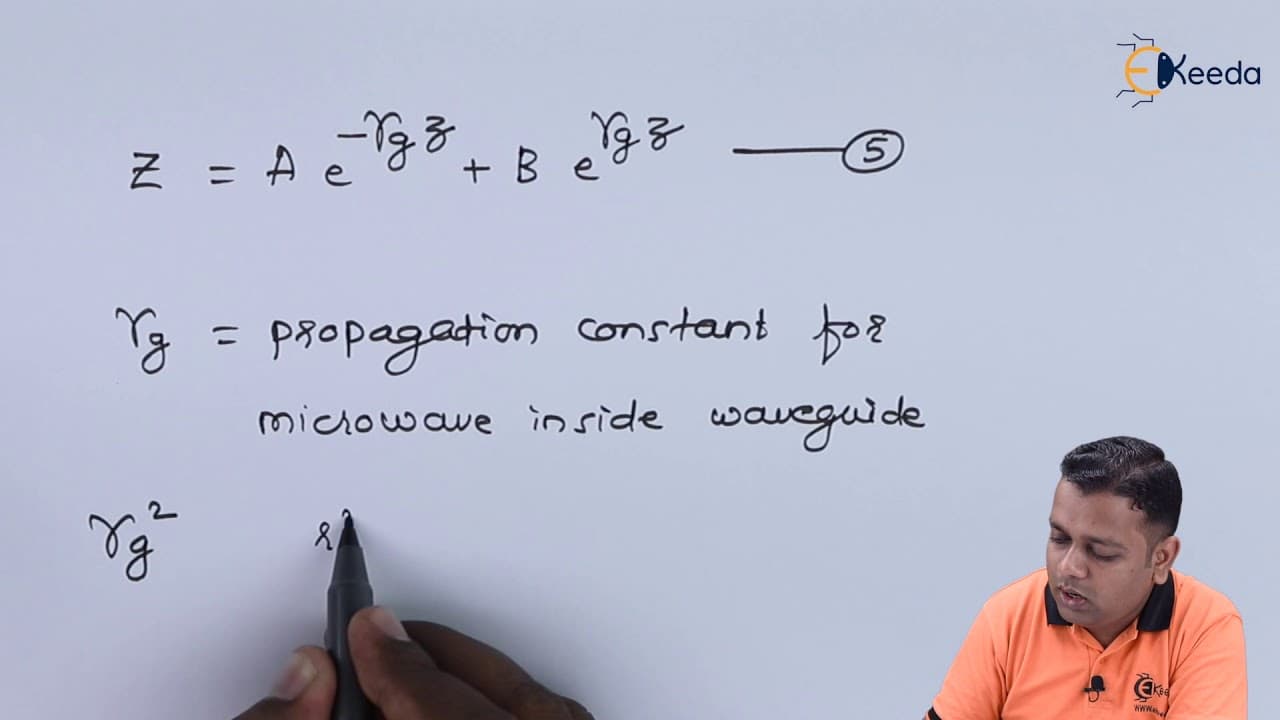
The propagation constant, represented as gamma, is related to the wave number and the propagation information. In lossless propagation, the wave number is given by the square root of omega^2 multiplied by 2(mu*epsilon - Kz^2), where omega is the angular frequency, mu and epsilon are the permeability and permittivity of the medium, and Kz represents the propagation in the z-direction.
Q: What are the NH order basis functions and how are they represented graphically?
The NH order basis functions are functions used in the solution of the Helmholtz equation in cylindrical coordinates. They are represented by the Bessel functions of the first kind (Jn) and the Bessel functions of the second kind (Nn). These functions are plotted graphically to show their values as a function of KC*R, where KC represents the wave number and R is the radius.
Summary & Key Takeaways
-
The video introduces the basics of cylindrical coordinates and their orientations.
-
It applies the scalar form of the Helmholtz wave equation to the cylindrical coordinate system.
-
The video derives the Basil's equation, characteristic equation, and the solution for the Helmholtz equation in cylindrical coordinates.
Read in Other Languages (beta)
Share This Summary 📚
Summarize YouTube Videos and Get Video Transcripts with 1-Click
Try YouTube Summary with ChatGPT & Claude or YouTube Transcript Generator
Explore More Summaries from Ekeeda 📚






Summarize YouTube Videos and Get Video Transcripts with 1-Click
Try YouTube Summary with ChatGPT & Claude or YouTube Transcript Generator