How Does Nuclear Fusion Power Stars?
TL;DR
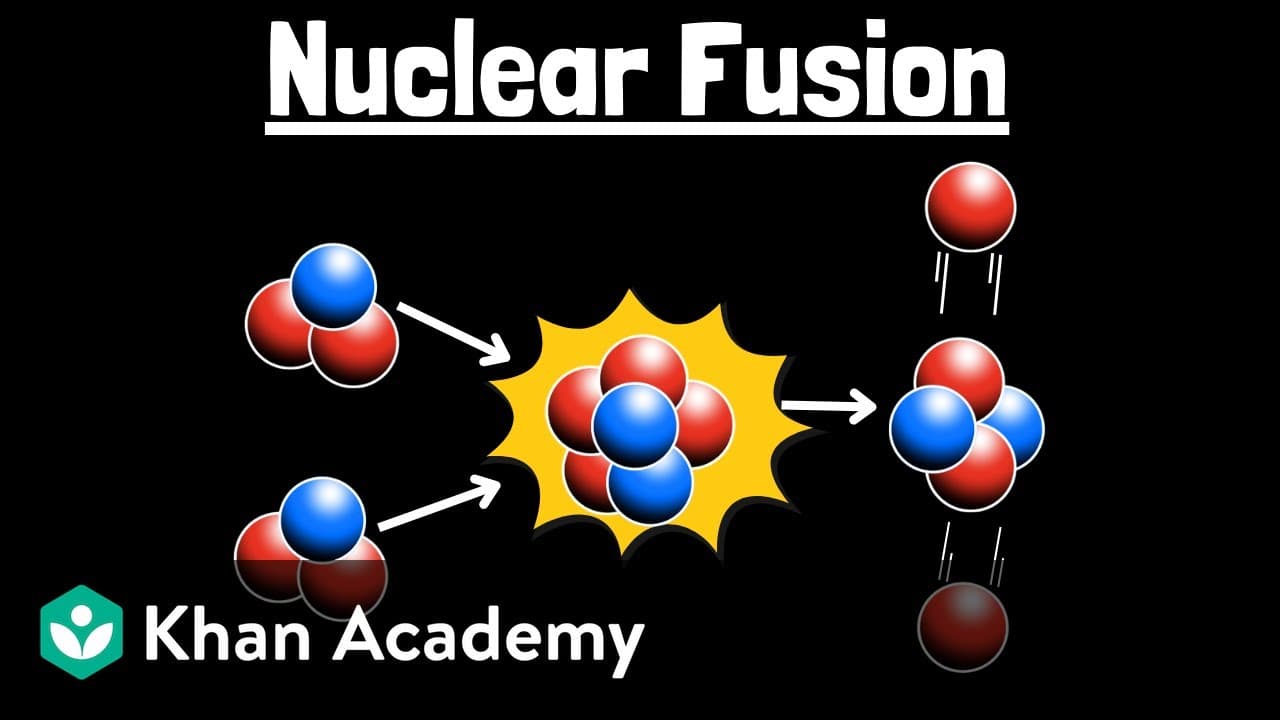
Nuclear fusion occurs when lighter atomic nuclei combine to form a heavier nucleus, releasing energy if the product is more stable than the reactants. This process powers stars, including the Sun, as immense temperatures and pressures in their cores enable fusion. The mass difference between reactants and products, explained by E=mc², determines the energy released.
Transcript
we believe that after the big bang the early Universe contained mostly hydrogen helium and traces of lithium but then how did the rest of the elements come by for example where did the oxygen that we are breathing right now or the calcium in our bones where did they come from well they are forged in nuclear fusion reactions that are happening insid... Read More
Key Insights
- Nuclear fusion is a process where smaller nuclei combine to form a larger nucleus, releasing energy if the resulting nucleus is more stable.
- Stars, including the Sun, derive their energy from nuclear fusion occurring in their cores, where extreme conditions allow fusion to take place.
- The proton-proton chain is a series of reactions in stars where hydrogen nuclei fuse to form helium, releasing energy in the process.
- E=mc² explains that the energy released in nuclear fusion is due to the mass difference between reactants and products, with mass converting to energy.
- Fusion reactions are exothermic when light nuclei fuse to form elements lighter than iron, and endothermic when heavier nuclei fuse to form elements heavier than iron.
- The energy output of fusion reactions is significant because of the sheer number of reactions occurring simultaneously in stars.
- The conditions necessary for fusion include high temperatures and pressures, which allow nuclei to overcome electrostatic repulsion and fuse.
- Supernovae can create elements heavier than iron, as the extreme conditions during these explosions allow for the fusion of heavier nuclei.
Install to Summarize YouTube Videos and Get Transcripts
Explore YouTube Video Summarizer or Get YouTube Transcript Extractor
Questions & Answers
Q: How does nuclear fusion power stars?
Nuclear fusion powers stars by combining lighter atomic nuclei into heavier ones, releasing energy if the resulting nucleus is more stable than the reactants. This process occurs in the cores of stars, where high temperatures and pressures allow nuclei to overcome electrostatic repulsion and fuse. The energy released from these reactions sustains the star's luminosity and heat.
Q: What conditions are necessary for nuclear fusion to occur?
Nuclear fusion requires extremely high temperatures and pressures to occur. These conditions allow atomic nuclei to overcome the electrostatic repulsion between their positive charges, enabling them to come close enough for the nuclear force to bind them together. Such conditions are naturally found in the cores of stars, where fusion reactions power their energy output.
Q: What is the role of E=mc² in nuclear fusion?
E=mc², Einstein's equation, plays a crucial role in nuclear fusion by explaining the energy release. It states that energy and mass are interchangeable. In fusion, the mass of the product nucleus is less than the sum of the reactant masses, with the mass difference converting to energy. This principle explains the energy output from fusion reactions in stars.
Q: Why doesn't nuclear fusion occur naturally on Earth?
Nuclear fusion doesn't occur naturally on Earth because the conditions required—extremely high temperatures and pressures—are not present. These conditions are necessary to overcome the electrostatic repulsion between atomic nuclei, allowing them to fuse. While stars have these conditions in their cores, replicating them on Earth is challenging and is a focus of ongoing research.
Q: What happens when a star runs out of hydrogen for fusion?
When a star exhausts its hydrogen supply, its core contracts and heats up, enabling helium fusion into heavier elements like carbon. For massive stars, fusion continues with heavier elements until iron is produced. Iron fusion is endothermic, leading to a lack of energy production and ultimately causing the star to collapse and explode as a supernova, dispersing elements into space.
Q: How are elements heavier than iron formed in the universe?
Elements heavier than iron are primarily formed during supernovae, the explosive deaths of massive stars. The extreme temperatures and pressures during a supernova allow for the fusion of nuclei heavier than iron, which is otherwise endothermic and not energetically favorable. This process disperses these heavy elements into space, contributing to the cosmic abundance of elements.
Q: What is the proton-proton chain reaction?
The proton-proton chain reaction is a series of nuclear fusion reactions occurring in stars like the Sun, where hydrogen nuclei (protons) fuse to form helium. This process releases energy and involves multiple steps, including the fusion of protons to form deuterium, and subsequent reactions leading to helium-3 and helium-4 production. It's a primary energy source for stars.
Q: Why is nuclear fusion a promising energy source on Earth?
Nuclear fusion is a promising energy source on Earth due to its potential to provide abundant, clean energy with minimal environmental impact. Fusion reactions produce no long-lived radioactive waste and use isotopes of hydrogen, which are plentiful. However, achieving the necessary conditions for sustained fusion on Earth remains a significant scientific and engineering challenge.
Summary & Key Takeaways
-
Nuclear fusion involves the combination of lighter atomic nuclei to form a heavier nucleus, releasing energy if the product is more stable. This process powers stars, including the Sun, where immense temperatures and pressures in their cores enable fusion reactions. The mass difference between reactants and products, explained by E=mc², determines the energy released.
-
Stars like the Sun use the proton-proton chain reaction to fuse hydrogen into helium, releasing energy that powers them. Fusion reactions are exothermic for elements lighter than iron and endothermic for elements heavier than iron. The extreme conditions in stars' cores allow these reactions to occur, overcoming the electrostatic repulsion between nuclei.
-
The energy from nuclear fusion is significant due to the vast number of reactions occurring in stars. Supernovae create elements heavier than iron, as the extreme conditions allow for the fusion of heavier nuclei. This process explains the formation of elements in the universe and the origin of elements found on Earth.
Read in Other Languages (beta)
Share This Summary 📚
Summarize YouTube Videos and Get Video Transcripts with 1-Click
Try YouTube Summary with ChatGPT & Claude or YouTube Transcript Generator
Explore More Summaries from Khan Academy 📚



Summarize YouTube Videos and Get Video Transcripts with 1-Click
Try YouTube Summary with ChatGPT & Claude or YouTube Transcript Generator