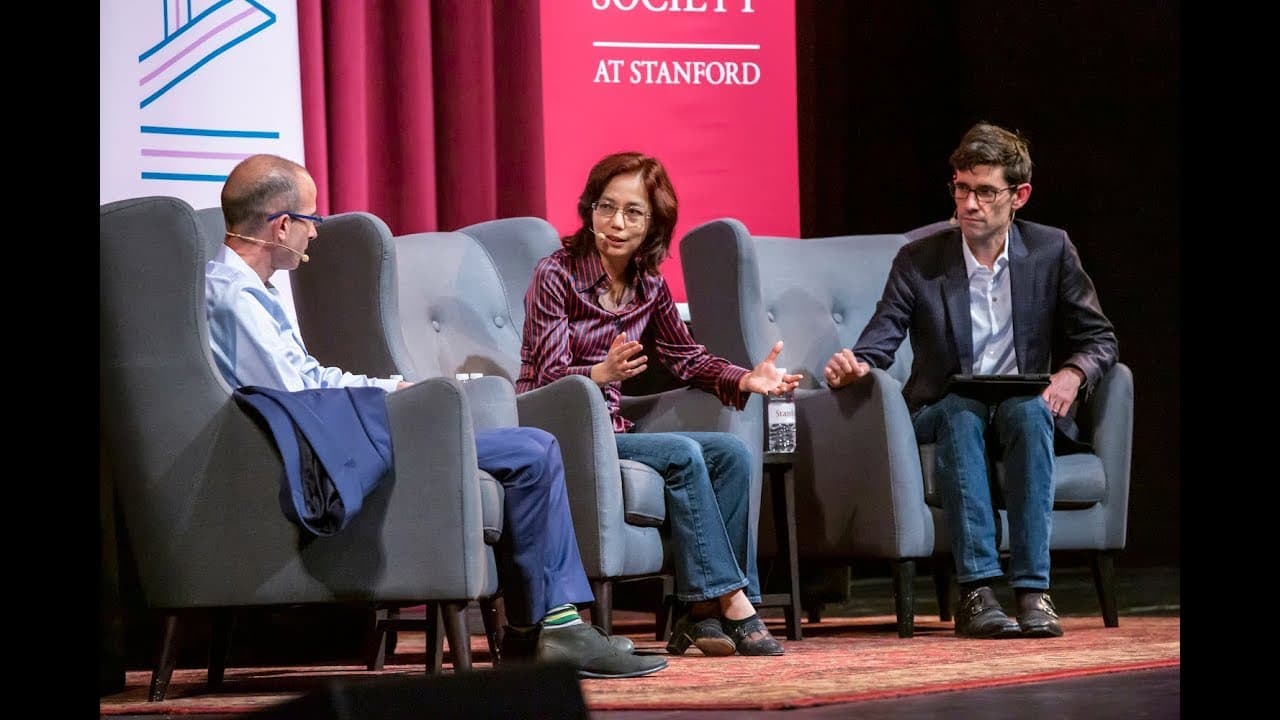
Yuval Noah Harari in Conversation with Fei-Fei Li, Moderated by Nicholas Thompson
TL;DR
The emergence of AI raises important questions about the future of work, the role of algorithms in decision-making, and the ethics of AI in authoritarian regimes.
Transcript
good evening everyone my name is Rob rish I'm delighted to welcome you here to Stanford University for an evening of conversation with Yuval Harare Fei Fei Lee and Nick Thompson I'm a professor of political science here and the faculty director of the Stanford center for ethics and society which is a co-sponsor of tonight's event along with the Sta... Read More
Key Insights
- 😚 The philosophical framework of the modern world is being challenged by practical technologies such as AI, requiring closer collaboration between engineers and philosophers.
- 🤨 The ability of AI to hack humans and manipulate their decisions raises ethical and philosophical concerns.
- ❓ The regulation and ownership of data are crucial to prevent abuses of AI technology, and efforts are being made to conceptualize and regulate data ownership.
- 🏑 The interdisciplinary study and development of AI, involving multiple fields like ethics, history, and psychology, is essential to fully understand its societal impact.
- 🪡 The conversation around AI needs to address biases in algorithms, strive for explainability, and balance efficiency with ethical considerations.
- 🦾 The potential for an arms race in AI underscores the importance of global cooperation to prevent domination and exploitation.
- 🌐 The dissemination of AI scientific knowledge is global, but challenges remain in ensuring equal access to data and infrastructure, especially in developing regions.
Install to Summarize YouTube Videos and Get Transcripts
Explore YouTube Video Summarizer or Get YouTube Transcript Extractor
Questions & Answers
Q: What is the main concern about the future of work with the rise of AI?
The main concern is the automation of jobs, which raises uncertainty about the future employment landscape and the need for new skills and job opportunities.
Q: How does the relationship between AI and data impact its potential for authoritarian governance?
AI's reliance on data creates the possibility of total surveillance and control by authoritarian rulers, enabling them to manipulate and monitor individuals on a large scale.
Q: Can AI algorithms make better decisions than humans in certain areas?
Yes, AI algorithms can provide more accurate and data-driven decisions based on complex calculations and patterns, but the challenge lies in determining the criteria for "good" decisions and avoiding biases.
Q: What are the potential risks of AI technology in the hands of authoritarian regimes?
Authoritarian rulers could use AI for surveillance, control, and suppression of their populations, leading to a loss of privacy, freedom, and human rights on a large scale.
Summary & Key Takeaways
-
AI technology is rapidly reshaping the economic, social, and political landscapes, raising questions about the future of work and decision-making by algorithms.
-
Challenges include the potential automation of jobs, the implications of machine intelligence surpassing human capabilities, and the risks of AI in the hands of authoritarian rulers.
-
The need for cooperation between engineers, philosophers, social scientists, and policymakers to address the ethical and societal implications of AI.
Read in Other Languages (beta)
Share This Summary 📚
Summarize YouTube Videos and Get Video Transcripts with 1-Click
Try YouTube Summary with ChatGPT & Claude or YouTube Transcript Generator
Explore More Summaries from Stanford 📚






Summarize YouTube Videos and Get Video Transcripts with 1-Click
Try YouTube Summary with ChatGPT & Claude or YouTube Transcript Generator