What Is Linear Discriminant Analysis (LDA) and How Does It Work?
TL;DR
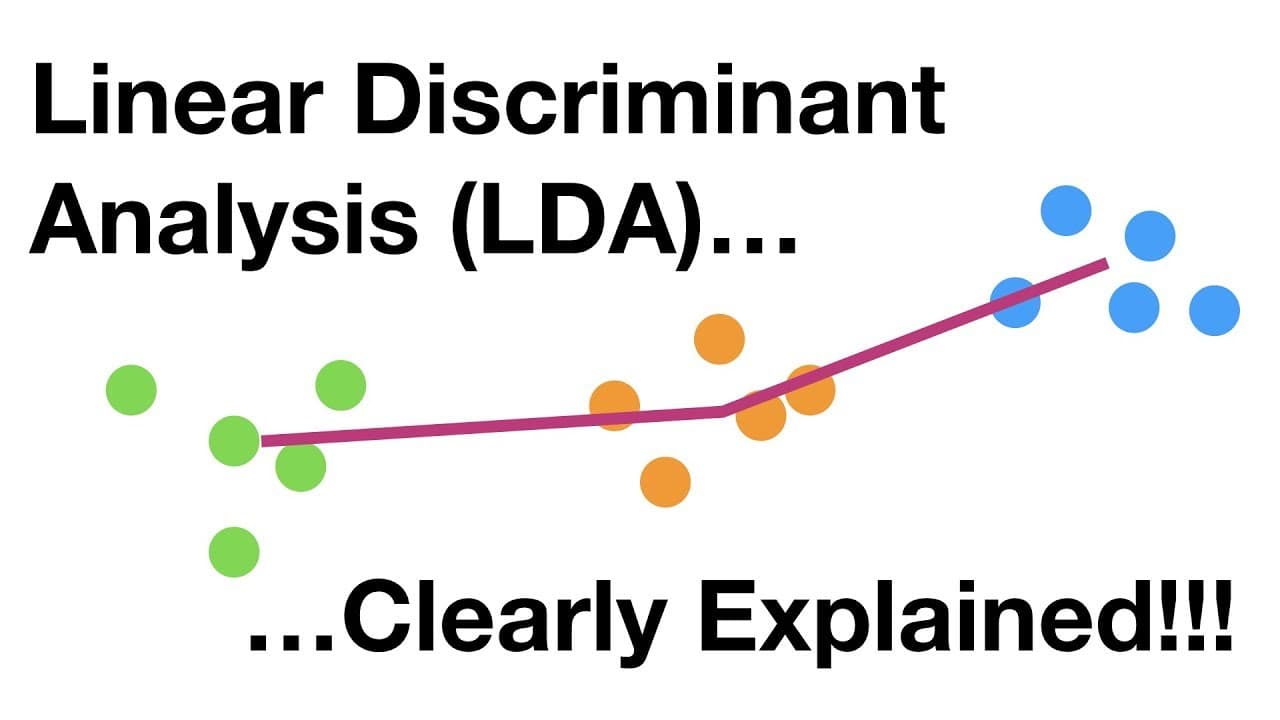
Linear Discriminant Analysis (LDA) is a statistical technique that maximizes category separation in multidimensional data by creating new axes that minimize within-category variation and maximize the distance between category means. Unlike Principal Component Analysis (PCA), which focuses on data variation without regard to category separability, LDA is specifically designed for optimal classification in problems such as predicting drug response.
Transcript
Starck wins that's coming at you stick quiz stats gonna find you stick quiz watch out hello and welcome to stat quest stat quest is brought to you by the friendly folks in the genetics department at the University of North Carolina at Chapel Hill today we're going to be talking about linear discriminant analysis which let's be honest sounds really ... Read More
Key Insights
- ❓ LDA maximizes category separation in multidimensional data by minimizing scatter and maximizing mean distance.
- 👶 Multiple genes can be used in LDA to create new axes for better category separability.
- 🗯️ LDA is beneficial in scenarios like drug response prediction, where choosing the right individuals for treatment is crucial.
- ❓ LDA's approach is different from PCA as it focuses on category separability rather than capturing data variation.
- 🆘 Visualizing data using LDA can help in better decision-making by highlighting distinct categories.
- 👶 LDA's methodology is based on creating new axes that prioritize category separability while reducing dimensionality.
- 😫 Comparing LDA to PCA shows that LDA is more effective in separating known categories in data sets.
Install to Summarize YouTube Videos and Get Transcripts
Explore YouTube Video Summarizer or Get YouTube Transcript Extractor
Questions & Answers
Q: What is the main objective of Linear Discriminant Analysis (LDA)?
The main goal of LDA is to maximize the separation between categories in multidimensional data to make better decisions, especially in scenarios like drug response prediction.
Q: How does LDA differ from Principal Component Analysis (PCA) in terms of their objectives?
While PCA focuses on reducing dimensions by capturing variation, LDA prioritizes maximizing category separability in data sets with known categories.
Q: Why is it important to consider both mean distance and scatter minimization in LDA?
Considering both mean distance and scatter minimization in LDA ensures that the new axes created effectively separate categories by maximizing the difference between category means while minimizing data variation.
Q: How does LDA handle multidimensional data with multiple categories?
LDA extends its approach to multiple categories by finding central points for each category and creating new axes (usually two) that maximize category separations while reducing dimensions for better visualization.
Summary & Key Takeaways
-
Linear Discriminant Analysis (LDA) aims to maximize category separation in data by creating new axes.
-
LDA uses mean distance and scatter minimization to optimize category separability.
-
LDA is compared to Principal Component Analysis (PCA) for dimensionality reduction and data visualization.
Read in Other Languages (beta)
Share This Summary 📚
Summarize YouTube Videos and Get Video Transcripts with 1-Click
Try YouTube Summary with ChatGPT & Claude or YouTube Transcript Generator
Explore More Summaries from StatQuest with Josh Starmer 📚



Summarize YouTube Videos and Get Video Transcripts with 1-Click
Try YouTube Summary with ChatGPT & Claude or YouTube Transcript Generator