Ratio test | Series | AP Calculus BC | Khan Academy
TL;DR
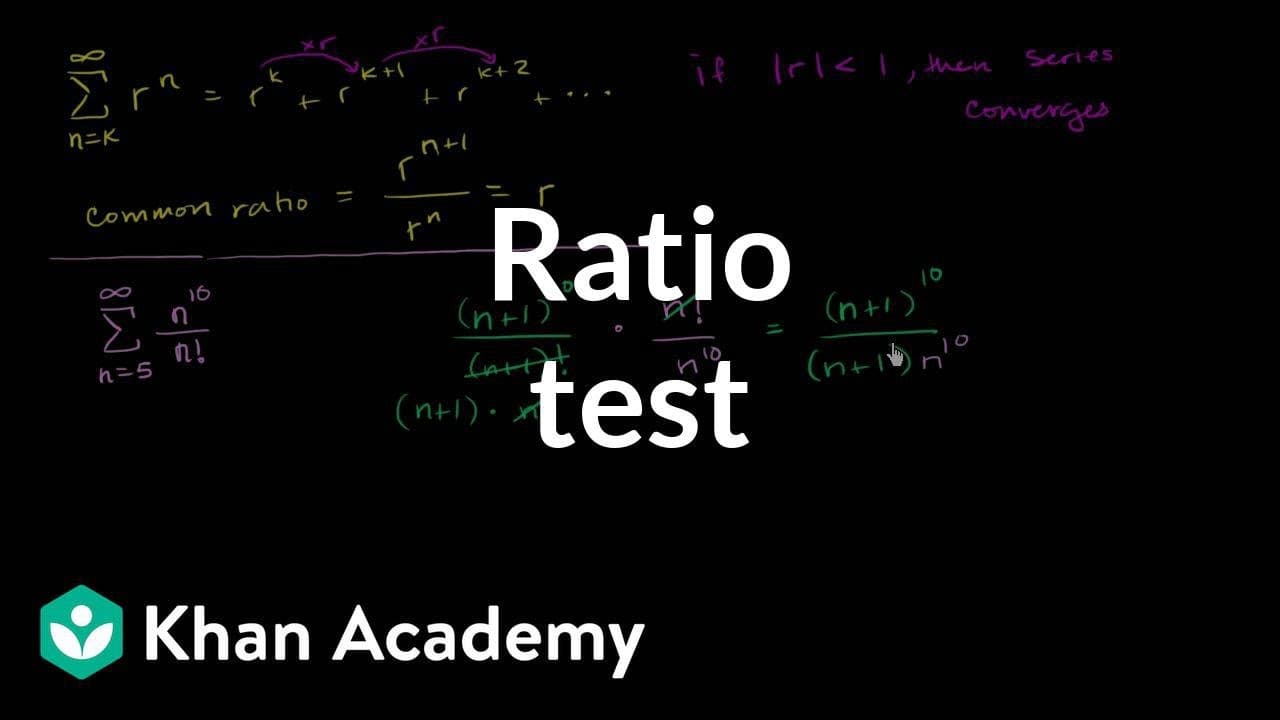
The ratio test is a method used to determine if an infinite series converges or diverges based on the limit of the absolute value of the ratio between consecutive terms.
Transcript
- [Voiceover] We already have a lot of experience with the geometric series. For example, if I have the infinite geometric series starting at N equals K to infinity of R to the N, which would be R to the K plus R to the K plus one plus R to the K plus two and keep going on and on and on forever. There are a few things we've already thought about he... Read More
Key Insights
- 🥳 Geometric series converge if the absolute value of the common ratio is less than one, and diverge if it is greater than or equal to one.
- 🥳 The ratio test is a method used to determine convergence or divergence of a series based on the limit of the absolute value of the ratio between consecutive terms.
- 🥳 The ratio test is based on the concept that as N approaches infinity, the ratio between consecutive terms gets smaller, indicating convergence.
- 🥳 If the limit of the ratio test is less than one, the series converges; if it is greater than one, the series diverges.
- 🏆 If the limit of the ratio test is equal to one, further tests are needed to determine convergence or divergence.
- 🥳 The ratio test is applicable to both geometric and non-geometric series.
Install to Summarize YouTube Videos and Get Transcripts
Explore YouTube Video Summarizer or Get YouTube Transcript Extractor
Questions & Answers
Q: How does the common ratio in a geometric series determine convergence or divergence?
The common ratio in a geometric series, which is the ratio between consecutive terms, determines if the series converges or diverges. If the absolute value of the common ratio is less than one, the series converges; if it is greater than or equal to one, the series diverges.
Q: How does the ratio test help determine convergence of a series?
The ratio test is a method used to determine if an infinite series converges or diverges by finding the limit of the absolute value of the ratio between consecutive terms. If this limit is less than one, the series converges; if it is greater than one, the series diverges.
Q: What happens if the limit of the ratio test is equal to one?
If the limit of the ratio test is equal to one, it is inconclusive and we need to use other tests to determine if the series converges or diverges.
Q: How is the ratio test similar to the common ratio in a geometric series?
The ratio test is based on the same fundamental idea as the common ratio in a geometric series. It looks at the ratio between consecutive terms and determines convergence based on the limit of this ratio.
Summary & Key Takeaways
-
Geometric series have a common ratio between consecutive terms, which determines if the series converges or diverges.
-
If the absolute value of the common ratio is less than one, the series converges; if it is greater than or equal to one, the series diverges.
-
The ratio test is used to determine convergence of series by finding the limit of the absolute value of the ratio between consecutive terms.
Read in Other Languages (beta)
Share This Summary 📚
Summarize YouTube Videos and Get Video Transcripts with 1-Click
Try YouTube Summary with ChatGPT & Claude or YouTube Transcript Generator
Explore More Summaries from Khan Academy 📚



Summarize YouTube Videos and Get Video Transcripts with 1-Click
Try YouTube Summary with ChatGPT & Claude or YouTube Transcript Generator