Diffusion and osmosis | Membranes and transport | Biology | Khan Academy
TL;DR
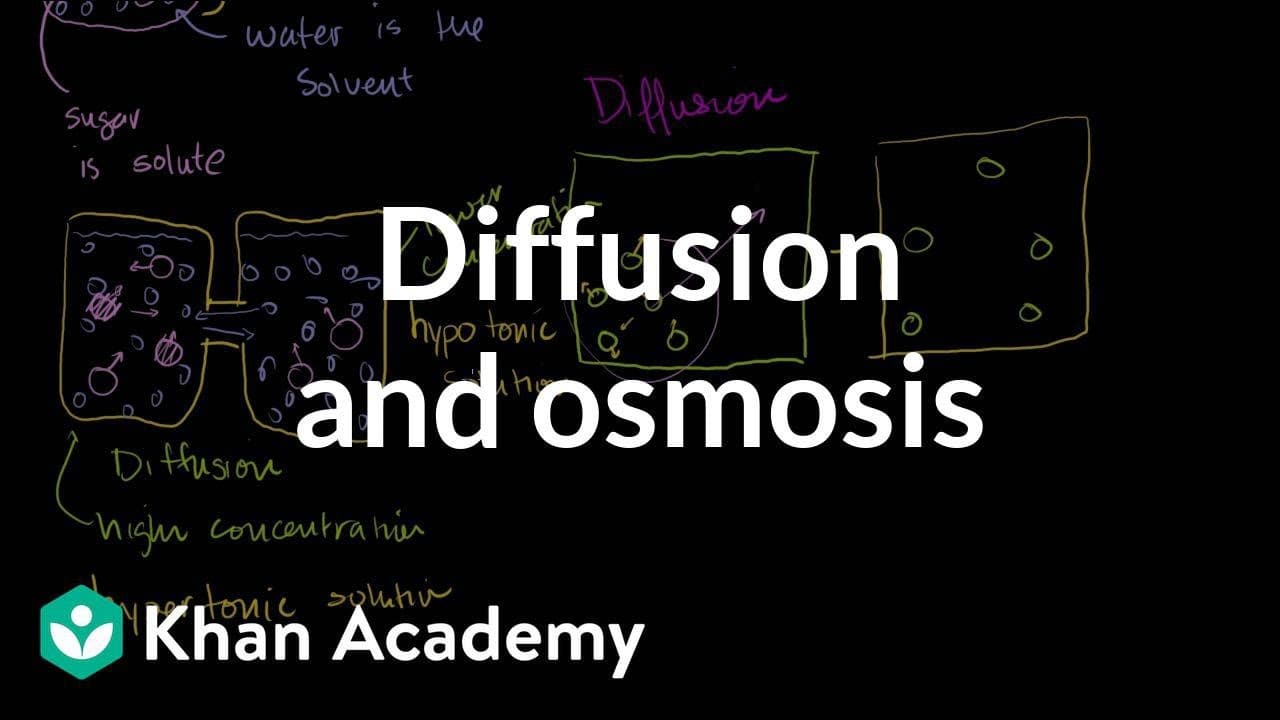
Diffusion is the movement of particles from an area of high concentration to low concentration, while osmosis is the diffusion of water through a semi-permeable membrane.
Transcript
In this video, I want to cover several topics that are all related. And on some level, they're really simple, but on a whole other level, they tend to confuse people a lot. So hopefully we can make some headway. So a good place to start-- let's just imagine that I have some type of container here. Let's say that's my container and inside of that co... Read More
Key Insights
- 😘 Diffusion is the movement of particles from an area of high concentration to low concentration.
- ❓ In a solution, the solvent is the substance with more molecules, while the solute is the substance with fewer molecules.
- 😘 Osmosis is the diffusion of water through a semi-permeable membrane, from low concentration to high concentration.
- ❓ Diffusion and osmosis are essential processes in biological and chemical systems.
- 🖐️ Concentration plays a crucial role in the movement of particles through diffusion and osmosis.
- 😑 Semi-permeable membranes allow for the selective movement of molecules and ions.
- 💦 Osmosis is the result of the solvent, in this case, water, trying to achieve equilibrium in concentration.
Install to Summarize YouTube Videos and Get Transcripts
Explore YouTube Video Summarizer or Get YouTube Transcript Extractor
Questions & Answers
Q: What is diffusion?
Diffusion is the process where particles move from areas of high concentration to areas of low concentration, resulting in the spreading out of the particles.
Q: What is the difference between the solvent and solute in a solution?
In a solution, the solvent is the substance with more molecules, while the solute is the substance with fewer molecules. The solvent is responsible for dissolving the solute.
Q: What is osmosis?
Osmosis is the diffusion of water through a semi-permeable membrane. It occurs when there is a difference in concentration of solute on either side of the membrane, causing water to move from an area of low concentration to an area of high concentration.
Q: Why is diffusion important in biological and chemical systems?
Diffusion is important in biological and chemical systems because it allows for the movement of molecules and ions across membranes, helping to maintain proper concentrations and facilitate cellular processes.
Summary & Key Takeaways
-
Diffusion is the spreading of particles from regions of high concentration to low concentration.
-
In a solution, the solvent is the substance with more molecules, while the solute is the substance with fewer molecules.
-
Osmosis is the diffusion of water through a semi-permeable membrane, from a low concentration solution to a high concentration solution.
Read in Other Languages (beta)
Share This Summary 📚
Summarize YouTube Videos and Get Video Transcripts with 1-Click
Try YouTube Summary with ChatGPT & Claude or YouTube Transcript Generator
Explore More Summaries from Khan Academy 📚



Summarize YouTube Videos and Get Video Transcripts with 1-Click
Try YouTube Summary with ChatGPT & Claude or YouTube Transcript Generator