Performance Parameter
TL;DR
This video discusses the performance parameters of an inverter, including harmonic factor, total harmonic distortion, distortion factor, and lowest order harmonic.
Transcript
hello friends today we are going to discuss about the performance parameters of an inverter so friends so while evaluating the performance parameters there are several factors or there are several performance parameters that is very much needed in case of an inverter application number one would be harmonic factor so mathematically harmonic factor ... Read More
Key Insights
- 🧑🏭 Harmonic factor and total harmonic distortion are important performance parameters in inverter applications.
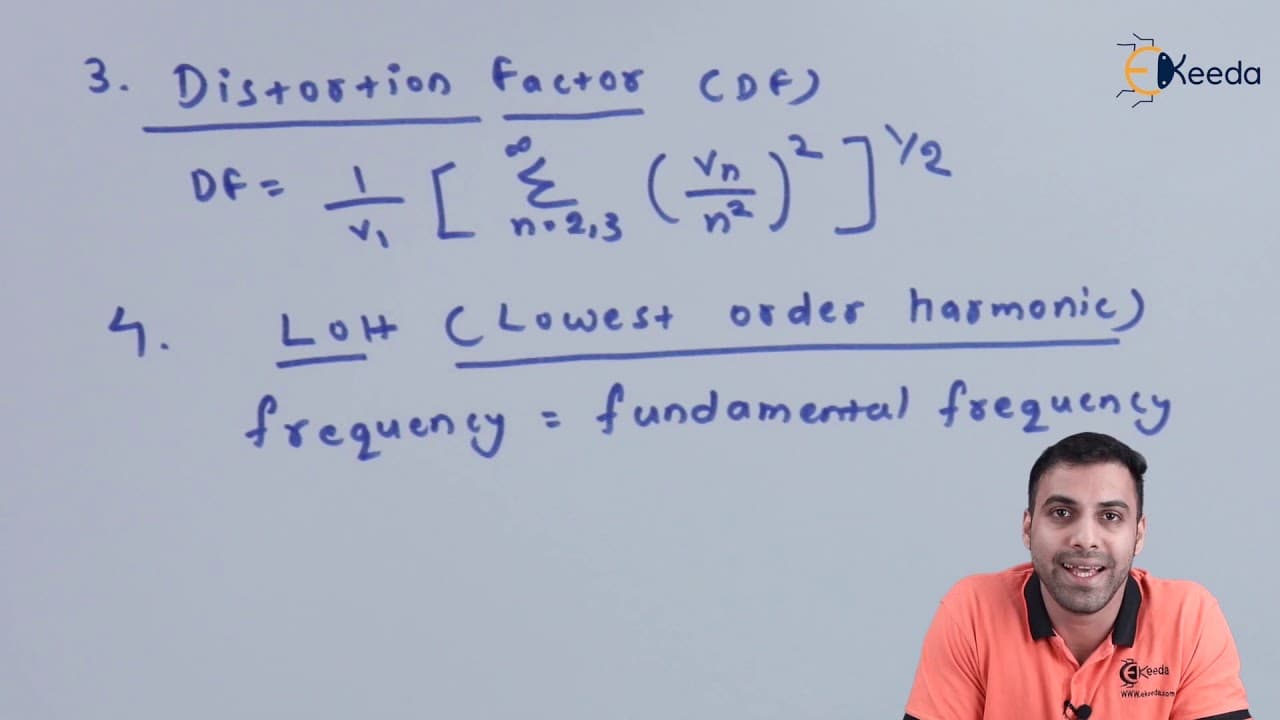
- 🧑🏭 Distortion factor provides a measure of waveform distortion in the output of an inverter.
- 😘 The lowest order harmonic has the same frequency as the fundamental harmonic and has an amplitude three percent or more than the fundamental harmonic.
- 🙊 Calculations for rms output voltage, output power, average and peak current, and peak reverse blocking voltage are essential in analyzing inverter performance.
Install to Summarize YouTube Videos and Get Transcripts
Explore YouTube Video Summarizer or Get YouTube Transcript Extractor
Questions & Answers
Q: What is the harmonic factor in an inverter application?
The harmonic factor is defined as the voltage of the nth harmonic divided by the rms voltage of the fundamental harmonic. It helps determine the harmonic content in the output waveform.
Q: How is the total harmonic distortion calculated in an inverter?
Total harmonic distortion is calculated as the inverse of the rms voltage multiplied by the square root of the summation of the squares of all the rms voltages of the harmonic components. It represents the deviation from the pure sinusoidal waveform.
Q: What is the distortion factor in an inverter?
The distortion factor is mathematically defined as 1 divided by the rms voltage of the fundamental harmonic, multiplied by the square root of the summation of vn divided by n square, all squared and under root. It quantifies the distortion in the output waveform.
Q: What is the lowest order harmonic in an inverter?
The lowest order harmonic is a harmonic whose frequency is the same as the fundamental frequency, and its amplitude is three percent or more than that of the fundamental harmonic. It plays a significant role in evaluating the inverter's performance.
Summary & Key Takeaways
-
The video explains the importance of performance parameters in evaluating an inverter application, including harmonic factor, total harmonic distortion, distortion factor, and lowest order harmonic.
-
Harmonic factor is defined as the voltage of the nth harmonic divided by the rms voltage of the fundamental harmonic.
-
Total harmonic distortion is defined as the inverse of the rms voltage multiplied by the square root of the summation of the squares of all the rms voltages of the harmonic components.
Read in Other Languages (beta)
Share This Summary 📚
Summarize YouTube Videos and Get Video Transcripts with 1-Click
Try YouTube Summary with ChatGPT & Claude or YouTube Transcript Generator
Explore More Summaries from Ekeeda 📚





Summarize YouTube Videos and Get Video Transcripts with 1-Click
Try YouTube Summary with ChatGPT & Claude or YouTube Transcript Generator