Partial derivatives of vector fields
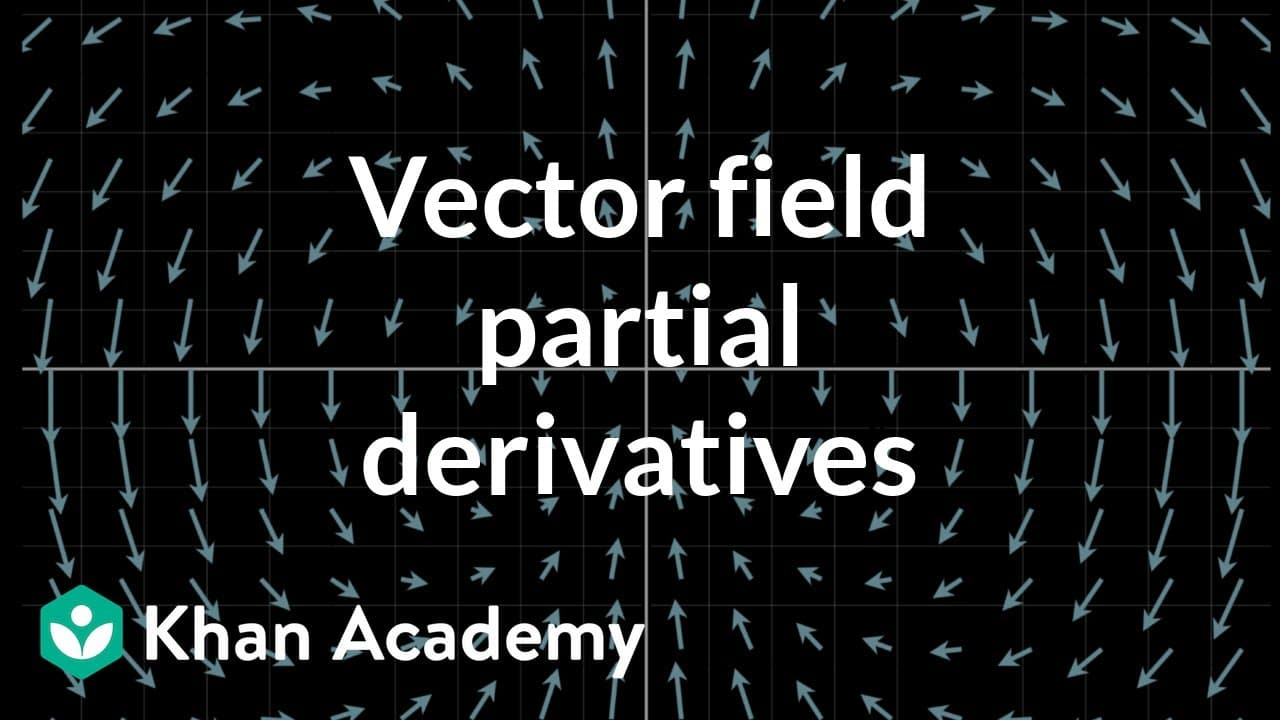
TL;DR
Partial derivatives of vector fields involve computing changes in output vectors with respect to changes in input variables, and they can be visualized as vectors attached to points in a grid.
Transcript
- [Voiceover] So let's start thinking about partial derivatives of vector fields. So a vector field is a function. I'll just do a two dimensional example here. It's gonna be something that has a two dimensional input. And then the output has the same number of dimensions. That's the important part. And each of these components in the output is gonn... Read More
Key Insights
- 😥 Vector fields are functions that associate a vector with each point in a given space.
- 🥡 Partial derivatives of vector fields can be computed by taking the partial derivatives of each component in the output vector.
- 💱 Partial derivatives represent the change in the output vector resulting from a small change in the corresponding input variable.
- 😥 Visualization of partial derivatives involves attaching vectors to points in a grid and observing how they change as you move through the input space.
Install to Summarize YouTube Videos and Get Transcripts
Explore YouTube Video Summarizer or Get YouTube Transcript Extractor
Questions & Answers
Q: What is a vector field?
A vector field is a mathematical function that assigns a vector to each point in a given space. In this context, it refers to a function that takes a two-dimensional input and produces a two-dimensional output.
Q: How are partial derivatives of vector fields computed?
To compute the partial derivatives of a vector field, you take the partial derivatives of each component in the output vector separately with respect to the corresponding input variable.
Q: How are partial derivatives of vector fields interpreted?
Partial derivatives represent the change in the output vector resulting from a small change in one of the input variables. They indicate the direction and magnitude of change as you move through the input space.
Q: How can partial derivatives of vector fields be visualized?
Partial derivatives can be visualized by attaching vectors to points in a grid. Each vector represents the output vector associated with a particular input point, and the direction and length of the vector convey information about the partial derivatives.
Summary & Key Takeaways
-
A vector field is a function that takes a two-dimensional input and produces a two-dimensional output, with each output component depending on the input variables.
-
Partial derivatives of vector fields can be computed by taking the partial derivatives of each output component with respect to the corresponding input variable.
-
To interpret and visualize partial derivatives, the input point is associated with an output vector, and the change in the output vector resulting from a small change in the input point is divided by the size of the input change.
Read in Other Languages (beta)
Share This Summary 📚
Summarize YouTube Videos and Get Video Transcripts with 1-Click
Try YouTube Summary with ChatGPT & Claude or YouTube Transcript Generator
Explore More Summaries from Khan Academy 📚



Summarize YouTube Videos and Get Video Transcripts with 1-Click
Try YouTube Summary with ChatGPT & Claude or YouTube Transcript Generator