Products
Features
YouTube Video Summarizer
Summarize YouTube videos
Web & PDF Highlighter
Highlight web pages & PDFs
Chat with PDF
Ask any PDF questions with AI
Ask AI Clone
Chat with your highlights & memories
Audio Transcriber
Transcribe audio files to text
Glasp Reader
Read and highlight articles
Kindle Highlight Export
Export your Kindle highlights
Idea Hatch
Hatch ideas from your highlights
Integrations
Obsidian Plugin
Notion Integration
Pocket Integration
Instapaper Integration
Medium Integration
Readwise Integration
Snipd Integration
Hypothesis Integration
Apps & Extensions
Chrome Extension
Safari Extension
Edge Add-ons
Firefox Add-ons
iOS App
Android App
Discover
Discover
Ideas
Discover new ideas and insights
Articles
Curated articles and insights
Books
Book recommendations by great minds
Posts
Essays and notes from readers
Quotes
Inspiring quotes collection
Videos
Curated videos and summaries
Explore Glasp
Glasp Newsletter
Weekly insights and updates
Glasp Talk
Interview series with great minds
Glasp Blog
Latest news and articles
Glasp Use Cases
Learn how others use Glasp
Build & Support
Glasp API
Access Glasp's API for developers
MCP Connector
Connect Glasp to Claude & ChatGPT
Community
Glasp Reddit Community
Students
Student discount and benefits
FAQs
Frequently Asked Questions
AboutPricing
DashboardLog inSign up

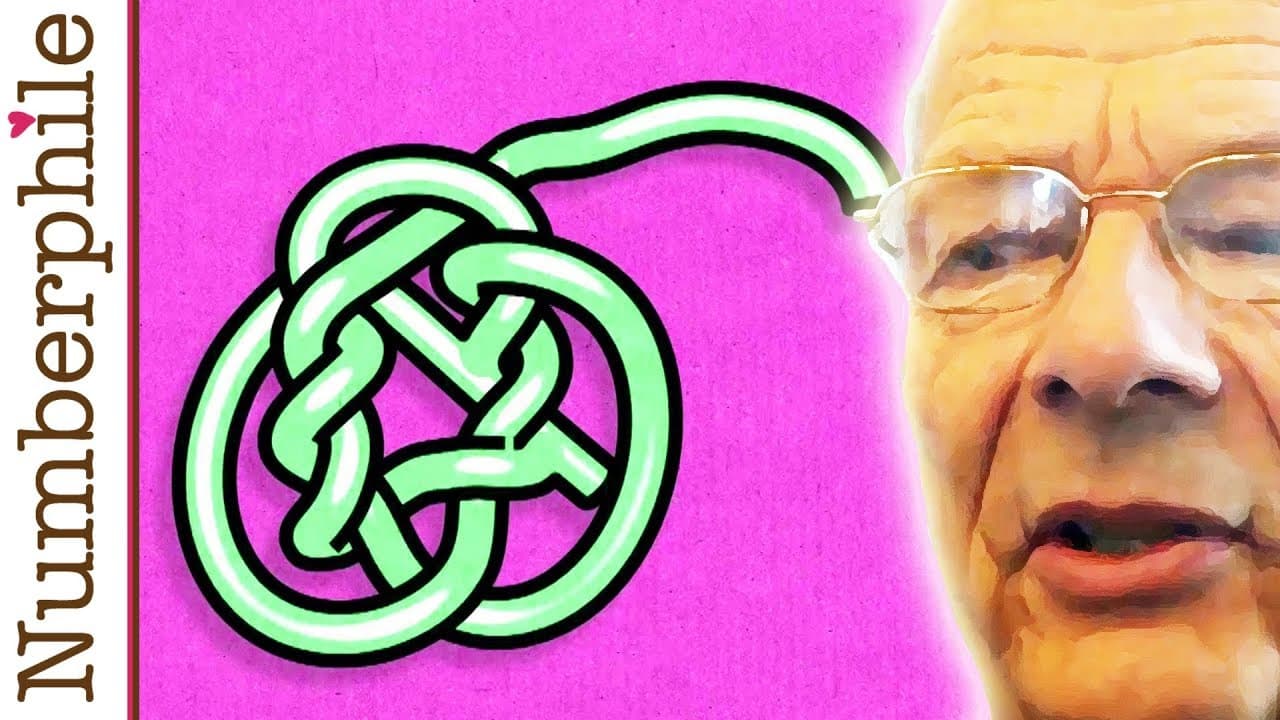
What is a Knot? - Numberphile
617.0K views
•
August 3, 2015
by
Numberphile
YouTube video player
What is a Knot? - Numberphile

TL;DR

Understanding mathematical knots, their classification, and complexities in knot theory.

Transcript

So here's a challenge for you; what about this sequence: 0, 0, 1, 1, 2, 3, 7, 21, 49 - what's the next number?

  • (Brady: I'm gonna go 73.) - No...
  • (I'm just guessing [laughs]) Of course. And you know if- any ordinary person would have no clue, this seems like totally vacuous and if I tell you it's 165 says, why on Earth it 165? This is the numbe... Read More

Key Insights

  • 🪢 Mathematical knots are closed loops with specific crossings, distinguished from physical knots.
  • âš¾ Knot classification is based on the least number of crossings, with unique identifiers for each type.
  • 🪢 Describing complex knots involves using polynomials and other mathematical descriptors.
  • 🪢 It is challenging to distinguish between two knots, even with all known characteristics matching.
  • 🤗 Classifying knots remains an open challenge in mathematics, with limitations on determining true uniqueness.
  • 🪢 The simplicity of knots with few crossings contrasts with the complexity of distinguishing between more intricate knots.
  • 🪢 Advancements in knot theory involve intricate algorithms and equations to better understand and classify knots.

Install to Summarize YouTube Videos and Get Transcripts

Explore YouTube Video Summarizer or Get YouTube Transcript Extractor

Questions & Answers

Q: What defines a mathematical knot?

Mathematical knots are closed loops with specific crossings, distinct from physical knots due to their topological properties.

Q: How are mathematical knots classified?

Mathematical knots are classified based on the lowest number of crossings, with unique identifiers for each knot type.

Q: How do mathematicians differentiate between different knots?

Mathematicians use intricate descriptors like polynomials and crossing numbers to distinguish between complex knots.

Q: What challenges exist in classifying knots?

Classifying knots becomes immensely difficult with complex knots, as determining true uniqueness remains a mathematical challenge.

Summary & Key Takeaways

  • Mathematical knots are more than physical knots, defined as closed loops with specific crossings.

  • Knots with the fewest crossings are classified, like the trefoil and figure-eight knots.

  • Classifying and distinguishing knots requires complex mathematical descriptors and remains an open challenge.


Read in Other Languages (beta)

English

Share This Summary 📚

Summarize YouTube Videos and Get Video Transcripts with 1-Click

Download browser extensions on:

Try YouTube Summary with ChatGPT & Claude or YouTube Transcript Generator

Explore More Summaries from Numberphile 📚
Professors React to 2048 - Numberphile thumbnail
Professors React to 2048 - Numberphile
Numberphile
The Light Switch Problem - Numberphile thumbnail
The Light Switch Problem - Numberphile
Numberphile
The Girl with the Hyperbolic Helicoid Tattoo - Numberphile thumbnail
The Girl with the Hyperbolic Helicoid Tattoo - Numberphile
Numberphile
The Z Factor - Numberphile thumbnail
The Z Factor - Numberphile
Numberphile
Statistics, Storks, and Babies - Numberphile thumbnail
Statistics, Storks, and Babies - Numberphile
Numberphile
The Most Favourite Number - Numberphile thumbnail
The Most Favourite Number - Numberphile
Numberphile

Summarize YouTube Videos and Get Video Transcripts with 1-Click

Download browser extensions on:

Try YouTube Summary with ChatGPT & Claude or YouTube Transcript Generator

Apps & Extensions

  • Chrome Extension
  • Safari Extension
  • Edge Add-ons
  • Firefox Add-ons
  • iOS App
  • Android App

Key Features

  • YouTube Video Summarizer
  • Web & PDF Summarizer
  • Web & PDF Highlighter
  • Chat with PDF
  • Ask AI Clone
  • Audio Transcriber
  • Glasp Reader
  • Kindle Highlight Export
  • Idea Hatch

Integrations

  • Obsidian Plugin
  • Notion Integration
  • Pocket Integration
  • Instapaper Integration
  • Medium Integration
  • Readwise Integration
  • Snipd Integration
  • Hypothesis Integration

More Features

  • APIs
  • MCP Connector
  • Blog & Post
  • Embed Links
  • Image Highlight
  • Personality Test
  • Quote Shots

Company

  • About us
  • Blog
  • Community
  • FAQs
  • Job Board
  • Newsletter
  • Pricing
Terms

•

Privacy

•

Guidelines

© 2026 Glasp Inc. All rights reserved.